

Key takeaways
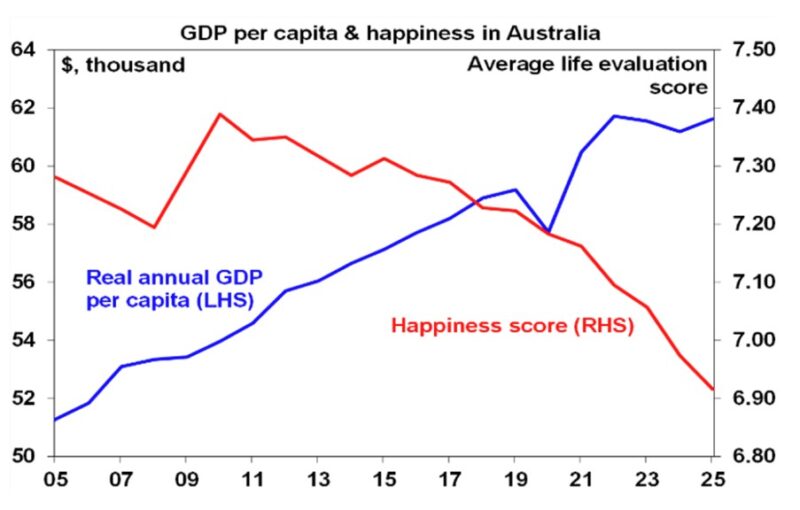
Australians enjoy far greater material prosperity than previous generations, yet measures of happiness have been flat or declining.
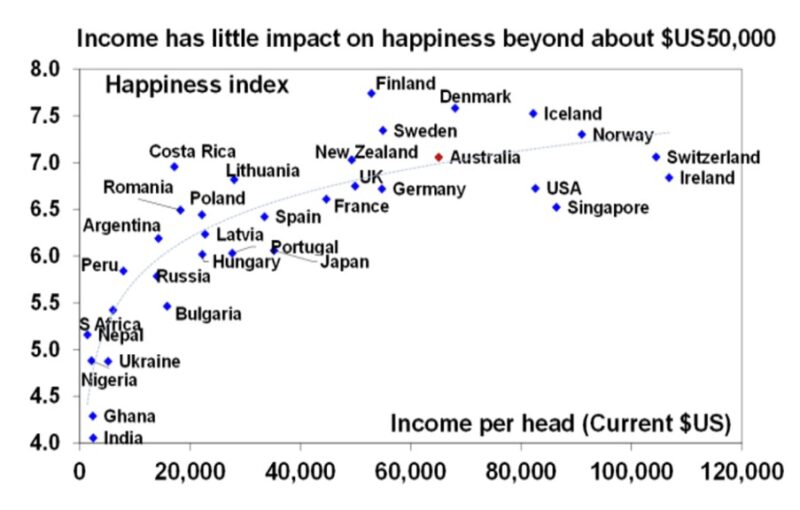
Once our basic needs and financial security are met, additional income delivers diminishing improvements in happiness.
Housing affordability, financial insecurity and the growing divide between property owners and non-owners are affecting Australians’ sense of progress.
Younger Australians are reporting particularly low levels of happiness, despite growing up with more technology, choice and opportunity.
Social media encourages constant comparison while often displacing the relationships and activities that support genuine wellbeing.
Wealth remains important because it provides security, freedom and choices, but accumulating more for its own sake can keep us on a never-ending hedonic treadmill.
Governments should consider broader measures of wellbeing alongside GDP, while leaving individuals free to define and pursue happiness for themselves.
Australians have never been wealthier, healthier or more comfortable.
We live longer, travel farther and have instant access to information, entertainment and conveniences that previous generations could scarcely have imagined.
Our homes are larger, our cars are safer, our food choices are broader and technology allows us to communicate with almost anyone in the world within seconds.
By almost every traditional economic measure, we should be happier. Yet we aren’t.
In a recent Oliver’s Insights report, AMP Chief Economist Dr Shane Oliver highlighted an uncomfortable paradox: while GDP per person has risen substantially, measures of happiness in Australia and many other developed countries have remained flat or declined.
In other words, economic progress has continued, but our sense of wellbeing has failed to keep pace.
So why do so many Australians feel dissatisfied when, measured against history, we have so much?
The great happiness paradox
Economics has traditionally assumed that higher income and consumption lead to greater satisfaction.
That assumption makes sense when people are struggling to pay for food, housing, healthcare or other essentials because an increase in income can materially improve their lives.
It also explains why people living in richer countries are generally happier than those living in very poor countries.
However, the relationship weakens once incomes rise beyond a certain level.
Dr Oliver points to research suggesting that after income reaches roughly US$50,000 per person, additional income produces relatively little improvement in national happiness.
A higher income still matters to individuals, particularly when it reduces stress or provides greater security, but the happiness gained from each additional dollar gradually declines.
Australia illustrates the problem particularly well.
Our real income and material living standards have risen considerably over the longer term, yet reported happiness has been trending in the opposite direction.
Source: World Happiness Report 2024, AMP.
Of course, national averages can conceal considerable differences.
A homeowner with substantial assets and secure employment may experience the economy very differently from a younger renter whose wages are being absorbed by housing costs.
That helps explain why economic data can tell us Australia is prosperous while many Australians feel that life is getting harder.
Source: World Happiness Report 2024, AMP.
We compare ourselves with other people
Our happiness depends partly on what we have, but it is also influenced by what we think we should have.
People rarely assess their living standards against those of Australians living 50 years ago. Instead, they compare themselves with friends, neighbours, work colleagues and increasingly with people they follow online.
This is why rising average incomes do not guarantee rising happiness.
If everyone’s income and lifestyle improve at roughly the same time, our relative position may remain unchanged, leaving us feeling little better off.
In fact, we may feel worse if our expectations rise faster than our circumstances.
A person who once wanted a comfortable home may begin to feel dissatisfied because someone else has a larger house, a better suburb, more expensive holidays or an apparently more successful career.
There has always been an element of keeping up with the Joneses, but today the Joneses include thousands of carefully curated lives appearing on our phones every day.
Social media has changed our comparison group
Social media has made other people’s wealth, achievements, appearance and lifestyles more visible than at any previous point in history.
The problem is that we usually see their highlights while experiencing the full, imperfect reality of our own lives.
We see the overseas holiday without the debt used to pay for it, the renovated home without the mortgage stress, and the successful business without the years of uncertainty behind it.
That constant exposure can create the impression that everyone else is moving ahead while we are falling behind.
Dr Oliver notes that younger people in English-speaking countries are now among the least happy cohorts, with social media considered one of the likely contributors to rising anxiety and depression.
This is particularly significant because younger generations have grown up with greater access to education, entertainment and technology than any previous generation. Yet many also face delayed homeownership, uncertain career paths, expensive housing and a growing fear that they will not enjoy the same financial progress as their parents.
Technology has connected them to the world, while sometimes weakening their connection with the people immediately around them.
Housing has become part of the happiness divide
Housing affordability deserves special attention because a home represents far more than a financial asset. Secure housing provides stability, privacy, control and a sense of belonging to a community.
For previous generations, buying a home was often seen as a realistic milestone that followed education, employment and marriage.
Today, many young Australians believe homeownership is moving further and further away, even when they work hard, earn reasonable incomes and save carefully.
That can create a sense that the economic system is working for people who already own assets while making it harder for those trying to get started.
The divide is becoming more complicated as parental wealth plays an increasingly important role.
Two young Australians with similar qualifications, incomes and work ethics can experience entirely different housing outcomes depending on whether their parents can help with a deposit or provide a financial safety net.
Moving forward as property wealth is transferred from one generation to the next, the gap may increasingly be between families with assets and families without them.
For renters, rising rents and short-term leases can add another layer of insecurity.
Even people earning good incomes may feel they have limited control over where they live, how long they can remain there and what proportion of their income will be consumed by housing next year.
It is difficult to feel as though you are moving forward when your largest household expense keeps rising faster than your wages.
Are we trapped on a hedonic treadmill?
One explanation for stagnant happiness is the idea of the “hedonic treadmill”.
We work harder to achieve a higher income, a better home or a more comfortable lifestyle, expecting the achievement to make us happier.
For a while, it often does. Then we adapt to the improvement; it becomes our new normal, and we set another goal.
The process begins again, with more work, more consumption and higher expectations.
This doesn’t mean ambition is harmful or that people should abandon the pursuit of financial success. Building wealth can provide security, freedom, choice and the ability to help family members or support worthwhile causes.
But wealth works best when it serves a purpose.
- Also read:This week’s Australian Property Market Update – Latest Data, State by State September 15th 2026

- Also read:Latest Property Price Forecasts. Australian Property Market Outlook 2026-2027: Navigating a Market Correction

- Also read:Brisbane Property Market Forecast [2026 & Beyond] – What The Olympics Decade Means for Investors.
- Also read:Melbourne property market forecast for 2026 & 2027 | Separating the fundamentals from the sentiment
- Also read:Sydney property market forecast for 2026 and 2027 | Why the short-term softness is a long-term opportunity
If the only objective is to accumulate more than someone else, there will almost always be another person with more money, a more impressive home or a larger investment portfolio.
That makes comparison a particularly unreliable foundation for happiness.
Money still matters, but perhaps differently
It would be a mistake to conclude that money cannot improve happiness.
A lack of money can cause enormous stress, restrict choices and leave families vulnerable to illness, unemployment and unexpected expenses.
Financial security can remove many of those pressures.
It can also give people greater control over their time, allow them to leave an unsuitable job, help their children or retire with dignity.
The distinction lies in the difference between using money to create freedom and using consumption to demonstrate status.
A larger asset base can improve wellbeing when it reduces uncertainty and provides options.
A larger collection of possessions may offer a shorter-lived benefit, particularly if it comes with more debt, more work and less time for relationships.
In my view, the purpose of creating wealth should be to fund the life you want and provide choices for yourself and your family.
It should not become an endless competition in which the target keeps moving.
The importance of relationships and community
The happiness research cited by Dr Oliver points to a number of activities associated with higher wellbeing, including physical and outdoor leisure, reading, seeing relatives, listening to music, shopping and attending sporting or cultural events.
These activities often involve movement, concentration, human connection or participation in the physical world.
Higher levels of internet and social media use, on the other hand, tend to be associated with lower happiness.
That raises broader questions about the way we are designing our cities and communities. Long commutes, car-dependent suburbs and neighbourhoods without inviting public spaces can reduce the time and opportunities people have to connect.
Australia’s growing number of one-person households also means more people may be vulnerable to loneliness, particularly as they age.
This is one reason our housing debate needs to consider more than the number of dwellings being constructed.
We need homes located near employment, transport, shops, parks, healthcare and community facilities.
Thoughtfully designed medium-density housing in established suburbs can offer a better balance between privacy, amenity and social connection than either isolated outer-suburban estates or poorly designed high-rise towers.
Homes may be private assets, but neighbourhoods help shape our daily quality of life.
Is unhappiness changing our politics?
There may also be political consequences when rising prosperity fails to produce a greater sense of wellbeing.
Dr Oliver suggests declining happiness could be contributing to growing support for populist and more extreme political movements.
People don’t need to be living in poverty to feel dissatisfied. They may be earning more than their parents did while also believing the opportunities available to them are narrowing.
This sense of unfairness can be particularly strong when housing, education and family formation appear less accessible, or when economic success seems increasingly dependent on inherited wealth.
People are generally more accepting of unequal outcomes when they believe the system is fair and that hard work will allow them to improve their position.
Confidence begins to weaken when effort no longer appears connected to reward.
That does not mean every political shift can be explained by happiness or housing, but feelings of insecurity, exclusion and lost control are powerful forces that policymakers should not ignore.
Should we replace GDP with happiness?
If growing GDP doesn’t guarantee greater happiness, perhaps governments should focus on a broader measure of national progress.
Some have proposed concepts such as Gross National Happiness or wellbeing budgets that account for health, housing, environmental quality, social connection and life satisfaction.
There is merit in measuring these outcomes because GDP records economic activity rather than whether people’s lives are improving.
For example, rebuilding after a natural disaster can add to GDP, even though the disaster has clearly reduced wellbeing.
However, Dr Oliver rightly warns about the risks of giving governments responsibility for defining happiness. Happiness is personal, subjective and influenced by culture, circumstances and individual values.
A government-determined version of happiness could be used to justify restricting choices or discouraging ambition, competition and achievement.
Economic growth also remains important.
Greater productivity and prosperity help pay for healthcare, education, infrastructure and the social safety net, so abandoning growth would not necessarily make Australians happier.
A more sensible approach would be to retain GDP while also measuring a wider set of outcomes.
Governments can create the conditions that help people pursue happiness by supporting housing security, public spaces, healthcare, education, community facilities and individual freedom.
They can’t manufacture happiness on our behalf.
What does this mean for property investors?
Property investment is sometimes portrayed as a race to accumulate as many properties as possible, but I have never believed that should be the goal.
The real objective is to build a sufficiently large asset base to provide financial independence, choices and the freedom to live life on your terms.
A carefully constructed property portfolio can help create financial security, but it should support your life rather than consume it.
Investors who stretch themselves too far, chase rapid gains or continually compare their portfolios with those of others may find that growing assets are accompanied by growing stress.
That is why a strategic approach, adequate financial buffers and a long-term perspective matter so much.
Good investing involves understanding what you are trying to achieve, recognising the risks you are prepared to take and building a portfolio that allows you to sleep well at night.
It also means appreciating that wealth is only one component of a successful life.
Health, relationships, contribution, purpose and control over your time cannot be captured in a balance sheet, although sensible financial decisions can give you more opportunity to protect them.
The bottom line
Australians have made extraordinary economic and social progress, and we should not dismiss the benefits this has brought.
Longer lives, better healthcare, safer workplaces, improved technology and greater personal freedom are genuine achievements.
However, rising prosperity has also raised our expectations and widened the field of people against whom we compare ourselves.
Housing insecurity, social media, financial pressure and declining community connection are leaving many Australians feeling that life is not improving, even when the national statistics suggest otherwise.
Money can make life easier and wealth can create choices, but lasting satisfaction is more likely to come when financial success is connected to a larger purpose.
Perhaps the challenge is to keep pursuing progress while becoming clearer about what we want that progress to deliver.