

Key takeaways
Most Australians feel financially worse off. More than half of Australians expect the 2026 Census to show their household is worse off financially than five years ago.
Housing costs are the biggest burden. Rising mortgage repayments and rents have outpaced incomes, making it harder for households to save and build wealth.
Wages haven't kept up with living costs. More than half of Australians say their income growth has failed to match inflation and rising household expenses.
Older generations are feeling the pressure most. Gen X and Baby Boomers are the most likely to say their financial position has deteriorated since the 2021 Census.
Long-term wealth requires more than higher income. Building quality assets and following a sound investment strategy remain the best way to stay ahead of inflation and improve financial security over time.
If you asked Australians whether they feel more financially secure today than they did five years ago, I suspect most wouldn't need to think too hard before answering.
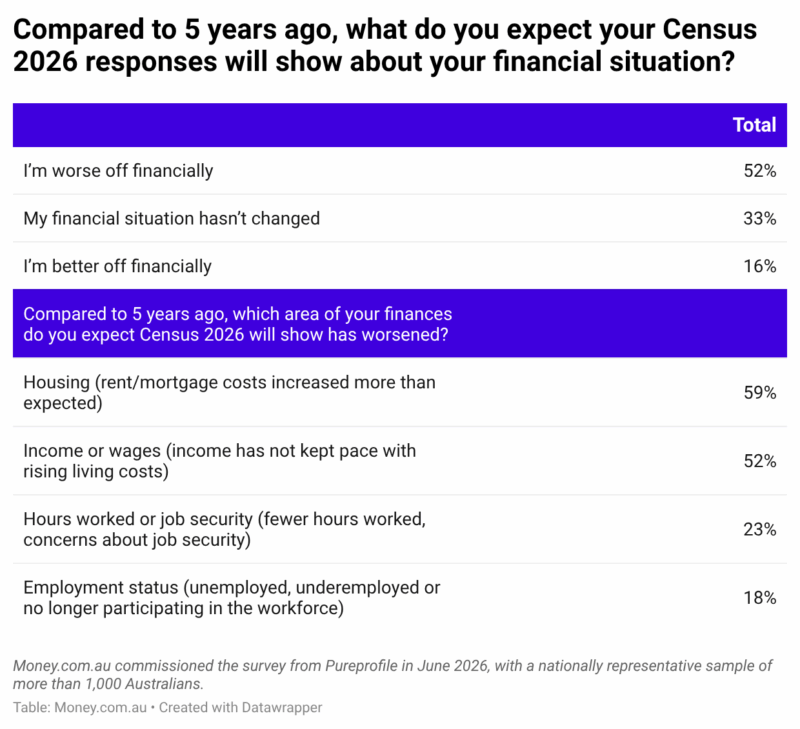
Then a new research from Money.com.au revealed that 52% of Australians, equivalent to 11.5 million people, expect their Census 2026 responses to show their household is financially worse off than it was five years ago when the last national snapshot was conducted.
Meanwhile, a third of Australians (33%) say their financial situation hasn’t changed since the last Census was conducted in 2021. Only 16% say they’re financially better off today than five years ago.
The 2026 Australian Census will be held on Tuesday, 11 August and conducted by the Australian Bureau of Statistics (ABS).
Money.com.au’s Head of Insights, Sean Callery, says millions of Australians have worked hard over the past five years without seeing a meaningful improvement in their financial position or living standards.
He further said:
"This year's Census won't be a positive report card for either the Government or the Reserve Bank. If most Australians feel they've gone backwards financially over the past five years, it's a sign many households don't feel the economy has worked in their favour.
However, we were living in a very different financial environment at the time of the 2021 Census. The country was emerging from the pandemic, the cash rate was sitting at a historic low of 0.10%, and there was far less pressure on household budgets from housing, fuel, insurance and other everyday essentials.
Housing costs remain a sticking point nationally. Whether you're paying a mortgage or rent, a growing share of household income is being swallowed by the cost of keeping a roof over your head. That makes it harder to build savings, invest for retirement and feel financially secure, even as wages rise."
Housing costs emerge as the biggest driver of financial deterioration
The research found that housing costs have become the biggest financial pressure point for Australians, with 59% saying they expect Census 2026 to show their rent or mortgage costs have risen faster than anticipated since 2021.
Income or wages ranked as the second-most deteriorated area of household finances, with 52% of Aussies saying their income has not kept pace with living costs.
- Also read:Migration Is Falling: What Happens to Australian Property Prices Now? | Property Insiders

- Also read:This week’s Australian Property Market Update – Latest Data, State by State September 22nd 2026

- Also read:Latest Property Price Forecasts. Australian Property Market Outlook 2026-2027: Navigating a Market Correction

- Also read:National Weekly Auction Report – September 19th 2026 | Clearance Rates Ease as Auctions Surge

- Also read:Adelaide housing market update | September 2026

This was followed by hours worked or job security, with 23% of respondents citing reduced working hours or concerns about employment stability.
Finally, 18% said their employment status had worsened since 2021, including becoming unemployed, underemployed or leaving the workforce altogether.
Older Australians most likely to feel financially worse off since the last Census
Gen X and Baby Boomers are the most likely to expect Census 2026 to show they’re financially worse off than five years ago, with 60% and 53% respectively saying their household finances have deteriorated since 2021.
This was followed by Millennials (49%) and Gen Z (34%).
Gen X are the generation most likely to say their housing costs have increased more than expected since the last Census, at 67%. They’re followed by Millennials (61%), Gen Z (55%) and Baby Boomers (50%).
Final note
Of course, how people feel about their finances and what the economic data tells us are not always the same thing.
Many Australians have seen the value of their homes, superannuation and other assets grow over the past five years, even while day-to-day living has become much more expensive.
Yet perception matters because it influences confidence, spending and investment decisions.
The challenge for households isn't simply earning more, but building assets that grow faster than inflation and creating a long-term financial strategy that allows them to prosper regardless of the economic cycle.
That's why, despite today's financial pressures, I remain optimistic that Australians who focus on growing their wealth rather than simply managing their expenses will put themselves in a much stronger position over the years ahead.