


Key takeaways
2.3 million individual housing investors in Australia, around 10 per cent of the working-age population, and this share has been broadly stable in recent years rather than growing unchecked
70 per cent of investors own just one property, confirming that property investment here is dominated by everyday Australians building one solid asset, not an army of large-scale portfolio holders
The 30 per cent who own multiple properties hold about half of all investment stock, and multi-property ownership has crept up 7 percentage points over the past two decades
80 per cent of multi-property investors still hold everything in a single state, and 30 per cent are concentrated in just one local market, which is a real diversification risk worth fixing
The investor base is ageing fast, with the share over 60 rising from 12 to 28 per cent since 1999/2000, though most in this group carry little or no mortgage debt
Nearly 40 per cent of investors sit in the top income quintile, and higher incomes mean greater capacity to absorb rate rises, vacancies, or income shocks
About 80 per cent of investors carry leverage on at least one property, and roughly a third have debt on both their home and their investment property
Around 1 in 5 leveraged investors had a debt-to-income ratio above 6 in 2021, the level regulators flag as higher risk, though these borrowers tend to have stronger incomes and buffers to match
Despite carrying more debt than owner-occupiers, investors have consistently defaulted less over the past two decades
The RBA's overall verdict is a resilient investor population, with geographic concentration and the ageing cohort flagged as the main areas to keep watching
You've heard every stereotype going around about property investors.
Some commentators paint us as reckless speculators piling into debt we can't handle, while others imagine a nation of mum-and-dad battlers gambling their super on a rental property they barely understand.
The truth, according to the most comprehensive dataset the Reserve Bank has ever had access to, is far less dramatic and far more reassuring than either caricature.
The RBA published a report using newly available ABS data which captures tax-compliant individual property investors who lodge rental property schedules, although it does not cover all ownership structures such as partnerships and trusts.
The analysis runs to 2022/23, so it does not fully capture the most recent phase of strong investor lending activity but it helps us better understand who property investors really are.
That means we finally have a complete, granular picture rather than an educated guess.
Just how many investors are there
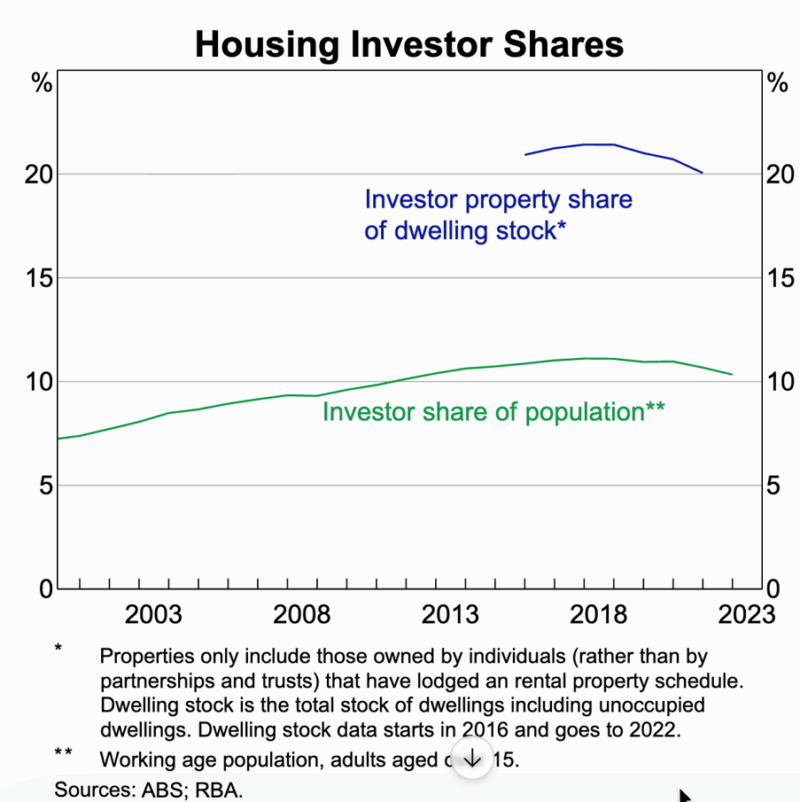
As at 2022/23, there were 2.3 million individual housing investors in Australia, equivalent to roughly 10 per cent of the working-age population. Investment properties made up around a fifth of the entire dwelling stock.
What I find particularly interesting is that this share of the population owning an investment property rose steadily through the 2000s and into the 2010s, but has been broadly stable more recently.
In other words, the investor cohort isn't ballooning out of control the way some media commentary would have you believe. It has settled into a fairly consistent proportion of working Australians.
Most investors own just one property
This is the finding that should put to rest the idea that property investment in Australia is dominated by a small army of tycoons hoovering up half the suburb.
Around 70 per cent of housing investors owned just one investment property, while the remaining 30 per cent owned multiple properties, though those with multiple properties owned around half of all investment properties in Australia.
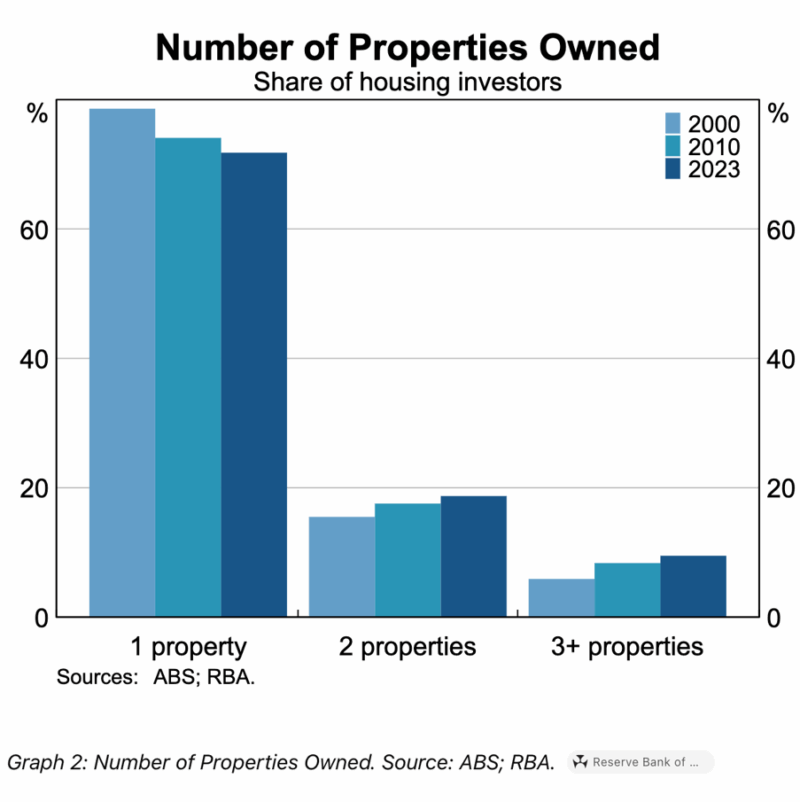
So while it's true that a minority of investors hold a disproportionate share of the total investment property stock, the overwhelming majority of Australians who invest in property are simply trying to build one solid asset alongside their own home.
The share of investors owning more than one property has increased by 7 percentage points over the past two decades, which tells me more investors are gradually building portfolios over time rather than stopping at their first purchase, exactly the strategic, multi-property approach we've always advocated at Metropole rather than a one-and-done mentality.
Multi-property investors are still too concentrated in one state
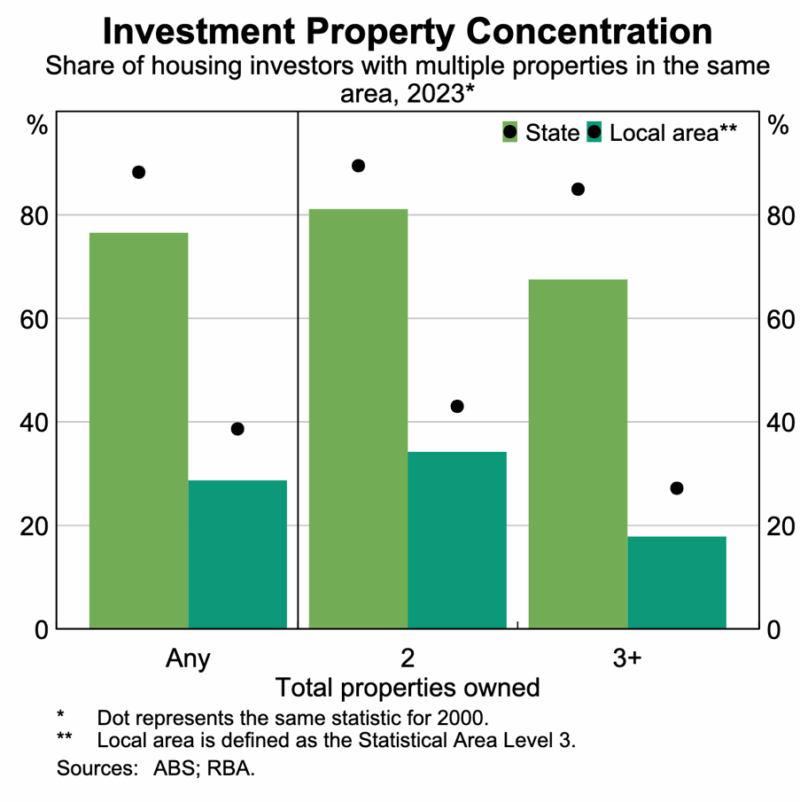
Interestingly around 80 per cent of housing investors who own multiple properties hold them in the same state or territory, and a closer look shows that around 30 per cent of multiple property owners hold all their investment properties within the same local housing market.
This is exactly the trap we warn investors about at Metropole.
If your entire portfolio sits in one city, or worse, one pocket of one city, you're not diversified.
You're just as exposed to a local downturn, a change in local infrastructure spending, or a shift in that particular market's cycle as someone who only owns a single property.
The RBA notes that regions close to each other tend to experience similar cycles of listing activity, vacancy rates, rental yields, and housing prices, which is precisely why we have always encouraged strategic geographic diversification as part of a long-term portfolio plan, rather than simply buying whatever is close to home because it feels familiar.
The good news is this concentration has been slowly easing. Investors have steadily become less geographically concentrated in their property holdings since 1999/2000, likely helped along by buyers agents, easier interstate property management, and the simple fact that you can now research a market anywhere in the country from your phone.
Of course, not every interstate property makes a good investment either.
The ageing investor base
One of the more striking demographic shifts in this data is how much older the investor population has become.
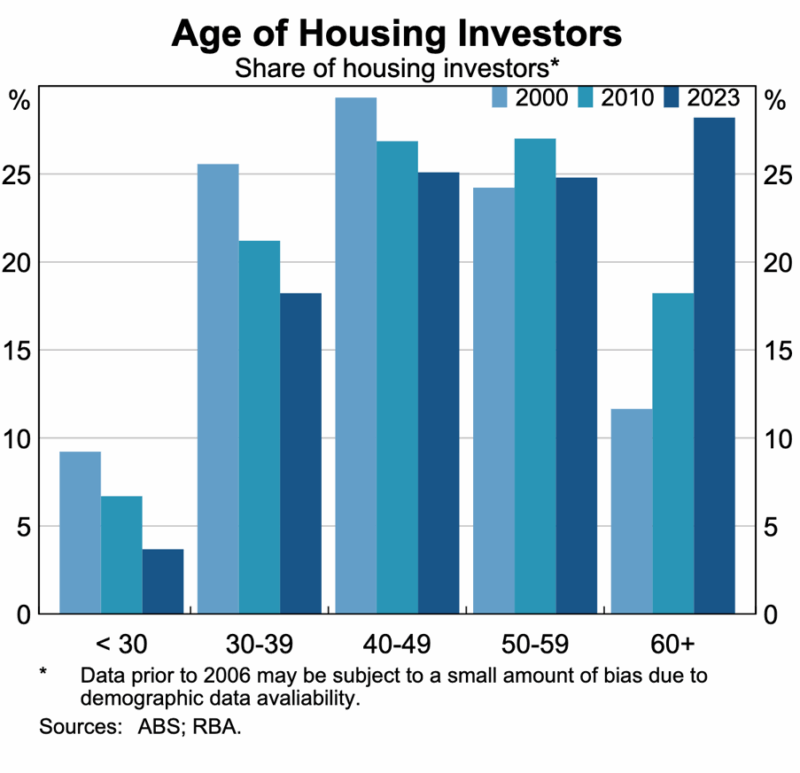
The median age of housing investors climbed from 45 to 51 years between 1999/2000 and 2022/23, and the share of housing investors aged over 60 has risen from 12 to 28 per cent over that same period.
About 40 per cent of that shift is simply Australia's population ageing generally, but the rest reflects more older Australians actively holding investment property later in life.
- Also read:This week’s Australian Property Market Update – Latest Data, State by State September 15th 2026

- Also read:Latest Property Price Forecasts. Australian Property Market Outlook 2026-2027: Navigating a Market Correction

- Also read:Brisbane Property Market Forecast [2026 & Beyond] – What The Olympics Decade Means for Investors.

- Also read:Melbourne property market forecast for 2026 & 2027 | Separating the fundamentals from the sentiment

- Also read:Sydney property market forecast for 2026 and 2027 | Why the short-term softness is a long-term opportunity

This matches exactly what I see with our clients at Metropole. Property has become the vehicle of choice for retirement planning and legacy building, not just wealth accumulation in your thirties and forties.
Encouragingly, the RBA found that only around half of these older investors still carry a mortgage on their investment property, and many are drawing on superannuation, other investments, or continued part-time work to support themselves, which suggests this cohort is generally well placed rather than dangerously exposed.
Higher income earners dominate, and that's a feature, not a bug
The RBA found that, not surprisingly, higher income earners are much more likely to own investment properties than those on lower incomes, and in 2022/23 the highest income quintile accounted for nearly 40 per cent of all housing investors in Australia.
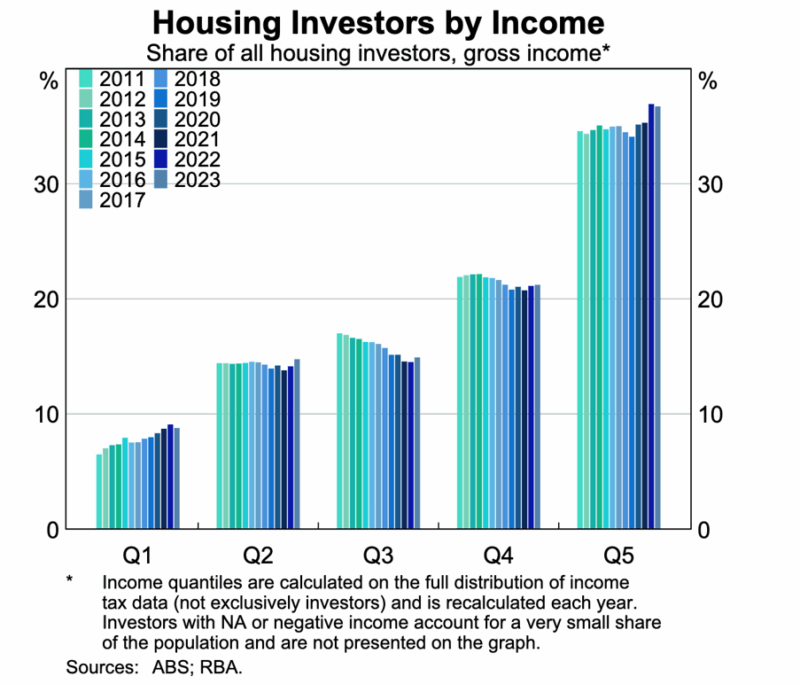
Rather than treating this as evidence of some unfair advantage, the RBA frames it correctly as a source of financial stability.
Higher income households have greater capacity to absorb shocks and have historically been less likely to become unemployed.
This is precisely why negative gearing and other tax settings should support smart investment decisions rather than drive them in the first place.
The people using these concessions most effectively tend to be the ones with the income and financial discipline to hold quality assets through a full cycle, which is exactly the buy and hold, capital growth focused approach I've been advocating for years.
Leverage, negative gearing and debt levels
Now to the part everyone gets excited about, how much debt investors are actually carrying.
The share of investors with at least one leveraged property has remained relatively stable and is high at around 80 per cent of investors.
Negative gearing usage has moved up and down over the years largely in response to interest rates rather than any change in investor appetite or behaviour, and given the rate rises we've seen recently, it's likely that the share of negatively geared investors has increased further since the most recent data was collected.
It will be interesting to see how this changes following the recent federal budget's amendments to how negatively geared properties will be treated in the future.
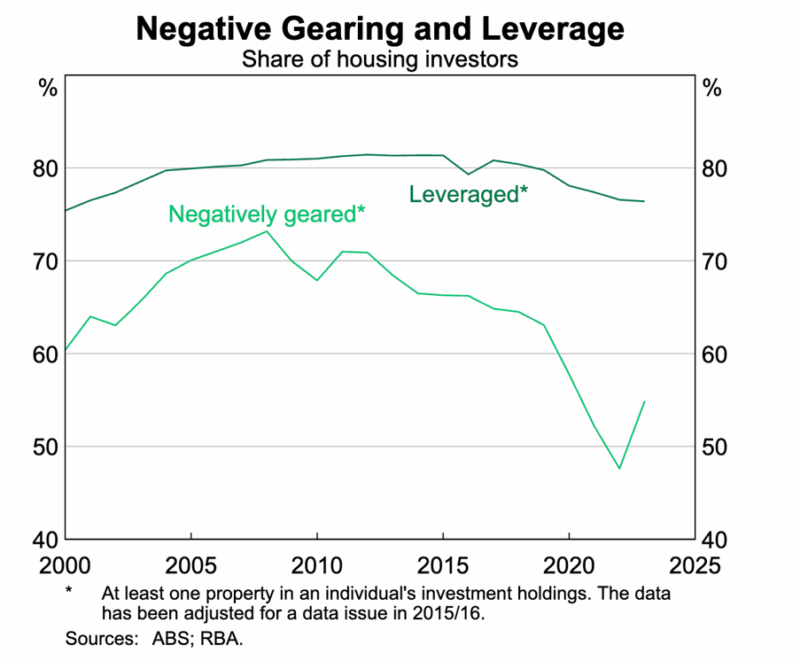
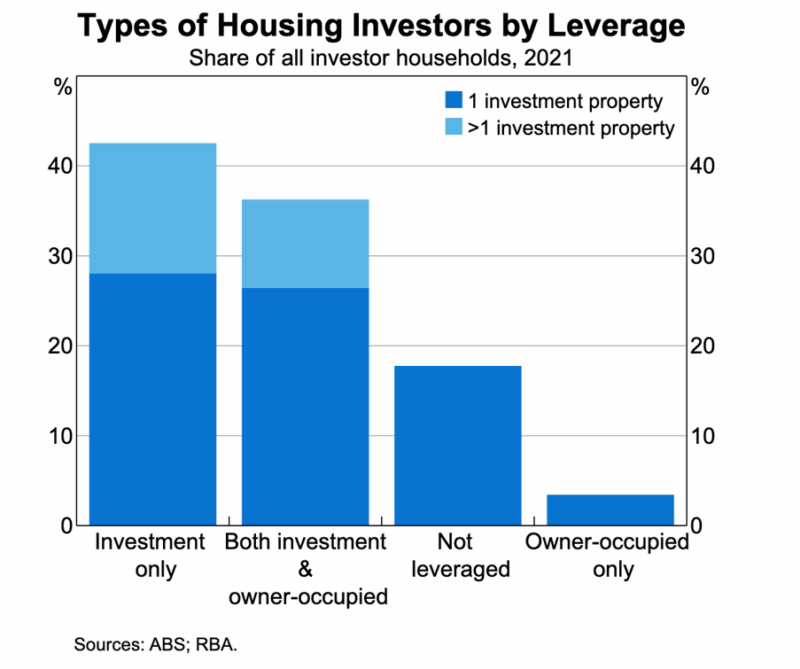
When you look at household level debt, around a third of investor households carry loans on both their investment property and their own home, and about one in five leveraged housing investors had a debt-to-income ratio above six, a level both the RBA and APRA consider higher risk.
That sounds concerning until you dig into who those highly geared investors actually are. The RBA found these borrowers tend to have higher incomes, hold rental income streams as a buffer, and can typically sell an investment property with far less personal disruption than an owner-occupier forced to sell the family home. That's a crucial distinction the headlines always miss.
The bottom line on risk
Despite carrying more debt than owner-occupiers, investors have consistently defaulted less.
The RBA is upfront that Australia hasn't been tested by a truly severe housing downturn during the period studied, so this resilience hasn't faced its toughest examination yet.
But the underlying characteristics, higher incomes, larger buffers, diversified income, and a demonstrated willingness to hold through cycles rather than panic sell, all point in the same direction.
The RBA's own conclusion sums it up well…their research points to a resilient investor population, with some pockets worth continued monitoring rather than any systemic alarm bell.
What this means for you as an investor
None of this data should surprise anyone who has been investing strategically for a while, but it should give you confidence in the approach.
The investors who come out of this research looking strongest are exactly the ones following the fundamentals I’ve been advocating for years.
They own a small number of high quality, well located properties rather than a large pile of average ones. They spread their holdings across different markets rather than concentrating everything in one postcode. They use leverage sensibly, with the income and buffers to service it through a full cycle rather than stretching to the absolute limit. And they think in decades, not months.
If this data tells us anything, it's that being a boring, patient, financially disciplined investor has always been the winning strategy, and it still is. The investors who get caught out aren't the ones following a proven process. They're the ones chasing yield in a regional hotspot with all their eggs in one basket and no buffer to speak of.
If you'd like to know how your own portfolio stacks up against these benchmarks, or whether your current strategy has you concentrated in ways you haven't fully considered, that's exactly the kind of conversation we have with clients in a Wealth Discovery Session at Metropole. Click here now to book a time with one of our Wealth Strategists.