


Key takeaways
Australia’s property market is losing momentum as listings rise and auction clearance rates soften. Buyers are becoming more cautious and selective.
Sydney and Melbourne are feeling the slowdown first because higher stock levels are giving buyers more choice while borrowing power shrinks.
Smaller capitals such as Adelaide, Perth, and Darwin remain more resilient due to tight housing supply and extremely low vacancy rates.
Rising stock levels are shifting negotiating power towards buyers, creating less urgency and more opportunities to negotiate on price.
Property markets are becoming increasingly fragmented, meaning strategic investors will need to focus on local market fundamentals rather than broad national trends.
For much of the last two years Australia’s property markets have defied expectations.
Despite higher interest rates, affordability pressures, and cost-of-living concerns, property values in many parts of the country continued to push higher as strong population growth, tight rental markets, and limited housing supply kept prices resilient.
But the landscape is beginning to change.
Domain's latest property market data reveals a rise in the total homes for sale across most capital cities in April, coinciding with a continued softening in auction clearance rates and a loss in price growth momentum.
These signals historically serve as a precursor to a slowdown in the market.
Domain’s Chief Residential Economist, Dr Nicola Powell said:
“While April was interrupted by multiple public holidays, the direction is becoming clearer as agents, sellers, and buyers navigate the impact of consecutive interest rate hikes and the uncertainty of an anticipated once-in-a-generation changes to property taxation policy. "
Let's dicuss what else the latest data is really telling us about the state of Australia’s housing markets.
Auction Clearance Rates
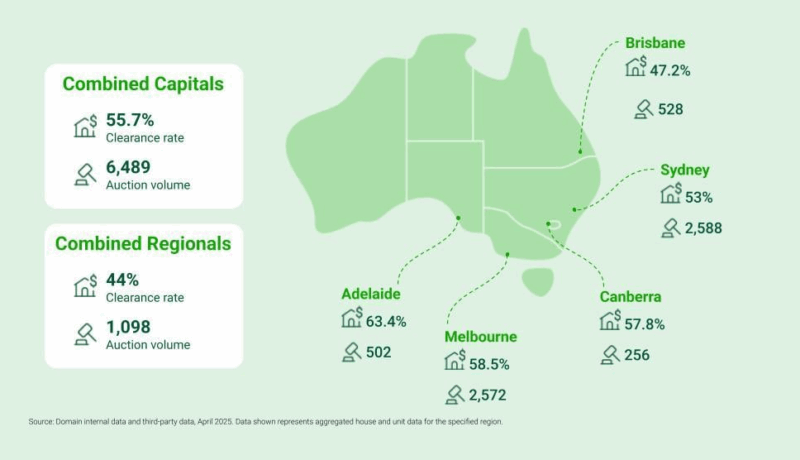
Across the combined capitals, April auction volumes fell to a three‑month low from already moderate levels, according to Domain.
Meanwhile clearance rates declined to 55.7%, the lowest since December 2024 and withdrawal rates reached 17.6%, the highest since the pandemic period in 2020.
New housing supply diverges across the country
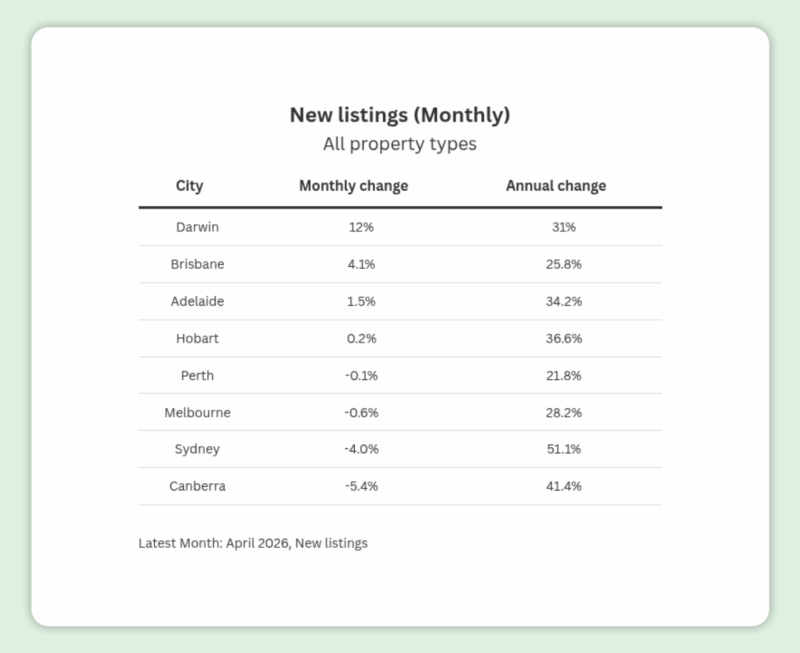
Domain's data show that monthly movements show a mixed picture, with most markets relatively steady, but sharper declines in Sydney (-4.0%), Canberra (-5.4%) and Melbourne (-0.8%).
Year‑on‑year comparisons are overstating the uplift in April 2026 new listings, as 2025 volumes were temporarily suppressed by the close timing of public holidays, making 2026 growth appear stronger than it is in underlying terms.
Dr Powell further explains:
"The Sydney and Melbourne markets are feeling this shift first. Their higher stock levels amplify the impact of rate rises because they give buyers more choice at a time their borrowing power is shrinking, so in this market prices tend to adjust faster and more visibly, while smaller capitals remain more resilient.
As stock levels expand and urgency shifts, buyers are benefiting from increased choice and greater room for negotiation, signalling a market transitioning out of its growth phase into a more discerning, patchwork landscape where Australians are seeking clarity amidst a complex array of economic unknowns.”
Capital city highlights
Melbourne
According to Domain, Melbourne's total supply has hit a five-month high, with new listings at their highest since 2021.
Meanwhile, auction clearance rates have fallen to 58.5%, their lowest since July 2022, while the share of auctions withdrawn rose to 12.1%, the highest point since January 2023.
Melbourne continues to have the highest vacancy rate among the capitals, albeit at a modest 1.1%.
Sydney
Sydney's new supply reached a record high in April, while total listings also increased.
Domain notes that its unit selling times are at their lowest level since December 2024.
The city’s vacancy rate has held at a record low of 0.8% for a third consecutive month, continuing to exacerbate challenges for Sydneysiders trying to secure rental accommodation.
- Also read:Melbourne housing market update | October 2026

- Also read:National Vacancy Rate Rises to 1.4% | SQM Research

- Also read:Australian housing market update | October 2026

- Also read:This week’s Australian Property Market Update – Latest Data, State by State October 13th 2026

- Also read:Latest Property Price Forecasts. Australian Property Market Outlook 2026-2027: Navigating a Market Correction

Brisbane
Brisbane’s market recorded a notable uplift in supply, with its highest April listing volume since 2021.
According to Domain, days on market for houses have edged up to a three-month high, suggesting buyers are taking longer to make decisions.
However, discounting remained near record lows, while the vacancy rate held at 0.6% - also a record low.
Adelaide
Domain's data show that Adelaide recorded the highest auction clearance rate across the capital cities at 63.4%.
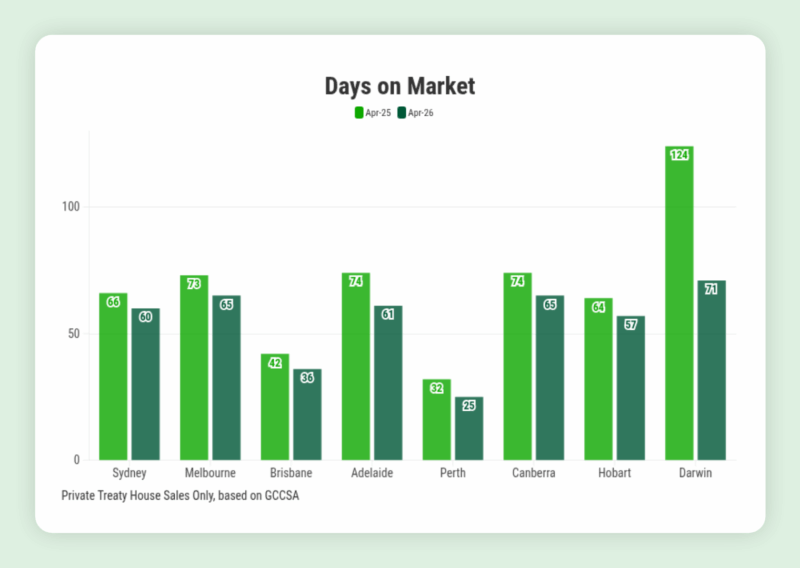
New listings hit a record high for the month, while days on market for both houses and units fell to their lowest levels since 2004.
At the same time, rental conditions remain extremely tight, with vacancy rates holding at 0.4% for the fourth consecutive month.
Perth
Perth remains the fastest-moving market across the country, with houses averaging 25 days on the market and units at 28 days, compared with 60 and 66 days respectively in Sydney.
New listings edged slightly lower in April, although total supply remains elevated while vacancy rates rose to 0.4% in April.
Canberra
According to Domain, Canberra was the only capital city to record a rise in auction clearance rates, reaching its highest April level since 2024.
New and total supply fell to three-month lows, although both remain at record highs for April.
Canberra’s vacancy rate rose to 1.1%, a three-month high, however the weakest since 2022.
Hobart
New listings in April represented the highest recorded in the month since 2020, however total supply is the lowest since 2022 as competition in the market is resulting in shorter sales cycles for both houses and units.
Domain notes that Hobart remains one of the tightest rental markets in the country with a vacancy rate of 0.3%, the lowest April on record.
Darwin
Darwin remains highly competitive for buyers, with total supply falling to the lowest April on record.
Days on market for houses and units are at their lowest levels since 2006 and 2010, respectively.
The vacancy rate remains at a record low of 0.2%, making Darwin the tightest rental market in the country.
End note
While the headlines may focus on slowing momentum and rising stock levels, the reality is that Australia’s property markets are simply moving into the next stage of the cycle.
And as always, there won’t be one market - there will be many markets performing very differently.
That’s why investors who stay focused on long-term fundamentals, rather than short-term noise, will continue to outperform.
In changing markets like these, strategy becomes even more important than timing.