

Key takeaways
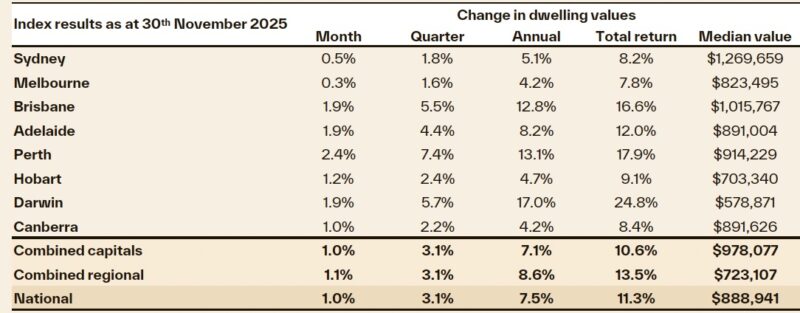
2025 was meant to be a flat year, yet buyer demand surged. Rate cuts, record migration, growing household formation, and the return of first-home buyers and investors kept the market unexpectedly resilient.
Confidence quietly improved even as the economy felt tight.
Construction activity fell to decade-low levels as costs rose, builders withdrew, and feasibility evaporated. New approvals stayed weak, creating an even sharper undersupply than the year began with. This chronic scarcity was a major driver of rising prices.
Upgraders, downsizers, Baby Boomers, and family-helped buyers dominated the market. These groups were largely insulated from rate pressure, and they concentrated their spending in inner- and middle-ring suburbs—amplifying price growth in higher-quality locations.
Investment-grade properties—gentrifying suburbs, family-friendly low-rise apartments, and established homes with land—kept outperforming.
Meanwhile, inferior stock (especially high-rise towers and oversupplied fringe areas) lagged even further behind.
Early 2026 should deliver strong price momentum thanks to confidence, government incentives, and continued population inflows.
The second half will flatten as borrowing limits bite. Premium, scarce, inner- and middle-ring markets will stay resilient, while outer suburbs and mortgage-stressed areas soften.
What a year we had in property in 2025.
After two years of strong property growth around Australia, 2025 started with many commentators predicting flat growth, yet the markets kept quietly rising.
It was a year when consumers were stretched, investors were cautious, and yet property prices kept defying gravity.
It was also a year when population growth surged, construction collapsed, vacancy rates plummeted, and affordability became the battleground for a generation.
And now, as we head into 2026, the big question is: Was 2025 the turning point… or just a warm-up for what’s coming next?
So let’s take a step back, look at the lessons of the past year, and explore what the next year has in store, because 2026 is shaping up to be another fascinating chapter in the story of Australian housing.

2025 - A year that shouldn’t have worked… but did
If you rewind to early 2025, sentiment was fragile.
Interest rates were high and sticky, households were tightening their belts, and the cost-of-living squeeze was biting hard.
Many expected the property market to finally hit the brakes, but that’s not how the Australian housing market behaved.
1. Demand remained far stronger than anyone expected
Despite the doom forecasts, buyers didn’t disappear. In fact:
- Three interest rate costs increased buyer confidence
- Migration remained historically high
- Household formation surged
- First-home buyers began re-entering
- Investors, after sitting on their hands in 2023 and 2024, started seeing rising yields and property prices too good to ignore
Every market has its surprises, and in 2025, the surprise was that demand didn’t just hold… it accelerated, boosted by increasing confidence for both buyers and sellers as interest rates fell three times.
2. Supply kept shrinking when we needed it most
We went into 2025 with a massive housing shortage, and we came out of the year with an even bigger one.
Construction costs rose again, labour shortages worsened, and more builders collapsed or stepped away from fixed-price contracts.
New building approvals tracked around decade-low levels, and developers scaled back projects because their feasibility simply wasn’t stacking up.
This chronic undersupply acted as a pressure cooker under prices all year long.
3. The wealth effect quietly returned
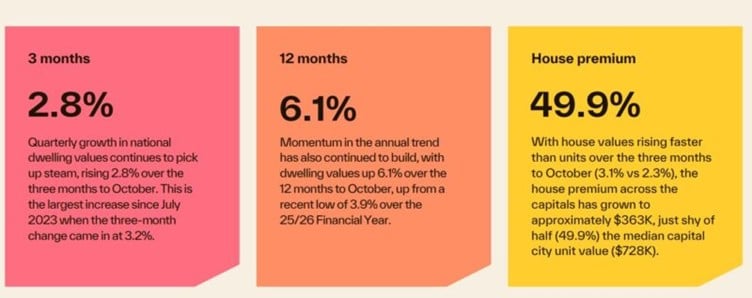
Affluent buyers, particularly upgraders, downsizers, and equity-rich Baby Boomers helping their children into the market, drove much of the activity in the inner and middle rings of our capitals.
This demographic has financial buffers that shield them from rate pressures.
As a result, these segments of the market saw strong and consistent price growth throughout 2025.
4. The gap between “investment-grade” and “everything else” widened even further
As I’ve been saying for years, we have multiple property markets running at different speeds.
In 2025, gentrifying middle-ring suburbs performed strongly and affordability issues ensured that well-located family-friendly apartments strengthened, but low-quality high-rise stock continued to lag.
5. First home buyers came back
First home buyers returned to the market in the last couple of months of 2025 thanks to new government support schemes helping with entry into the market via grants, shared equity, and lower deposit requirements.
What’s ahead for property in 2026
2026 is shaping up as a year of two very different halves, each driven by its own forces.
I see 2026 as likely to be another year of national price growth - not booming, but steady - even though interest rates are not expected to fall again, because demand will continue to rise faster than supply can respond.
1. Strong population growth will continue to do the heavy lifting
Migration levels will remain elevated, and most new arrivals will continue settling in Melbourne, Sydney and Brisbane
This will keep rental markets tight and push more renters to consider buying, especially when government incentives reduce their deposit hurdle.
2. Housing supply will remain severely constrained
All the factors that suppressed supply in 2025 will only intensify in 2026:
- Construction costs will still keep rising
- Labour shortages will remain entrenched
- Approvals are not increasing meaningfully
- The high cost of new construction will mean many new developments will not come out of the ground, as they will not be financially feasible.
This is the perfect recipe for a market that grinds higher over time because of scarcity.
3. Interest rate stability will encourage buyer confidence
Nobody expects another rate cut anytime soon.
But interest rate stability is almost as powerful as it reduces uncertainty and gives anxious buyers permission to move forward.
- Also read:This week’s Australian Property Market Update – Latest Data, State by State September 15th 2026

- Also read:Everything you need to know about the state of Australia’s property markets in 20 charts – September 2026

- Also read:Latest Property Price Forecasts. Australian Property Market Outlook 2026-2027: Navigating a Market Correction

- Also read:Brisbane Property Market Forecast [2026 & Beyond] – What The Olympics Decade Means for Investors.

- Also read:Melbourne property market forecast for 2026 & 2027 | Separating the fundamentals from the sentiment

Many will return to the market early in 2026, particularly upgraders, downsizers with substantial equity, rentvestors, and those assisted by the bank of mum and dad.
4. Government incentives will add fuel
With first-home buyers now able to purchase a median price property with a 5 per cent deposit and a government guarantee, tens of thousands of additional buyers are expected to enter the market in 2026.
And the new Help To Buy Scheme will allow eligible Australians to buy a home with the federal government contributing up to 30% for existing homes and 40% for new builds.
History tells us these schemes increase demand far more than they increase supply.
And when demand rises in a market already short of stock, prices rise.
Expect this to drive growth in the low- and mid-priced segments in 2026, especially established homes and liveable low-rise apartments.
2026 will be a year of two halves
I see strong property growth around Australia in the first half of 2026.
While borrowing capacity won’t improve, confidence will, and we’re already seeing this with FOMO (Fear Of Missing Out) evident on the ground.
This will be enough to keep delivering solid national price growth, but the second half of the year will be shaped by the reality that buyers’ borrowing capacity will not materially improve.
With interest rates steady rather than falling, household budgets will remain stretched, and wage growth will not keep up with housing costs, and many buyers are already at their borrowing limits.
This means high prices will begin to slow activity in the more affordable suburbs, which are most sensitive to borrowing constraints.
I don't see this slowdown as being dramatic, more of a flattening than a correction. But it will be noticeable.
The suburbs most affected will be:
- Affordable outer suburbs
- Mortgage-stress hotspots
- Locations with abundant new supply
- Areas dependent on wage-constrained buyers
Yet higher income, premium suburbs will remain more insulated.
Where the opportunities will be in 2026
1. Investment grade inner and middle-ring suburbs
While the cheaper and median price suburbs have performed well over the last couple of years, I see a shift to outperformance of areas that exhibit:
- Scarcity
- Gentrification
- Wages growth
- Amenity, including good school zones or 20-minute neighbourhoods.
These are the areas where money is made in property in the long term.
2. Established family homes with land value
I see houses and townhouses in the middle ring suburbs of our capital cities continuing to perform well because of their underlying land value.
These properties have always been the most resilient in flat periods or downturns , benefiting from their scarcity.
3. Boutique, low-rise apartments
Family friendly low-rise apartments will continue to attract demand from buyers who can no longer stretch to a house, but refuse to compromise on lifestyle and local amenity.
Not high-rise towers, but the older, solid, well-located blocks with good layouts, sizable balconies or courtyards and renovation potential.
4. Value-add opportunities
“Manufacturing” capital growth will again become an important strategy for experienced investors who will add value to their property through cosmetic renovations, small-scale redevelopment, or subdivision.
What savvy investors will focus on in 2026
Here’s the mindset that will outperform:
- Start by building a strategic property plan, based on long term fundamentals
- Look for long-term wealth, not quick wins
- Have a financial offer in place so you can hold through the cycles
- Buy quality, not quantity
- Prioritise scarcity over bargains
- Favour demographics over short-term sentiment
- Stick to proven, resilient locations
- Avoid the outer-suburban “growth stories” that rely on cheap land and fast approvals
This is not a market to speculate in. It’s a market to position wisely in.
Final thoughts: the cycle doesn’t define your success – your strategy does
Despite the noise, despite the affordability challenges, despite rate uncertainty, despite political debates… the fundamental drivers of Australian property remain firmly intact.
- Strong migration
- Growing household formation
- Chronic undersupply
- Generational wealth effect
- Structural demand for desirable suburbs
- Long-term wage growth in high-skilled industries
These forces don’t disappear because the market slows for six months.
Property investing is a long-term game measured in decades, not seasons.
And in 2026, those who buy the right asset in the right location, and hold it for the long term, will look back on this year as an opportunity, not an obstacle.
So what should you do about this?
As we step into 2026, the opportunities will be significant – but they won’t be evenly distributed.
Smart property decisions will depend on understanding demographic shifts, supply constraints, changing buyer behaviour, and the structural forces shaping our capital city markets.
With so many mixed messages out there, it’s no wonder investors feel uncertain.
But the good news is that uncertainty creates opportunity for those who act with clarity and a proven strategy.
That’s where a tailored, evidence-based plan becomes invaluable.
If you’d like to make 2026 the year you take advantage of these market conditions rather than be overwhelmed by them, now is the ideal time to speak with one of Metropole’s Wealth Strategists.
We can help you build a personalised, forward-looking strategic plan aligned with your goals, risk profile, timeframes, and financial capacity.
If you’re ready to move beyond the noise and put a proven framework around your next steps, click here to organise a complimentary Wealth Discovery Chat and position yourself to make the most of the opportunities ahead.