

Key takeaways
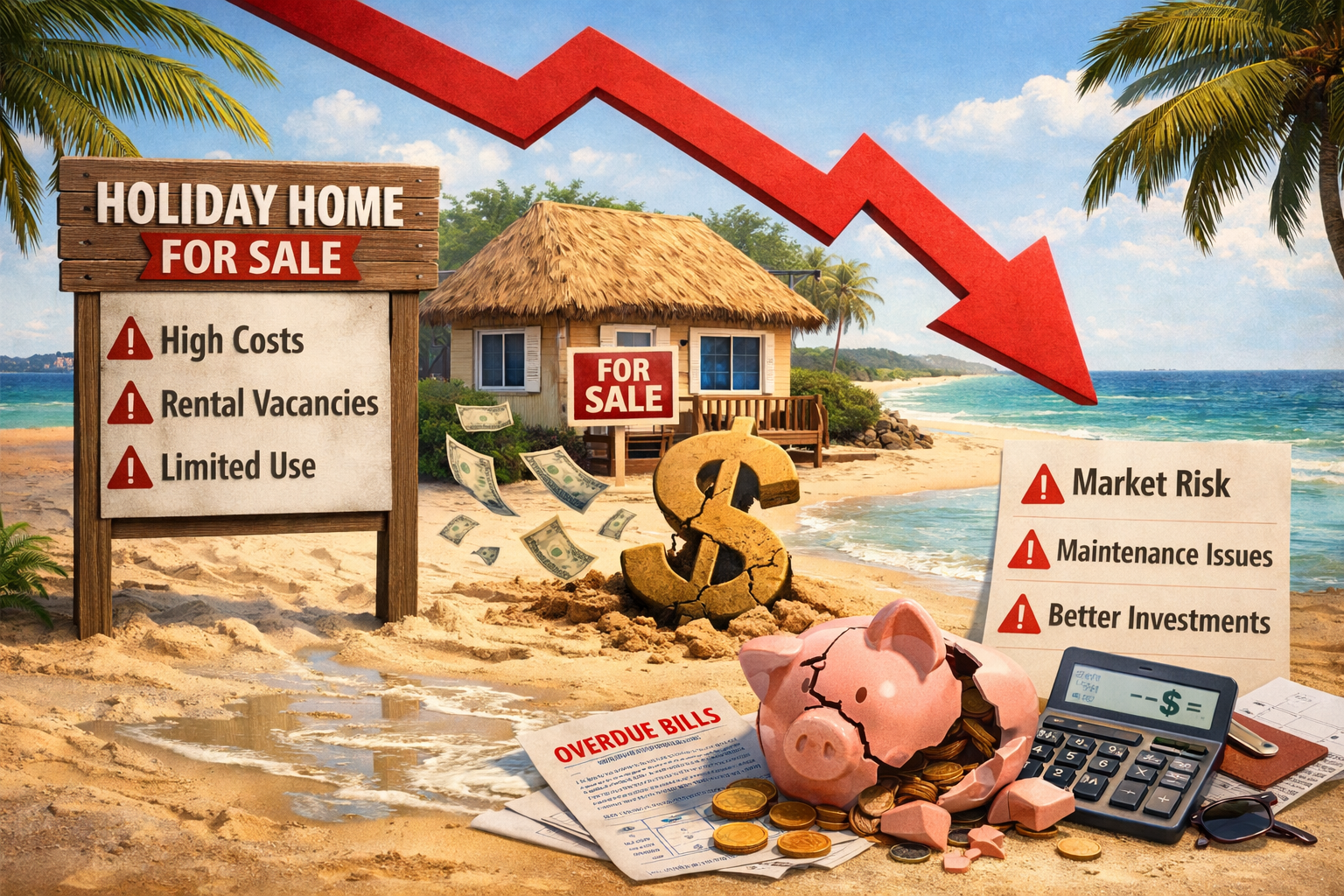
Most coastal or tourist-dependent towns simply don’t have the economic depth, population growth, incomes, or infrastructure investment needed to drive long-term price appreciation.
Historically, they deliver around half the growth of investment-grade capital-city properties — and that compounds into massive opportunity cost over a decade.
Holiday rentals face seasonal demand, unreliable income, higher vacancy risk, and very high running costs (cleaning, wear and tear, insurance, and 20–30% management fees).
A high-growth, investment-grade property in a major capital city compounds faster, generates more reliable income, carries lower risk, and gives more liquidity.
Let that asset grow and fund your future lifestyle choices — including holidays wherever you want — rather than tying up capital in a low-growth, high-maintenance holiday home.
You wouldn’t believe how often this comes up …every summer without fail, my mother-in-law asks me - at least ten times - whether we should all chip in and buy a holiday home.
And to be fair, I get the appeal.
Like many families, we live interstate, so holidays usually mean piling into the car, heading up or down the coast, and spending a week together somewhere sunny.
After a few days of morning swims, good coffee, lazy lunches, and a few too many glasses of wine, the conversation always drifts to the same place…
“Gee, this would be a lovely place to invest in a holiday home! What do you think, Brett?”
At that exact moment, I can see my father-in-law’s eyes glaze over. He knows what’s coming.
And usually, the next few days involve more versions of this same conversation.
And honestly, this probably happens in most Australian families at some point. When you're relaxed and enjoying yourself, it's easy to start imagining a slice of this lifestyle every weekend.
You know the script:
We could be here all the time!
We could rent it out when we’re not using it!
It could pay for itself!
We’ll have it forever - Christmas, Easter, long weekends… perfect!
Sounds magical, doesn’t it? But the reality? Very, very different.
And that’s why, in almost every case, a holiday home makes a terrible investment.
Let me walk you through why.
Capital Growth - the real deal breaker
Here’s the blunt truth: Most holiday locations never deliver the strong, consistent capital growth you need to build real wealth.
Most are:
- Secondary locations
- Highly seasonal
- Economically undiversified
- Dependent on tourism rather than long-term employment
- Prone to boom-bust cycles
- Popular at the wrong times for the wrong reasons
And while they look great on Instagram, these areas don’t have what really drives long-term property price growth:
- Deep, diverse economies and job markets
- Population growth driven by employment, not holidays
- Infrastructure investment
- Local residents with high incomes
- Strong owner-occupier demand
Our entire investment philosophy at Metropole is built around buying the right type of property in the right locations, and holiday towns almost never meet the criteria.
To illustrate the difference:
If you invested $550,000 in a typical coastal holiday-town property 10 years ago, you might have scraped in an average of 3 percent annual growth if you were lucky.
Put that same $550k into a well-located, investment-grade property in one of our capital cities, and you could reasonably have expected around 7 per cent annual growth - meaning your property could have doubled.
That’s about a $350,000 difference… for doing nothing more than choosing a better location.
I know how hard I work to deserve my holidays - and I expect my investments to work just as hard.
Rent - the numbers rarely stack up
Even if you’re fortunate enough not to need a loan, holiday rentals are a very poor form of passive income.
A few realities people don’t consider:
1. Occupancy is highly seasonal
Holiday rental managers might promise 70 percent occupancy, but in real life, that’s almost never achieved consistently.
2. Your best earning periods are the exact times you want to stay
The peak income times are Christmas, Easter, school holidays and long weekends
- Also read:Melbourne housing market update | October 2026

- Also read:Australian housing market update | October 2026

- Also read:Latest Property Price Forecasts. Australian Property Market Outlook 2026-2027: Navigating a Market Correction

- Also read:Brisbane Property Market Forecast [2026 & Beyond] – What The Olympics Decade Means for Investors.
- Also read:Melbourne property market forecast for 2026 & 2027 | Separating the fundamentals from the sentiment
Your peak enjoyment times are usually at the same times.
So now you’re either losing income every time you use the propert or avoiding the property so you don’t lose the income
Neither of these scenarios feels like a “dream holiday lifestyle.”
3. The income is irregular and unreliable
And as you know, irregular income is the enemy of any sound wealth-building strategy.
4. Running costs are much higher
Holiday homes come with:
- higher cleaning costs
- higher maintenance due to heavy guest turnover
- management fees of up to 20 to 30 percent
- furnishing, replacements, constant wear and tear
- insurance premiums that make your eyes water
When you add it all up, the yield is rarely anywhere near what people hope.
Here’s the part most people don’t consider.
Buy a holiday home today, and for the next 10 years, where do you think most of your holidays will be?
That’s right - the same spot. Every. Single. Time.
And sure, it’s lovely now. But after a decade? You might be itching to explore something new.
With AirBnB and similar sites, it’s never been easier to travel widely, cheaply, and flexibly.
You don’t need to tie up millions of dollars in a single destination to enjoy holidays.
The smarter alternative
Instead of locking yourself into a poor-performing asset chasing a lifestyle illusion, you’re far better off strengthening your asset base first.
Invest in:
- a high-growth, investment-grade property
- in a major capital city
- in a gentrifying suburb where people aspire to live
- where incomes are higher than the state average.
- where demand from both owner occupiers and tennats is deep and diverse
- where capital growth has been proven over decades
Call that your holiday home.
Seriously.
Let that property fund your future lifestyle. Because here’s what experience and decades of data show:
Most Australians want the holiday lifestyle now and hope the money will follow.
The wealthy do the opposite.
They build wealth first - and then the lifestyle choices are unlimited.
Additional considerations most people overlook
Here are a few more perspectives that align with our strategic philosophy:
- Holiday homes attract emotional decision-making - Buying while you’re sunburnt, relaxed and half a bottle of wine in is the worst frame of mind for a multi-million-dollar decision.
- They are often the first asset to be sold in tough times - In downturns, holiday homes tend to experience bigger price drops and longer time on market. They’re discretionary assets in discretionary locations.
- They rarely outperform during interest-rate cycles - Secondary markets rely heavily on cheap money. When rates rise, demand evaporates.
- There’s an opportunity cost - Every dollar tied up in a low-growth asset is a dollar not compounding in a high-growth one.
- Liquidity is limited - Selling a property in a coastal holiday town during winter? Good luck.
Putting all this together….
When you’re lying on a beach with a cold drink in hand, it’s easy to picture yourself living this lifestyle all year round. But that’s not the time to make a major investment decision.
Holiday homes almost always deliver:
- poor capital growth
- irregular income
- high running costs
- lifestyle limitations
- and huge opportunity costs
Meanwhile, a well-selected investment-grade property in a capital city delivers:
- superior long-term growth
- more consistent rental income
- stronger liquidity
- fewer surprises
- and a much faster path to financial independence
Travel widely. Explore the world. Stay wherever you want.
And let your investment property - not your holiday home - do the heavy lifting.