


Key takeaways
In the world of property investment, a troubling phenomenon often rears its head: the Dunning-Kruger Effect.
You see.. when it comes to money, seemingly rational people don’t always act rationally. We are subject to cognitive biases.
The Dunning-Kruger Effect states that people who know very little about something often think they know more than they do, while experts are more aware of what they don’t know.
There are four main stages of the Dunning-Kruger Effect, and I must admit I have experienced all four stages in the early years of my investment journey.
In the world of property investment, a troubling phenomenon often rears its head: the Dunning-Kruger Effect.
You see.. when it comes to money, seemingly rational people don’t always act rationally. We are subject to cognitive biases.
Let me explain…
In 1999, psychologists David Dunning and Justin Kruger published research finding that people with limited knowledge or skills in a particular area tend to overestimate their abilities, while experts often underestimate their competence.
To put it simply, the Dunning-Kruger Effect means that people who know very little about something often think they know more than they do, while experts are more aware of what they don’t know.
This was particularly obvious during the property boom of 2020-21, when low interest rates created a once-in-a-generation boom that meant almost every property increased in value substantially.
Unfortunately, this made many novice property investors think they were smarter than they really were and created a whole new world of so-called property “experts”.
There are four main stages of the Dunning-Kruger Effect, and I must admit I have experienced all four stages in the early years of my investment journey.
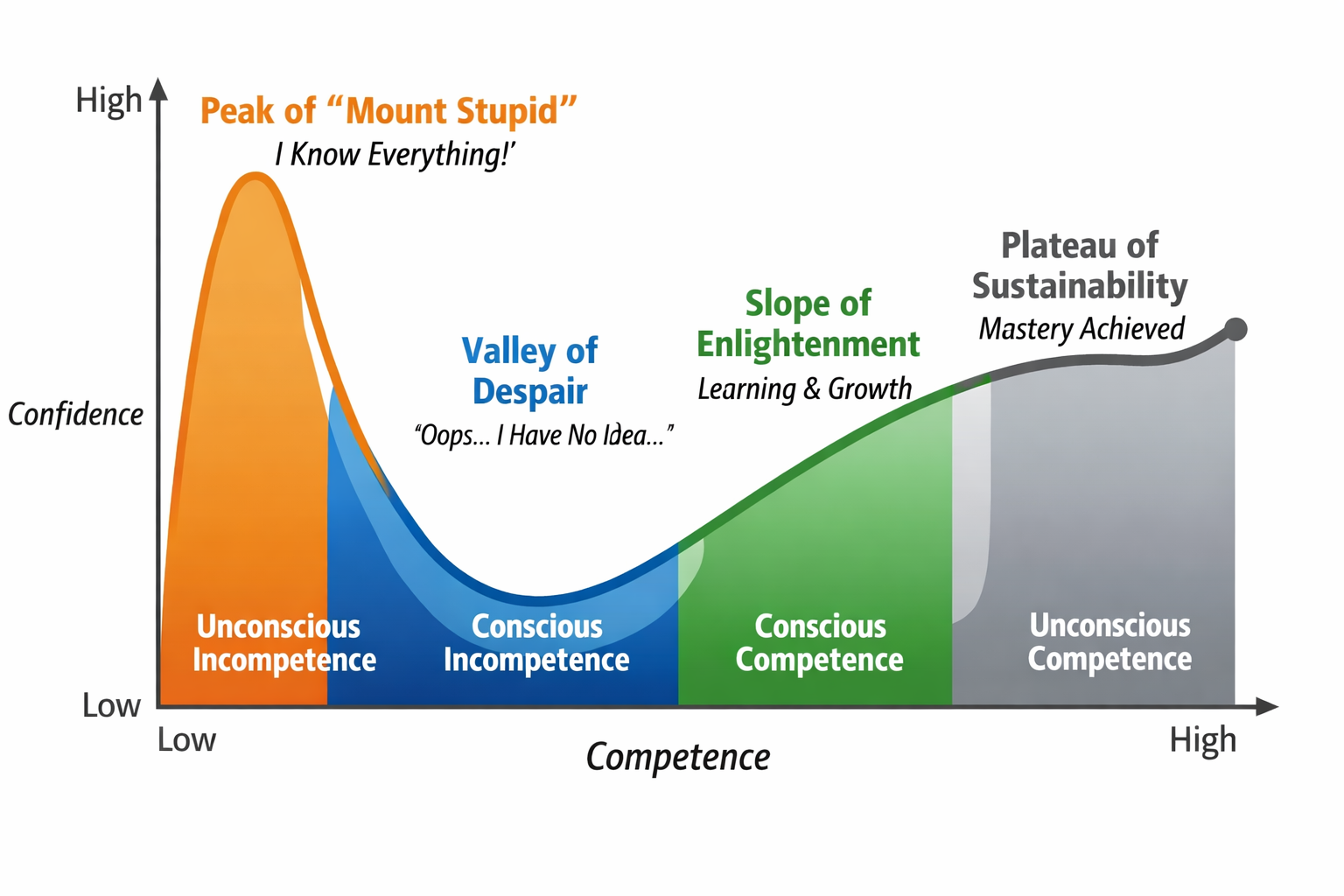
1. The Peak of Mt. Stupid: Overestimating Knowledge
The Dunning-Kruger Effect is vividly illustrated in the concept of the "Peak of Mt. Stupid."
This peak occurs when individuals, having acquired a superficial understanding of a subject, become excessively confident in their knowledge.
For beginning property investors, this often occurs after they have learned a few fundamental concepts and experienced early success in a rising market.
As I said, during the recent property boom, many new investors experienced significant gains with minimal effort.
The market conditions, characterised by surging property prices, created an illusion of skill, when in reality luck and timing played major roles.
These initial wins fuelled overconfidence, leading many to believe they had mastered property investment.
To be honest, my first forays into property investment were wildly successful because of booming inflation, and I believed property investment was easy and anyone could be successful.
I was oblivious to my incompetence and was clearly standing at the peak of Mt Stupid.
The Emergence of Unqualified Gurus
Today, the issue is compounded by social media platforms that have enabled a proliferation of self-proclaimed property “experts.”
These individuals, often with only a few successful deals under their belts, quickly pivot to offering advice and coaching services.
They establish a presence on platforms such as TikTok, YouTube, and Instagram, attracting followers seeking guidance.
However, these “gurus” are often still at the Peak of Mt. Stupid, dispensing advice without a comprehensive understanding of market complexities.
Their followers, drawn in by the promise of easy money, are often unaware that the advice they receive is based on a limited and potentially flawed perspective.
This dynamic perpetuates a cycle of overconfidence and poor decision-making among novice investors.
2. The Valley of Despair: Facing Harsh Realities
As market conditions change, the fragility of these overconfident strategies becomes evident.
Property prices may fall (as they did in 2022), interest rates may rise as the following years, and the market can shift in unexpected ways.
When this occurs, many investors are unprepared for the challenges they face.
This descent from the Peak of Mt. Stupid into the "Valley of Despair" is a critical phase in the learning journey.
In the Valley of Despair, investors experience a crisis of confidence.
Their early successes no longer seem indicative of their abilities, and they become acutely aware of how much they don’t know.
This stage is marked by confusion and a sense of failure, as they struggle to understand why their strategies are no longer working.
My Valley of Despair came when, after the booming property market of the late 1980s interest rates rose to over 15%, my cash load dried up, and I learned some hard lessons about the nature of property cycles.
3. Climbing the Slope of Enlightenment
For those who persist, the journey continues with the climb up the "Slope of Enlightenment."
This phase involves a more realistic appraisal of one's knowledge and capabilities.
Investors start to seek out more comprehensive education, learning from their mistakes and gaining a deeper understanding of the market's intricacies.
They begin to appreciate the importance of factors such as strategic planning, maintaining a financial buffer to weather the ups and downs of the property cycle, and conducting thorough due diligence and risk management.
Climbing the Slope of Enlightenment requires humility and a willingness to admit past errors.
It also involves recognising the value of expert advice from seasoned professionals who have weathered multiple market cycles.
Investors who embrace this mindset can gradually build a solid foundation of knowledge and skills.
4. Reaching the Plateau of Sustainability
Ultimately, the goal is to reach the "Plateau of Sustainability."
At this stage, investors have a well-rounded understanding of the economy and how property investment works.
They know that while they may not have all the answers, they possess a sufficient grasp of the fundamentals to make informed decisions. Their confidence is based on competence, not overestimation.
On the Plateau of Sustainability, investors are better equipped to navigate market fluctuations.
They understand that property investment is a game of finance with some houses thrown in the middle.
They understand the intricacies of correct ownership structures and the importance of a diversified portfolio, prudent financial management, and staying informed about economic trends.
They also recognise that property investment is an ongoing learning process, and they remain open to new information and strategies.
Property investment is inherently multifaceted. Simple strategies might yield results in a booming market, but as conditions evolve, so too must the approaches.
Investors must be wary of the temptation to oversimplify these complexities.
While it’s possible to achieve success with straightforward buy-and-hold strategies, more advanced investments require a deeper knowledge base.
Recognising the limits of one’s expertise and seeking professional advice can mitigate risks and enhance long-term success.
As my knowledge increased, I became involved in medium-density property development, which is one of the main ways I have consistently outperformed the markets.
Some Final Thoughts
The Dunning-Kruger Effect serves as a cautionary tale for property investors.
Overconfidence, particularly when fuelled by a booming market, can lead to significant financial setbacks.
The market downturn of 2022 and the long period of high and rising interest rates were a sobering reminder of this reality, shaking many investors from the Peak of Mt. Stupid and forcing them to confront the limits of their knowledge.
To thrive in property investment, it is essential to approach the field with a mindset of continuous learning and humility.
By acknowledging the complexities of the market and seeking out reliable expertise, rather than taking advice from the new breed of so-called experts who last year were flipping burgers at McDonalds and this year are flipping properties, investors can navigate the journey from naive confidence to sustainable competence.
The path may be challenging, but the rewards of informed, strategic investing are well worth the effort.
- Also read:This week’s Australian Property Market Update – Latest Data, State by State September 15th 2026

- Also read:Latest Property Price Forecasts. Australian Property Market Outlook 2026-2027: Navigating a Market Correction

- Also read:Brisbane Property Market Forecast [2026 & Beyond] – What The Olympics Decade Means for Investors.

- Also read:Melbourne property market forecast for 2026 & 2027 | Separating the fundamentals from the sentiment

- Also read:Sydney property market forecast for 2026 and 2027 | Why the short-term softness is a long-term opportunity

In summary, property investment is not immune to the psychological traps that affect all fields.
The Dunning-Kruger Effect is a powerful reminder that success requires more than just confidence—it demands a commitment to learning and growth.
So, if you’re embarking on your property investment journey, tread carefully, seek wisdom from seasoned professionals, and remain open to the lessons that each experience brings.
The uncomfortable truth is that most people never make it past the Valley of Despair.
Not because they lack intelligence or motivation, but because it’s far easier to retreat back to overconfidence than to do the hard, disciplined work required to build real mastery.
This is where experience, guidance, and the right environment matter.
Progress up the Slope of Enlightenment doesn’t happen by accident.
It happens when you surround yourself with people who are further along the curve, who can challenge your assumptions, shorten your learning cycle, and help you see what you can’t yet see for yourself.
That’s exactly why we created Wealth Retreat.
It’s not a seminar, and it’s certainly not about hype or shortcuts.
It’s an immersive experience designed to help serious investors move beyond surface-level knowledge and develop the thinking, frameworks, and judgement that lead to unconscious competence over time.
The goal isn’t to feel confident - it’s to earn it.
And when your decisions are driven by deep understanding rather than emotion or noise, that’s when investing becomes calmer, more strategic, and ultimately more rewarding.
If you’re ready to stop guessing, stop reacting, and start thinking like the truly wealthy do, Wealth Retreat is where that next step up the curve begins. Click here now, learn all about it and register your interest