

What if interest rates don’t fall?
I keep seeing charts like the ones below.
They all tell much the same story. Rates rise some more, inflation eventually behaves itself and sometime around late 2027 or early fiscal 2028 the cost of money starts heading south again.
Maybe.
But for mine, there is a growing risk that we are confusing interest rates eventually easing with money becoming cheap again. They aren’t the same thing.
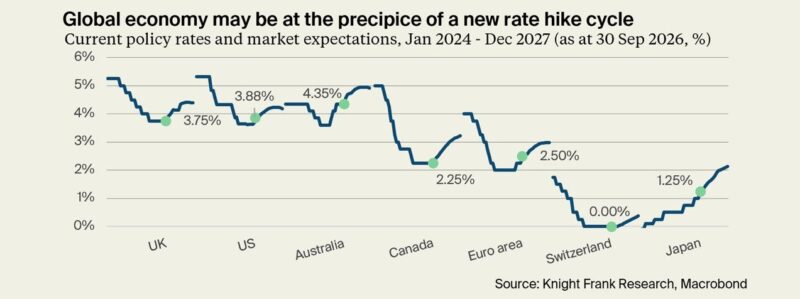
The RBA cash rate is now 4.60%.
I still reckon there is a reasonable chance we get another one, perhaps two, quarter-point increases from here. But increasingly I think the more interesting question isn’t what happens at the next couple of RBA meetings.
It is what happens after the next 12 to 18 months. There are basically three ways this can play out.
1. Rates fall
This is the conventional forecast and, to be fair, there is logic behind it.
Higher interest rates work with a lag.
Borrowing capacity falls, mortgage repayments rise, households pull back on spending, businesses defer investment and housing turnover weakens.
Eventually employment growth slows, unemployment edges higher and inflation retreats.
If inflation gets back inside the RBA’s 2% to 3% target range, there would be little point keeping monetary policy unnecessarily tight. Rates could then fall.

Tip: There is also the possibility that something breaks.
A recession, a sharper housing correction, a meaningful jump in unemployment, a credit or banking-related event (increasing possible due to AI, which for mine, is the real artificial intelligence threat) or a substantial global downturn could force the RBA to cut more quickly.
Of course given the RBA’s recent past record - when they started dropping the cash rate in early 2025 in the lead up to the federal election in May that year - they could rinse in repeat as the May 2028 Australian election looms.
All possible.
What I struggle with is the leap from that argument to the idea that we somehow return to low inflationary environment.
That period was extraordinary. The world had excess savings, relatively weak inflationary investment, cheap energy and globalisation continually squeezing production costs. Central banks were also buying enormous quantities of bonds and driving long-term borrowing costs lower.
A lot of that has changed.
Governments are borrowing heavily. Defence spending is climbing. The energy transition requires enormous investment. AI and data centres require mountains of capital - and more on this in a future Missive. Infrastructure spending remains elevated. Supply chains are becoming more insecure, as well as less efficient and more expensive.
So yes, offical rates might eventually fall. But falling from, say, 5% to 4.5%, or perhaps 4.25%, is very different from returning to 2%.
Under this scenario mortgage rates could still remain above 6%. Development finance would remain substantially higher. Private credit higher again.
A rate cut or two doesn’t necessarily mean cheap money.
2. Rates keep rising
Then there is the less comfortable possibility.
What if today’s interest rates aren’t actually particularly high?
They certainly look high compared with most of the past 15 years. But maybe that is the wrong comparison.
The more important issue is the neutral interest rate - the rate that neither stimulates nor materially restricts economic activity.
And there are good reasons to believe that neutral rate has moved higher.
Think about the forces at work. And to repeat. Government debt is rising. Fiscal deficits remain large. Infrastructure programs continue.
- Also read:Melbourne housing market update | October 2026

- Also read:Australian housing market update | October 2026

- Also read:Latest Property Price Forecasts. Australian Property Market Outlook 2026-2027: Navigating a Market Correction

- Also read:Brisbane Property Market Forecast [2026 & Beyond] – What The Olympics Decade Means for Investors.
- Also read:Melbourne property market forecast for 2026 & 2027 | Separating the fundamentals from the sentiment
Defence spending is increasing. Energy investment is capital intensive. AI investment could be enormous.
At the same time, Australia’s productivity performance remains ordinary, to put it politely.
That combination matters. If population and demand keep growing faster than the economy’s ability to efficiently produce more goods and services, inflation becomes harder to kill.
Add occasional shocks involving oil, gas, shipping, commodities, geopolitics plus geoeconomics and inflation becomes even stickier.
We also have very obvious domestic capacity constraints.
Housing construction remains expensive. Skilled labour remains tight in many sectors. Infrastructure projects compete with housing for the same workers and materials. Electricity, insurance, council charges and numerous other business and household costs continue heading higher. Our household’s essential costs have doubled since Covid.
Under those conditions, another one or two 0.25% increases aren’t difficult to imagine.
So 4.60% becomes 4.85%. Then probably 5.10%.
The bigger issue comes if inflation continues settling above where central banks wants it. In that world, rates may have to remain higher for considerably longer and potentially move several times higher again.
Maybe today’s interest rates aren’t the historical oddity. Maybe the oddity was the last two decades when money cost a lot less.
3. Rates simply stay there
For mine, this is the scenario that deserves much more attention.
Rates rise another once or twice during the coming year and then basically stop moving. Not for six months. Possibly for several years.
Imagine inflation falls from over 4% towards the mid-3% range. Economic growth remains weak. Housing activity softens and stay lacklustre. Household spending slows and unemployment edges higher.
That probably removes the need for much more tightening.
With underlying inflation settles at say between 3% and 4%, why would the RBA - outside of political pressure - rush to cut? It shouldn’t, especially given the elevated government spending and overall political largesse.
That leaves us in an uncomfortable middle ground. The economy isn’t strong enough to warrant substantially higher rates, but inflation isn’t weak enough to warrant substantially lower ones.
So the cash rate might simply sit somewhere around 4.5% to 5%.
And this is where the discussion becomes particularly important for property.
Property people often focus too much on the RBA cash rate. Developers don’t actually borrow at the cash rate.
Their cost of capital reflects bank funding costs, bond yields, lending margins, credit risk, equity return requirements and, increasingly, the cost of private credit.
Long-term bond yields could remain elevated even if the RBA eventually trims the cash rate.
So the RBA might eventually take 50 basis points off and a developer barely notices.
That matters enormously for feasibility. It affects what can be paid for land, the margin required to compensate for risk, presale requirements, construction finance and ultimately what buyers can afford to pay.
My two bob's worth
I can understand why economists have rates falling from late 2027 onwards.
The logic isn’t silly. But I think it is wishful thinking and is looking at the world through the rear view mirror.
For mine, we are very likely to see another one or perhaps two quarter-point increases over the next six month, followed by a prolonged period where rates don’t do very much.
Maybe rates eventually ease. But I suspect the much bigger structural change is that the era of cheap money is over.
And if that is right, the next housing and development cycle won’t be built around waiting for interest rates to rescue feasibility.
Land values, project costs, development margins and selling prices will increasingly have to make sense in a world where the cost of money stays higher for longer.