
Key takeaways
Australians are marrying later than ever. People are prioritising education, careers and financial security before tying the knot.
Marriage remains important, but the journey has changed. More couples live together and build a life before making their commitment official.
Divorce has risen slightly, but the long-term trend is more stable. Australians are generally staying married longer than they did a generation ago.
Economic pressures are influencing personal decisions. Housing affordability and the cost of living are shaping when people marry, separate and form households.
Demographic trends matter for property investors. Changes in family formation drive housing demand, making them more important than short-term market cycles for long-term investors.
Every now and then, a set of statistics comes along that appears to be about one thing, but actually tells us something much bigger.
The latest Australian Bureau of Statistics figures on marriages and divorces might seem relevant only to couples planning a wedding or navigating a separation.
But if you look beyond the headline numbers, they offer a fascinating insight into how Australians are changing their priorities, managing financial pressures, and adapting to a very different social and economic landscape.
As someone who spends much of my time studying long-term demographic and economic trends, I've learned that changes in the way people form families often foreshadow broader changes in our economy, housing markets and society.
Marriage has always been about more than romance - it influences where people choose to live, when they buy property, how they build wealth, and ultimately how communities evolve.
That's why these latest numbers deserve a closer look.
Australians are marrying less often and later in life
The ABS recorded 118,804 marriages in 2025, around 2,000 fewer than the previous year.
The marriage rate also declined from 5.5 to 5.3 marriages per 1,000 Australians aged over 16.
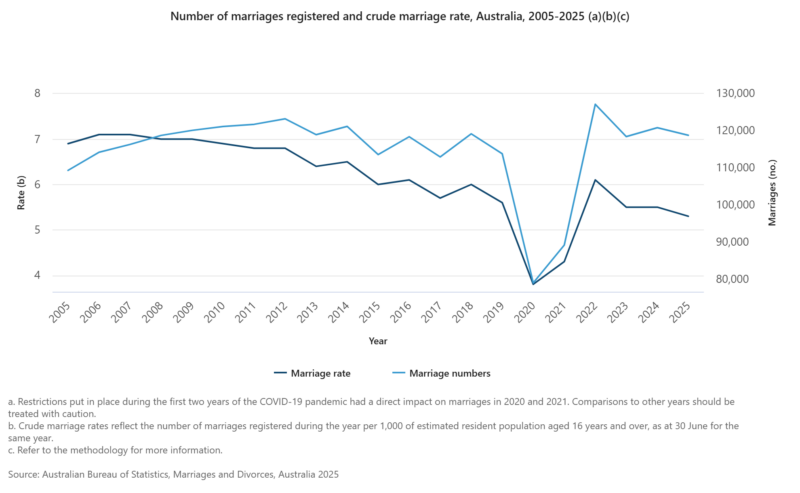
Now this isn't a sudden shift - marriage rates have been trending lower for decades.
Fifty years ago Australians married at more than twice today's rate, reflecting profound changes in education, career paths, financial independence and social attitudes.
Today's Australians typically spend longer studying, establish their careers later, travel more, and often live together for years before deciding whether marriage is right for them.
The median age at marriage has continued to rise, reaching 32.7 years for men and 31.2 years for women.
That may sound like a simple demographic statistic, but it actually reflects an important economic reality - people are increasingly waiting until they feel financially secure before making a lifelong commitment.
Unfortunately, financial security is becoming harder to achieve these days. Housing affordability remains stretched, childcare costs continue to climb, and many younger Australians feel they need to establish themselves professionally before taking the next step.

Note: Marriage hasn't become less important - it's simply happening later.
Weddings still matter
Despite declining marriage rates, Australians clearly still value the institution of marriage.
According to ABS data, the most popular wedding day in 2025 was Saturday 25 October, when more than 2,000 couples chose to marry.
Spring remained Australia's favourite wedding season, continuing a pattern that has persisted for years.
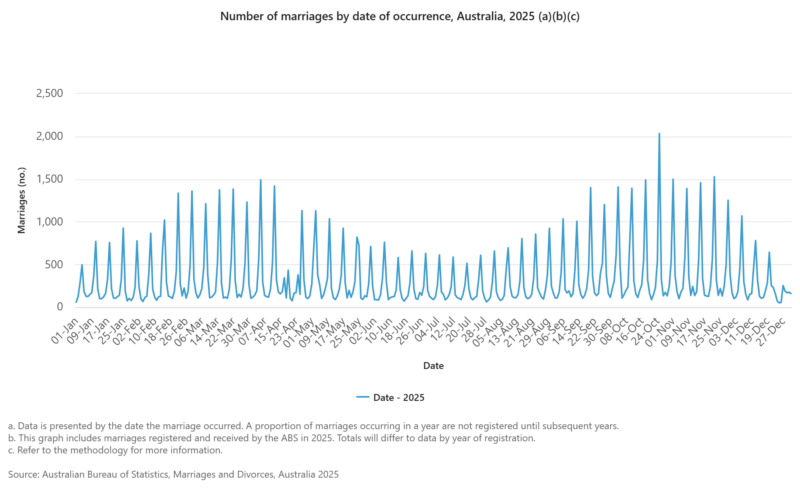
Interestingly, one record still stands: the most popular wedding date in the past two decades remains 10 November 2012, when more than 3,000 couples tied the knot.
These quirky statistics might seem trivial, but they highlight something important - marriage remains a milestone Australians want to celebrate.
What has changed isn't the desire for commitment; it's the pathway people take before getting there.
Same-sex marriage has become part of the social fabric
One of the more interesting findings is how quickly Australia's marriage landscape has normalised following the legalisation of same-sex marriage.
Around 3.9% of all marriages in 2025 were between same-sex couples or included a non-binary partner, almost identical to recent years.
The stability of that figure suggests the initial surge following legalisation has settled into a consistent pattern and rather than representing a social trend still finding its feet, it has simply become another part of Australian family life.
Divorce numbers deserve a little more context
At first glance, the divorce figures appear less encouraging.
Divorces increased by just over 4% during 2025, taking the divorce rate to 2.2 per 1,000 adults.
- Also read:Migration Is Falling: What Happens to Australian Property Prices Now? | Property Insiders

- Also read:This week’s Australian Property Market Update – Latest Data, State by State September 22nd 2026

- Also read:National Weekly Auction Report – September 19th 2026 | Clearance Rates Ease as Auctions Surge

- Also read:Adelaide housing market update | September 2026

- Also read:National Vacancy Rate Steady at 1.3% | SQM Research

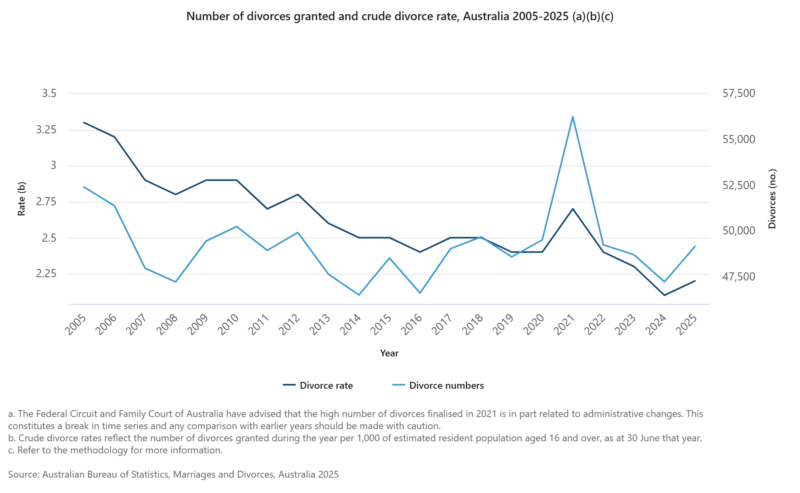
However, context matters...
Note: Even with this increase, Australia's long-term divorce rate remains well below where it was two decades ago, when it stood at 3.3 divorces per 1,000 adults.
In other words, while there has been a modest rebound over the past year, the longer-term trend remains one of greater relationship stability.
That's an important distinction because headlines often focus on annual movements while missing the broader picture.
Couples are staying together longer
Perhaps the most revealing statistic isn't the divorce rate at all - it's the length of marriages.
The median time from marriage to separation has increased to 9.4 years, continuing a gradual upward trend over recent decades.
This suggests Australians are working harder to make relationships succeed.
Marriage today tends to be entered more deliberately than in previous generations. Many couples have already lived together, shared finances, bought property and even had children before exchanging vows.
In many ways, marriage has become less of a starting point and more of a confirmation that a relationship has already proved itself and that naturally leads to greater stability.
The housing market may also be influencing relationship decisions
There's another factor that's difficult to ignore - leaving a relationship has become extraordinarily expensive.
For many Australians, separating no longer simply means emotional upheaval.
It often means finding another home in one of the world's least affordable housing markets, taking on a second mortgage or rental payment, dividing assets and facing significant legal costs.
Demographer Simon Kuestenmacher has suggested that today's high housing costs may be one reason couples stay together longer, while Relationships Australia notes that couples increasingly seek counselling and support before ending their marriages.
I'm certainly not suggesting financial pressure is keeping unhappy couples together. Relationships are always complex, but it's hard to ignore how economic realities increasingly shape personal decisions.
We've seen similar trends influence fertility rates, household formation and even migration. Relationships don't exist in isolation from the economy.
Why relationship trends matter for property investors
You may wonder what marriage and divorce statistics have to do with property investment.
In reality, they reveal some of the most powerful forces shaping long-term housing demand.
People don't buy bigger homes simply because interest rates fall or the economy improves - they buy them because they reach important life milestones such as forming relationships, having children, or needing more space.
Likewise, when relationships end, one household often becomes two, creating additional demand for housing.
The latest ABS figures suggest Australians aren't turning away from commitment; they're approaching it differently. They're marrying later, spending more time building careers and financial security, and often living together long before they marry.
As a result, marriage has become less of a starting point and more of a confirmation that a relationship has already stood the test of time.
These evolving relationship patterns influence when people enter the housing market, the types of homes they need, and how demand changes over time.
That's why successful property investors pay close attention to demographic trends rather than becoming distracted by short-term market noise.
Interest rates and sentiment may influence prices in the short term, but changes in how Australians live, work, and form families shape housing demand for decades.