

Key takeaways
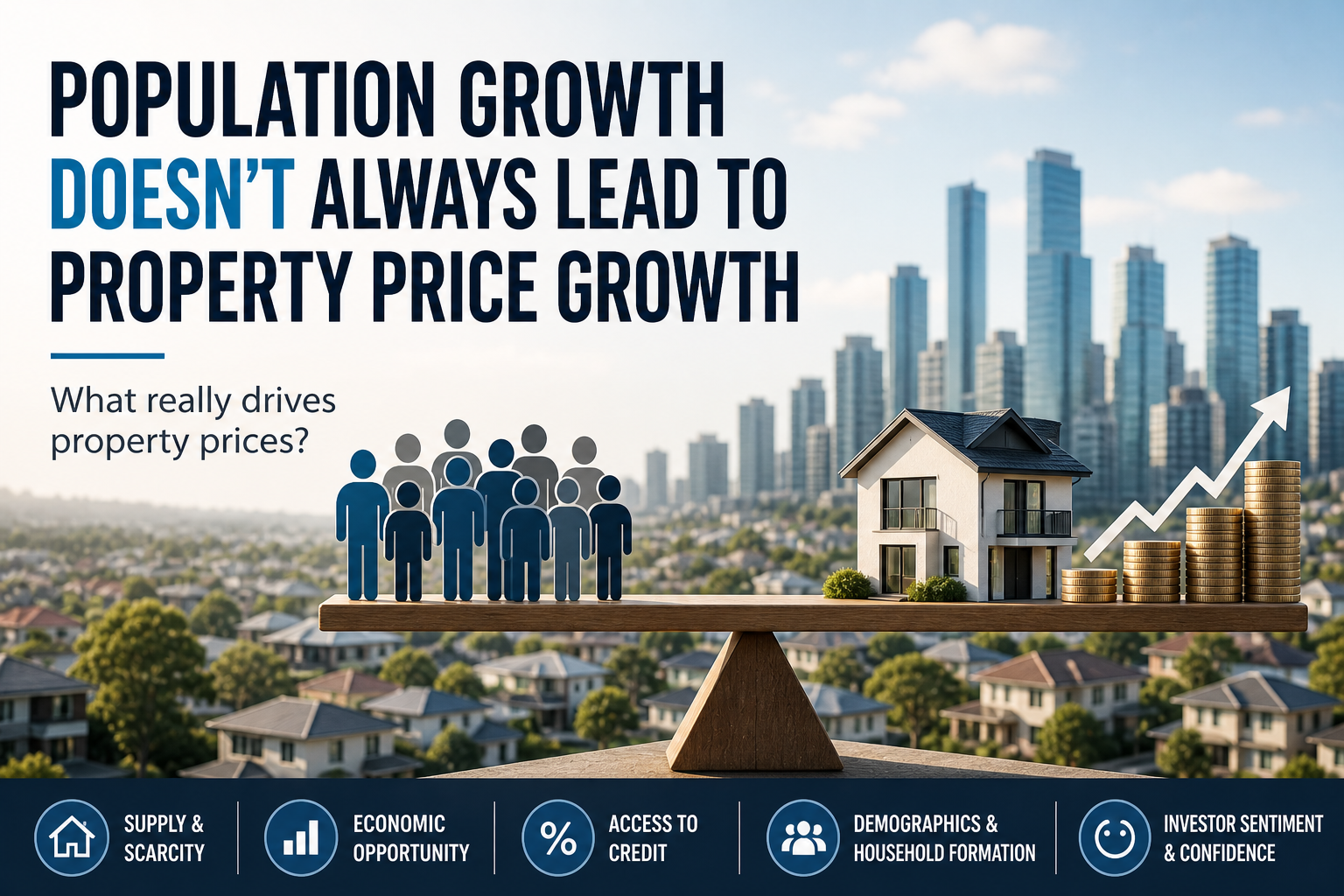
Population growth and property price growth are not directly linked in a simple cause-and-effect way
Strong population growth often boosts rental demand first, not necessarily property prices
The type of population growth matters - migrants, students, and transient workers influence markets differently
Where people settle is more important than how many people arrive
Areas with abundant new housing supply can absorb population growth without significant price increases
Some high population growth regions have delivered weak capital growth due to oversupply or lower-income demographics
Conversely, many high-performing property markets have experienced only modest population growth
Property prices are more strongly driven by borrowing capacity, interest rates, and access to credit
Scarcity of well-located, desirable properties is a critical driver of long-term capital growth
Economic fundamentals such as jobs, income growth, and infrastructure have a greater impact than population numbers alone
Changes in household formation can increase housing demand even without strong population growth
Investor sentiment and confidence can move markets independently of population trends
Rapid population growth can sometimes trigger increased development, which reduces scarcity and limits price growth
Population growth should be viewed as a supporting factor, not a primary investment driver
Successful investors focus on quality locations, strong owner-occupier appeal, and supply constraints rather than chasing population “hotspots”
There’s a widely accepted belief among property investors that strong population growth automatically leads to rising property prices.
It sounds logical, and at a surface level it makes sense, but once you dig a little deeper the relationship becomes far less reliable than most people assume.
In fact, some of Australia’s best-performing property markets have had relatively modest population growth, while other high-growth population centres have delivered very ordinary capital growth.
So let’s look at what’s really going on here.
The myth: more people = higher prices
There’s no doubt that population growth plays a role in housing demand.
More people need more homes, and at the national level, there has historically been a correlation between population growth and rising property values.
I have read one estimate that suggests a 1% increase in population has been associated with an 8% rise in property prices nationally over time.
But that’s where many investors make a mistake. They assume that correlation equals causation, and more importantly, that it applies evenly across all markets.
It doesn’t.
Population growth is uneven and so is housing demand
Not all population growth creates the same type of demand.
Australia’s recent population surge has been driven largely by overseas migration, and most new arrivals initially rent rather than buy.
That means the immediate impact is often felt in rental markets rather than property prices.
Of course, it also matters where that population settles.
If population growth is concentrated in areas with ample new housing supply, prices may barely move because supply keeps pace with demand.
On the other hand, areas with limited supply, strong employment hubs and lifestyle appeal can see prices surge even without strong population growth.
The evidence doesn’t support a simple link
When you look at real-world data, the relationship between population growth and property price growth becomes even less convincing.
Sydney is a good example.
Over the past couple of decade Sydney has delivered some of the strongest capital growth in Australia, yet its population growth rate has not been among the highest.
Meanwhile, places like Mandurah in Western Australia experienced rapid population growth but relatively little price growth.
There are also lifestyle markets like Byron Bay and Noosa, where population growth has been modest, but property values have soared due to desirability, scarcity and wealth-driven demand.
Even during COVID, when Australia’s population growth slowed dramatically due to closed borders, property prices didn’t fall. They actually surged, largely because of record-low interest rates and increased borrowing capacity.
That alone should make investors pause before relying on population growth as a leading indicator.
What really drives property prices
If population growth isn’t the key driver, then what is?
In reality, property prices are influenced by a combination of factors, and some of them are far more powerful than population trends.
1. Supply and scarcity
Prices rise when there’s a shortage of desirable properties, not just a shortage of properties in general.
That’s why well-located inner and middle-ring suburbs consistently outperform.
Even today, Australia is facing a structural housing shortage, with new construction falling short of demand targets, but again, that shortage is not evenly distributed.
2. Access to credit
Borrowing capacity is one of the biggest drivers of property prices.
When interest rates fall, buyers can borrow more, pushing up prices.
We saw this clearly during the COVID boom when prices surged despite minimal population growth.
- Also read:Melbourne housing market update | October 2026

- Also read:Australian housing market update | October 2026

- Also read:Latest Property Price Forecasts. Australian Property Market Outlook 2026-2027: Navigating a Market Correction

- Also read:Brisbane Property Market Forecast [2026 & Beyond] – What The Olympics Decade Means for Investors.
- Also read:Melbourne property market forecast for 2026 & 2027 | Separating the fundamentals from the sentiment
3. Economic opportunity
People follow jobs and income growth.
Areas with strong employment prospects and higher wages tend to outperform, regardless of population growth rates.
4. Demographics and household formation
It’s not just how many people there are, but how they live.
Changes in household size, more single-person households, and lifestyle preferences can increase housing demand even without significant population growth.
5. Investor sentiment and confidence
Markets move when buyers are willing and able to pay more.
Right now, for example, we’re seeing a “multi-speed” market where some cities are rising while others are flat or falling despite ongoing population growth.
A more useful way to think about population growth
Rather than seeing population growth as a direct driver of price growth, it’s better to think of it as a background factor.
It creates underlying demand, but it doesn’t determine where that demand translates into higher prices.
As I said, what matters more is how population growth interacts with:
- local supply constraints
- economic conditions
- infrastructure and amenity
- the type of housing available
Population growth can amplify price growth, but only when these other factors are aligned.
What this means for property investors
Now, this is where many investors get caught out.
They chase “hotspots” based on population growth statistics, assuming that more people will automatically push up prices.
But that’s often how you end up in markets with plenty of new supply, limited scarcity, lower-income demographics meaning weaker long-term growth prospects
Instead, experienced investors focus on areas where demand consistently outstrips supply, particularly in established gentrifying suburbs with strong owner-occupier appeal.
That’s where long-term capital growth tends to come from.
Here’s a contrarian thought
If anything, rapid population growth can sometimes be a warning sign.
It often leads to increased development, which can dilute scarcity and cap price growth.
In contrast, tightly held, supply-constrained areas with modest population growth can deliver stronger long-term performance.
Of course, that’s not the narrative you hear in the media, but it’s what the data repeatedly shows.
The bottom line
Population growth is an important part of the property story, but it should never be the whole story.
Smart investors understand that successful property investment is not about chasing the latest population hotspot or following a single data point that looks impressive on a chart.
It’s about understanding how population growth interacts with supply, scarcity, local incomes, employment opportunities, infrastructure, demographics, household formation, lending conditions, and buyer demand.
That’s why some high-growth areas disappoint investors, while some tightly held, established locations with modest population growth quietly outperform over the long term.
At Metropole, we don’t believe in guesswork, hotspots, or one-size-fits-all property advice.
We help clients formulate a personalised Strategic Property Plan that takes all these factors into account, so they can make confident, evidence-based decisions and build a portfolio designed to create, protect, and pass on wealth.
So before you buy your next investment property, make sure you have a plan.
Click here now and organise to have a wealth discovery chat with one of Metropole’s wealth strategists and let us help you build a property strategy that fits your financial position, your goals, your risk profile, and the realities of today’s property markets.
We're much more than another buyer's agent. We help our clients safely grow, protect, and pass on their wealth through strategic property advice.
Sure, property is the vehicle, but strategy is the driver.