

Key takeaways
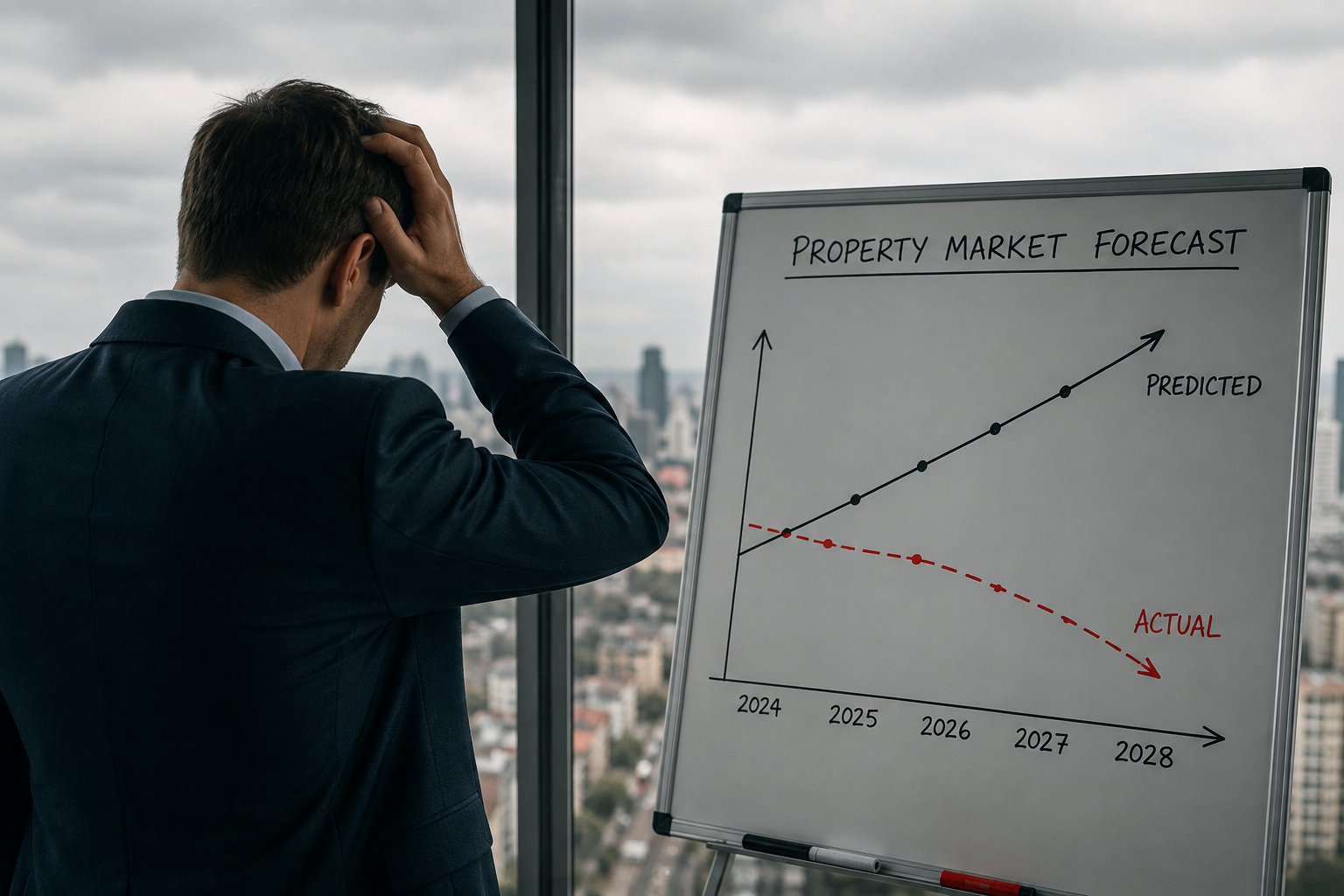
Economic and property forecasts are useful scenarios rather than promises about the future.
Australia contains many property markets, so national and city-wide predictions may have little relevance to an individual property.
Dramatic boom and crash forecasts attract attention, but rarely provide a reliable investment strategy.
Investors should focus on property fundamentals, asset selection, financial buffers and their ability to hold for the long term.
A resilient investment strategy should remain workable under several different economic and property-market outcomes.
Expert opinions are most valuable when they provide context and reduce poor decisions, rather than offering false certainty.
Every year, property investors are presented with a fresh collection of forecasts telling them where interest rates, house prices, rents and the economy are heading.
Some forecasts will be broadly right, many will miss the mark, and almost none will accurately predict the unexpected events that ultimately shape the market.
Yet investors continue to search for certainty because buying property involves a substantial amount of money, significant debt and a long-term commitment.
Obviously a forecast can make an uncertain decision feel more comfortable, but that comfort can become dangerous when an investor treats someone’s opinion about the future as if it were a fact.
That is the central message in a recent Oliver’s Insights report by AMP Chief Economist Dr Shane Oliver, and it has important implications for anyone investing in property.
Why forecasting is so difficult
Dr Oliver explains that economic and investment forecasts can be useful for communicating a view, preparing budgets and establishing a base case against which risks can be considered. However, he warns that “relying too much on precise forecasts can be dangerous.”
Economic forecasts are conditional on what is known at the time they are made, and the assumptions behind them can quickly become outdated when interest rates, government policies, geopolitical conditions or consumer behaviour shift.
Property forecasts face an additional challenge because there is no single Australian property market.
Sydney can, and is, behaving differently from Melbourne, Brisbane or Perth, while houses can outperform apartments and investment-grade suburbs can move in a very different direction from the broader city averages.
Even within the same suburb, two properties purchased at the same time can deliver vastly different results because of their location, land component, scarcity, condition and appeal to affluent owner-occupiers.
This means that a forecast that Australian dwelling values will rise or fall by a certain percentage tells an individual investor surprisingly little about how a particular property will perform.
Forecasters are human too
Dr Oliver points out that forecasters are affected by the same psychological biases as everyone else. They may extrapolate from recent trends, seek evidence that supports their existing views, adjust slowly when circumstances change, and become overly confident in their ability to predict what comes next.
Property commentators are particularly susceptible to extrapolation.
When prices have risen strongly for several years, predictions of continued growth become more common. When values fall, the media quickly fills with forecasts suggesting the decline will continue or accelerate.
However, property cycles rarely move in straight lines because the factors affecting them are constantly changing.
Interest rates influence borrowing capacity, while migration affects housing demand. Construction costs and planning restrictions shape future supply, while employment, wages, credit availability and consumer confidence influence what buyers can pay.
Government intervention adds another layer of uncertainty. Changes to taxes, lending rules, first-home buyer incentives, foreign investment restrictions, or rental legislation can alter behaviour in ways that are difficult to model in advance.
Precise property forecasts create false confidence
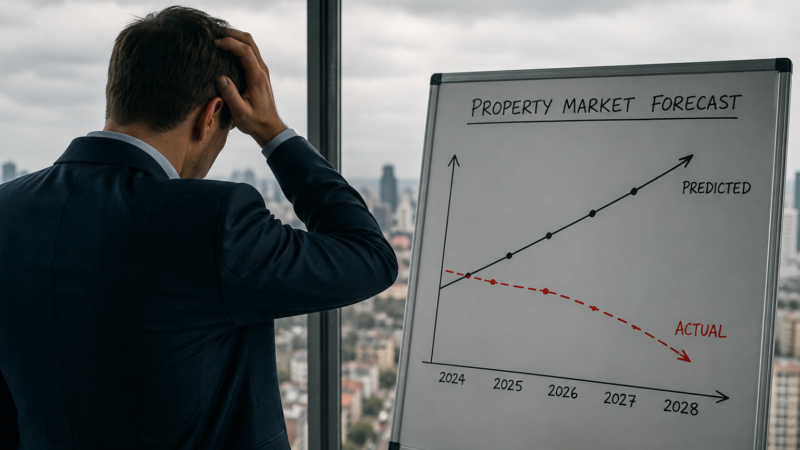
Headlines claiming house prices will rise by 7.3 per cent or fall by 8.2 per cent create an impression of scientific precision.
In reality, these figures usually represent the midpoint of a wide range of possible outcomes.
Dr Oliver argues that most forecasts fail to communicate the risks surrounding them and should be updated as new information becomes available.
This matters because some property investors base major financial decisions on a single prediction. They buy because someone says prices are about to boom, or they stay on the sidelines because another expert warns that a crash is approaching.
Both responses hand too much influence to a forecast.
An investor who waits for every uncertainty to disappear will probably wait forever, while someone who blindly follows an optimistic prediction may pay too much for an inferior asset.
The better approach is to treat forecasts as one input into a wider investment process.
The danger of dramatic crash predictions
Property bears often attract considerable attention because dramatic forecasts generate headlines and appeal to our natural fear of losing money.
As Dr Oliver observes, investors suffer from loss aversion, meaning that a financial loss generally affects us more than an equivalent gain.
This helps explain why warnings of a property crash can sound more intelligent and compelling than a measured discussion about long-term fundamentals.
Australia has experienced recessions, credit restrictions, political upheaval, high inflation, rapidly rising interest rates, and repeated changes to property taxation. Each time commentators predicted that residential property values would suffer a permanent collapse.
There have certainly been downturns, as we are experiencing at present, and there will be more in the future, but our major housing markets have repeatedly recovered and moved to new highs over time.
Some forecasters eventually claim credit when a downturn arrives, even though they may have spent many years predicting it. An investor who followed their advice from the beginning could have missed substantial capital growth, rental income and opportunities to build equity.
Dr Oliver puts this distinction neatly: for investors, the objective is “to make money, not to be right.”
What property investors should focus on instead
Property investors can’t avoid making assumptions about the future. Every purchase carries an implicit forecast that people will continue wanting to live in that location, that household incomes will rise over time and that the property will remain attractive to tenants and future buyers.
The sensible response is to replace reliance on precise predictions with a disciplined, evidence-based strategy.
Start with your financial position, investment timeframe, borrowing capacity and ability to hold the property through periods of higher interest rates or weaker market conditions. By the way, that's what we do when we put together a Strategic Property Plan for our clients at Metropole.
- Also read:Melbourne housing market update | October 2026

- Also read:Australian housing market update | October 2026

- Also read:Latest Property Price Forecasts. Australian Property Market Outlook 2026-2027: Navigating a Market Correction

- Also read:Brisbane Property Market Forecast [2026 & Beyond] – What The Olympics Decade Means for Investors.

- Also read:Melbourne property market forecast for 2026 & 2027 | Separating the fundamentals from the sentiment

Then concentrate on the fundamentals that are likely to remain relevant across multiple property cycles.
These include population and employment growth, household incomes, infrastructure, local land constraints, housing supply, neighbourhood liveability and the depth of future owner-occupier demand.
Of course, asset selection matters enormously. A strategically located property with scarcity, a substantial land component and broad appeal has a better chance of outperforming over the long term than a generic dwelling chosen simply because a suburb appears on a hotspot list.
Cash flow buffers are equally important because an investor who can comfortably hold through the cycle is less likely to be forced to sell during a temporary downturn.
Forecasts should inform your strategy rather than drive it
Dr Oliver recommends that investors minimise their reliance on expert forecasts, invest for the long term and follow a disciplined process.
I believe the same principles apply even more strongly to property because residential real estate has high transaction costs, limited liquidity and long investment horizons.
You cannot cheaply trade in and out of a house every time an economist changes an interest-rate forecast.
A sound property strategy should therefore work across a range of possible futures.
Before purchasing, consider what would happen if interest rates remained higher for longer, prices temporarily declined, rent growth slowed or the property remained vacant for an extended period.
Also consider the upside scenario in which population growth remains strong, housing supply remains constrained and desirable locations continue attracting higher-income households.
This scenario-based approach is more useful than building an investment plan around one precise prediction.
The bottom line
Forecasts can provide context and help investors understand the forces influencing property markets, but they can’t remove uncertainty.
Dr Oliver says the real value of good investment experts is their ability to explain the issues, place events in context and help investors avoid costly mistakes.
That is also how property advice should be used.
Successful investors develop a long-term strategy, purchase investment-grade assets, maintain financial buffers and regularly review their position as circumstances change.
They listen to forecasts, consider the assumptions behind them and remain flexible when the evidence changes.
After all, you don’t need to know exactly what property prices will do next year to build substantial wealth over the next decade. You need a strategy capable of surviving the forecasts that turn out to be wrong.
Your property strategy should outlive the forecasts
One of the most damaging habits in property investment is repeatedly changing direction in response to short-term forecasts.
An investor hears that interest rates may rise and postpones buying. Six months later, a forecast of falling rates draws them back into the market, only for a warning about weaker prices to frighten them away again.
Before long, they have spent years reacting to predictions without making meaningful progress towards their financial goals.
That is why every serious property investor needs a Strategic Property Plan.
Your plan should begin with the future you want to create, including the income you will require, the asset base needed to produce it and the timeframe available to get there.
From there, it should establish what you can afford to invest, how many properties you are likely to need, the type of assets that belong in your portfolio and how you will manage debt, cash flow and risk along the way.
A well-designed plan does not ignore changing economic conditions. It allows you to respond thoughtfully while keeping your long-term objectives in view.
There will always be another interest-rate decision, federal budget, election, property forecast or alarming headline competing for your attention.
Most will have little bearing on the performance of a carefully selected investment-grade property held for a decade or more.
Of course, your strategy should be reviewed regularly as your income, family circumstances, borrowing capacity and goals evolve. However, a short-term forecast alone is rarely a sound reason to abandon a long-term plan.
At Metropole, we help investors build a personalised Strategic Property Plan based on where they are today and where they want to be financially in the future.
We assess your current position, identify the gap between your existing trajectory and your goals, and develop a practical roadmap covering property acquisition, finance, cash flow, risk management and portfolio reviews.
This gives you a framework for making decisions with greater clarity, even when commentators disagree and the outlook remains uncertain.
If you would like to understand what your next property move should be, why not take advantage of a complimentary Wealth Discovery Chat with one of Metropole’s experienced wealth strategists?
We will discuss your goals, review the opportunities and obstacles ahead, and explain how a Strategic Property Plan could help you build, protect and pass on your wealth.
Click here now to book your complimentary Wealth Discovery Chat with a Metropole Wealth Strategist today.