Key takeaways
Rate levels constrain borrowing. Rate changes influence behaviour.
Correlations remain surprisingly weak. Confidence moves before prices.
Stable rates encourage adjustment. Tax changes unsettle investors. Expectations shape housing markets.
Tomorrow, Tuesday 3 November, the Reserve Bank announces its next cash-rate decision.
Four increases this year have taken the target to 4.60%. Another quarter-point increase would make it 4.85%.
The latest inflation figures give the Bank reason to remain uncomfortable. Headline CPI reached 4.3% in September, while underlying inflation was 3.6%.
I expect the annual inflation rate to hover around the high threes, occasionally brushing four, for longer than many anticipate.
Part of that pressure comes from beyond our shores: energy costs, conflict in the Middle East and an increasingly fractured trading world. But domestic capacity constraints, continued government spending and consumer and business inflation expectations also matter.
Once households and businesses expect continuing price rises, those expectations become part of the problem.
My working view is another two quarter-point increase between now and June 2027, potentially including tomorrow. That would take the cash rate to 5.10%, followed by a pause.
I can also envisage one or two cuts in late 2027 or early 2028 if unemployment rises to uncomfortable levels.
The next federal election provides a political backdrop, although we are told that the RBA makes (snigger!) its decisions independently.
What actually moves dwelling prices?
This brings me to a question I have been testing:
Is it the level of interest rates, or the change in those rates, that matters more for Australian dwelling values?
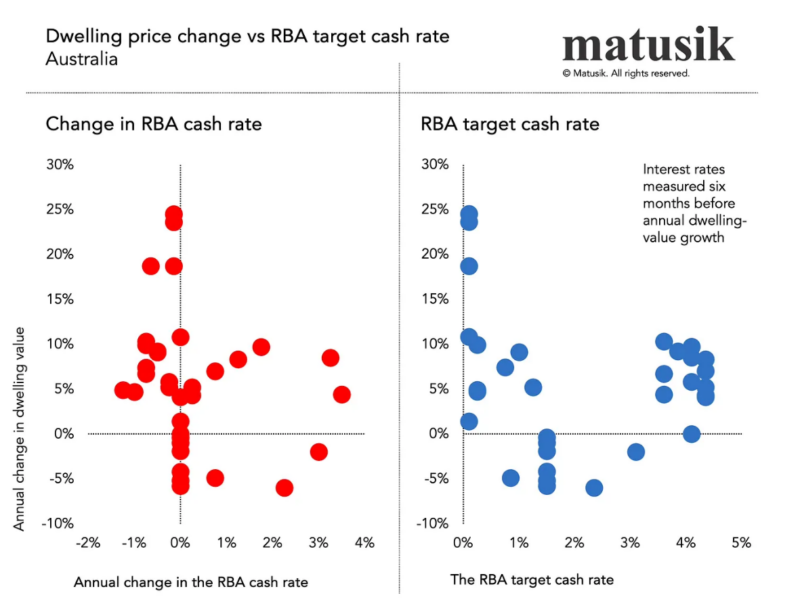
I compared national dwelling-value movements over the decade ending September 2026 with both the cash-rate level and its annual change.
The accompanying charts compare interest rates with annual dwelling-value growth six months later.
The case for change is intuitive.
An interest-rate increase reduces borrowing capacity, resets household budgets and changes buyers’ expectations.
It is the adjustment, rather than simply the interest rate itself, that can prompt people to reconsider purchasing.
Yet the numbers are less decisive.
- Also read:Latest Property Price Forecasts. Australian Property Market Outlook 2026-2027: Navigating a Market Correction

- Also read:Home Prices Continue to Steady Over October | Latest Property Market Stats

- Also read:Brisbane Property Market Forecast [2026 & Beyond] – What The Olympics Decade Means for Investors.

- Also read:Melbourne property market forecast for 2026 & 2027 | Separating the fundamentals from the sentiment

- Also read:Sydney property market forecast for 2026 and 2027 | Why the short-term softness is a long-term opportunity

Across 34 comparable quarterly observations, the correlation with subsequent annual dwelling-value growth is approximately −0.22 for annual cash-rate changes, compared with −0.20 for the cash-rate level.
Both relationships are weak. Neither measure adequately explains price movements on its own.
Consider the exceptions.
National dwelling values fell during 2018 while the cash rate remained unchanged at 1.50%.
Conversely, dwelling values grew strongly during parts of 2023 and 2024 despite cash rates above 4%.
More recently, national dwelling values (based on settlements not asking prices) fell 3.7% during the September 2026 quarter, bringing annual growth to zero.
Clearly, interest rates are not working in isolation.
My two bobs worth
The level of interest rates constrains borrowing capacity. But changes in rates influence behaviour.
Buyers can become accustomed to relatively high rates when they are stable. What unsettles them is the prospect of further increases.
And we should not overlook the May 2026 Federal Budget.
The announced changes to negative gearing and capital gains tax have, in my view, spooked the horses, particularly among residential investors.
From July 2027, negative gearing concessions will favour new housing, while the existing 50% capital gains tax discount will be replaced by inflation-based arrangements and a minimum tax, with special treatment for new builds.
Existing property holdings receive transitional protection. However, the prospect of different after-tax returns may already be influencing investment decisions.
Whether these changes ultimately redirect more investment towards new supply remains to be seen.
Housing also responds to employment, wages, migration, credit conditions and confidence.
My concern is that further rate increases, combined with tax changes, could undermine buyer confidence and housing turnover before their full financial effects are felt.

Note: The level of interest rates shapes what buyers can afford. Their direction determines what buyers are prepared to do.