


Key takeaways
Pent-up demand is building. Buyers may be holding back, but population growth and Australia’s housing shortage continue to support underlying demand.
Falling borrowing costs could trigger the slingshot. As confidence and borrowing capacity improve, sidelined buyers could return quickly and push prices higher.
The recovery won’t be uniform. Some suburbs will significantly outperform, making property and location selection more important than ever.
The slingshot effect is about to occur and that it has the potential to deliver strong price growth in many areas where prices are falling right now. This is how it works.
We all know that housing demand increases in line with population growth, but doesn’t translate into price growth during times of uncertainty or confusion.
This is one of those times, when some property buyers are pulling back, leading to price falls even though there’s an underlying shortage of housing.
The longer that potential property buyers hold off, the more that this pent-up demand grows, just like a slingshot being pulled further and further back.
Eventually, of course, the slingshot will be fired, causing a sharp price bounce and booms in locations where prices have been falling.
The slingshot effect has occurred before
A classic example of the slingshot effect in action occurred immediately after the Global Financial Crisis of 2008, when prominent economists publicly predicted that our housing market was about to crash.
Expecting the worst, many potential buyers became concerned and confused, and as buyer demand fell so did housing prices across Australia in 2009.
But, the underlaying demand for housing had not stopped – buyer demand had merely been held back. So, when buyers returned, the slingshot was fired.
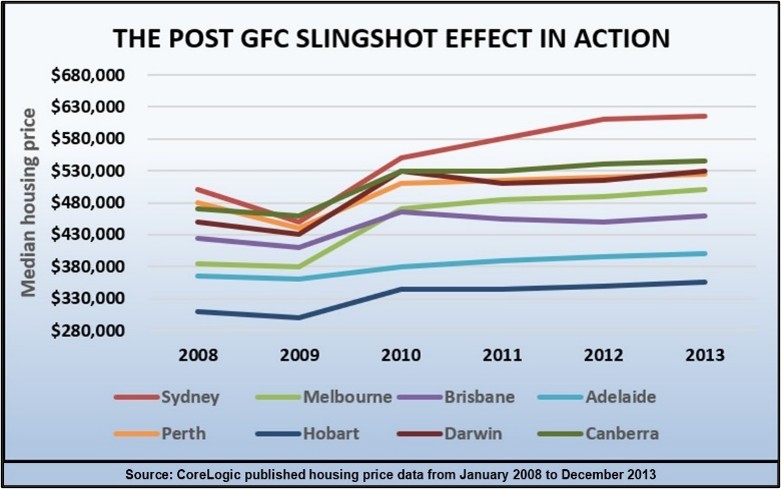
As the graph shows, every capital city experienced strong price growth in the years following 2009, proving the doomsayers completely wrong.
Housing prices in Sydney and Melbourne shot up by over 30% in the years after 2009, and every capital city experienced double digit price growth.
- Also read:Latest Property Price Forecasts. Australian Property Market Outlook 2026-2027: Navigating a Market Correction

- Also read:Brisbane Property Market Forecast [2026 & Beyond] – What The Olympics Decade Means for Investors.
- Also read:Melbourne property market forecast for 2026 & 2027 | Separating the fundamentals from the sentiment
- Also read:Sydney property market forecast for 2026 and 2027 | Why the short-term softness is a long-term opportunity

- Also read:Adelaide housing market update | October 2026

The trigger was a fall in interest rates during late 2008 to early 2009 and the current situation is uncannily like those years, because the underlying demand for housing has not stopped.
In fact the housing shortage is increasing even as the slingshot of pent-up demand is being pulled back further and further.
When interest rates fall, the slingshot is fired and another housing market boom will follow.
The trigger is a real or de-facto fall in interest rates
Even though the RBA hasn’t lowered interest rates, it doesn’t matter, because banks rely heavily on housing finance for income. As the graph shows, housing loan numbers, especially investor loans, are falling.
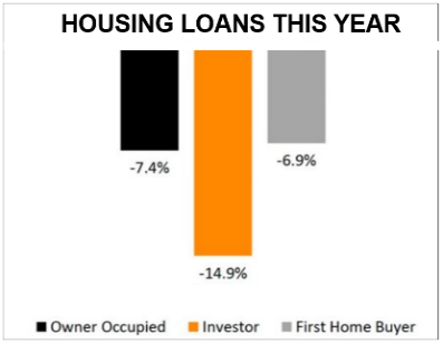
So the banks are now effectively cutting rates with attractive low introductory interest rates and cashback offers to motivate more buyers.
They will do enough to trigger the slingshot, releasing all that pent-up buyer demand into the market. So not only is now the right time to act, it’s also the best time, while buyer demand still remains subdued and bargains abound.
The growth, however, will not be even, with some suburbs booming while prices in others hardly move at all.
That’s why it’s essential to invest in suburbs with strong imminent price growth potential.