

Key takeaways
Domain reports that combined capital city house rents increased by $20 over the June quarter – the strongest annual rise in almost two years.
Sydney recorded the largest quarterly rent increase in four years
Darwin overtook Perth as Australia's second most expensive rental market for houses
Rental market splitting into two speeds, with Sydney, Brisbane, Canberra and Darwin accelerating while growth moderates in Melbourne, Perth, Adelaide and Hobart
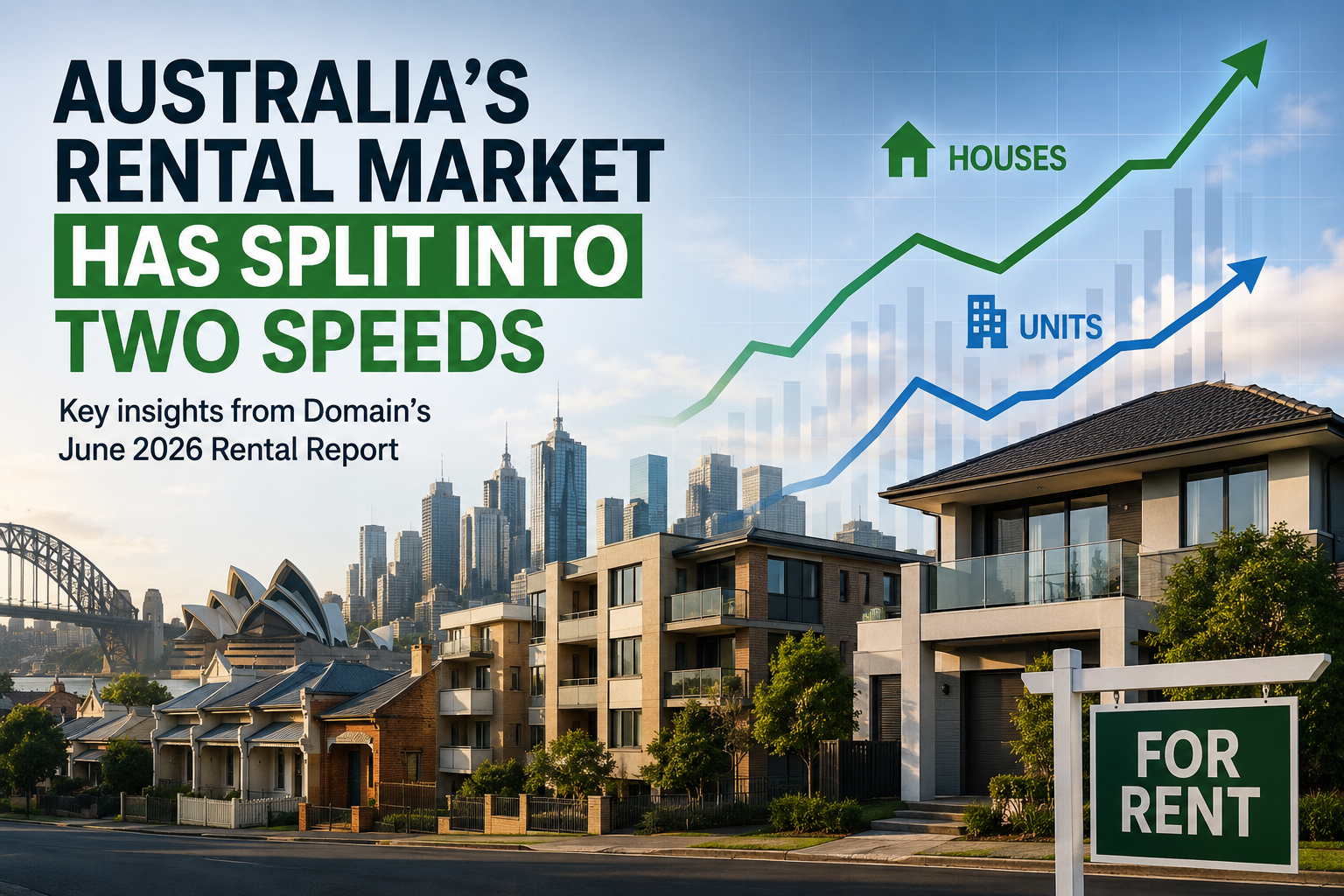
Domain’s June 2026 Rental Report confirms what many tenants, landlords and property managers have been feeling on the ground: Australia’s rental market remains tight, but it is no longer moving in one uniform direction.
According to Domain, combined capital city house rents re-accelerated in the June quarter, rising by $20, while unit rents increased by $5.
Domain described this as a “step-change in pricing behaviour”, with the acceleration strongest in the house market, particularly in Sydney, Brisbane, Canberra and Darwin.
In fact, Domain says the rental market is now “splitting into two speeds - the rental crisis has not disappeared, but affordability is now becoming a much more important constraint in some cities.
What Domain's report shows
The strongest quarterly rental increases were recorded in Darwin and Sydney, while Melbourne, Adelaide, Perth and Canberra showed much more subdued momentum in their unit markets.
Capital city weekly rents and quarterly changes - June 2026
| Capital city | House rent | House QoQ change | Unit rent | Unit QoQ change | Vacancy rate |
|---|---|---|---|---|---|
| Sydney | $850 | 6.3% | $780 | 4.0% | 1.1% |
| Melbourne | $600 | 0.8% | $600 | 0.0% | 1.2% |
| Brisbane | $700 | 2.9% | $660 | 0.0% | 0.6% |
| Adelaide | $650 | 1.6% | $550 | 0.0% | 0.4% |
| Canberra | $710 | 1.4% | $580 | 0.0% | 1.2% |
| Perth | $750 | 0.4% | $700 | 0.7% | 0.5% |
| Hobart | $625 | 0.8% | $520 | 4.0% | 0.4% |
| Darwin | $760 | 5.6% | $650 | 8.3% | 0.1% |
Source: Domain June 2026 Rental Report.
Sydney remains the most expensive capital city rental market, with house rents reaching a record $850 a week after jumping 6.3% over the quarter, while unit rents rose 4.0% to a record $780 a week.
Domain noted that Sydney’s vacancy rate was 1.1% in June, which remained a record low for this time of year despite a seasonal lift.
Darwin produced the most striking numbers in the report. House rents rose 5.6% to $760 a week, while unit rents surged 8.3% to $650 a week, with Domain reporting Darwin’s vacancy rate at a record-low 0.1%.
Fastest quarterly rent increases - June quarter 2026
| Ranking | Market | Quarterly change | Weekly rent |
|---|---|---|---|
| 1 | Darwin units | 8.3% | $650 |
| 2 | Sydney houses | 6.3% | $850 |
| 3 | Darwin houses | 5.6% | $760 |
| 4 | Sydney units | 4.0% | $780 |
| 5 | Hobart units | 4.0% | $520 |
| 6 | Brisbane houses | 2.9% | $700 |
Source: Domain June 2026 Rental Report.
Clearly the rental market is still undersupplied, but the pace of rental growth is now being shaped by local affordability, local wages, local investor activity and the type of property being offered.
Houses are doing the heavy lifting
One of the most important findings in Domain’s report is that the recent rental acceleration has been concentrated in houses.
And that makes sense - family-friendly houses in well-located suburbs are difficult to replace, especially in established middle-ring and inner-ring locations where new supply is limited.
Sydney’s house rents rose by $50 in the June quarter alone, while Brisbane house rents increased by $20 to a record $700 a week.
Canberra house rents also reached a record $710 a week, and Darwin house rents hit $760 a week.
This supports one of our long held views at Metropole: investment-grade family homes, townhouses and villa units in the right suburbs tend to have a scarcity value that becomes more obvious over time.
Of course, this does not mean investors should chase any house in any location. It means the right type of property in the right location is becoming even more important as tenants become more selective and affordability bites.
Melbourne tells a different story
Melbourne is the standout example of a market where tight vacancies have not translated into strong rental growth.
Domain reports Melbourne house rents rose just 0.8% over the June quarter to $600 a week, while unit rents were flat at $600 a week.
Annual growth for houses was only 1.7%, while unit annual growth was 4.3%, a 4.5-year low.
At first glance, that may look disappointing for investors.
My view is a little different - Melbourne has been weighed down by policy changes, higher holding costs and investor caution, but those same conditions have also discouraged the supply of rental properties.
In time, that usually creates the conditions for a rebound, particularly in established suburbs where new supply remains constrained.

Tip: Melbourne may not be the rental growth leader today, but smart investors should not confuse current sentiment with long-term fundamentals.
Brisbane is still tight, but tenants are pushing back in units
Brisbane house rents rose 2.9% over the quarter to a record $700 a week, with annual growth strengthening to 7.7%.
Domain reported Brisbane’s vacancy rate at just 0.6%, matching 2022 as the lowest June result on record.
However, Brisbane unit rents were unchanged at $660 a week after six consecutive quarters of growth.
That suggests the market is still tight, but tenants are reaching the limit of what they can afford in some segments.
This is an important warning for investors. Strong population growth and tight vacancy rates are powerful tailwinds, but they do not give landlords unlimited pricing power.
Perth may be closer to its affordability ceiling
Perth has been one of Australia’s strongest property markets over recent years, and its rental market is still extremely tight.
Domain reports Perth house rents at $750 a week and unit rents at $700 a week, with annual growth still elevated at 7.1% for houses and 7.7% for units.
- Also read:Melbourne housing market update | October 2026

- Also read:Australian housing market update | October 2026

- Also read:Latest Property Price Forecasts. Australian Property Market Outlook 2026-2027: Navigating a Market Correction

- Also read:Brisbane Property Market Forecast [2026 & Beyond] – What The Olympics Decade Means for Investors.
- Also read:Melbourne property market forecast for 2026 & 2027 | Separating the fundamentals from the sentiment
But the quarterly numbers tell a more cautious story. House rents rose just 0.4% over the June quarter, while unit rents increased by only 0.7%.
Domain also noted that the increase in rental stock is easing some of the pressure on the market.
In my mind, Perth remains a strong market, but investors should be careful about simply extrapolating the past few years into the future.
The best investment decisions are made before the crowd arrives, not after the easy gains have already been priced in.
Adelaide remains tight, but momentum is slowing
Adelaide’s rental market is still very tight, with Domain reporting a 0.4% vacancy rate in June.
House rents rose 1.6% to a record $650 a week, while unit rents held steady at $550 a week. Domain also noted that unit rental growth has slowed to its weakest pace in just over four years.
Adelaide has been a terrific market for many investors, but value is now harder to find.
That does not mean the market has run its race, but investors need to be more selective and avoid buying secondary assets just because the broader city has performed well.
Darwin is the headline act, but it is not for everyone
Darwin’s figures are extraordinary. House rents rose 11.8% over the year, while unit rents rose 18.2%, and the vacancy rate tightened to just 0.1%.
That will attract attention, and rightly so, however Darwin is a small, cyclical and more volatile market. It can deliver strong rental yields and rapid rental growth at certain points in the cycle, but it does not have the same depth, diversity or long-term economic resilience as our larger capital cities.
For experienced investors, Darwin may have a role in a portfolio at the right time and at the right price. For most investors, I would be cautious about letting one strong quarter dictate a long-term wealth creation strategy.
Vacancy rates remain exceptionally tight
Chart 3: Capital city vacancy rates - June 2026
| Capital city | Vacancy rate |
|---|---|
| Darwin | 0.1% |
| Adelaide | 0.4% |
| Hobart | 0.4% |
| Perth | 0.5% |
| Brisbane | 0.6% |
| Sydney | 1.1% |
| Melbourne | 1.2% |
| Canberra | 1.2% |
Source: Domain June 2026 Rental Report.
The vacancy figures show why tenants remain under pressure.
A balanced rental market is generally considered to have a vacancy rate closer to 3%, and every capital city in Domain’s June report was well below that level.
However, the report also shows that tight vacancy rates alone do not guarantee strong rental growth.
Melbourne and Canberra both recorded vacancy rates of 1.2%, yet unit rents were flat in both cities. Adelaide’s vacancy rate was only 0.4%, but unit rents were also unchanged over the quarter.
That tells us affordability is now doing more of the heavy lifting in the rental market.
What this means for property investors
The obvious conclusion is that rents are rising because Australia still does not have enough rental accommodation.
But the more useful conclusion is that rental growth is becoming more uneven.

Note: Investors should not assume that every market, every suburb and every property type will benefit equally from the shortage. In the next stage of the cycle, quality will matter more.
Well-located houses, townhouses and family-friendly apartments in desirable suburbs are likely to remain in demand, especially where tenants have good incomes and limited alternatives.
Secondary apartments, poorly located new stock and properties in suburbs with weaker wage growth may face more resistance, even in cities where vacancy rates remain low.
There is also a policy lesson here.
Domain suggested that as greater clarity emerged around proposed housing investment policy changes in April and May, landlords moved quickly to lift asking rents where market conditions allowed.
That is exactly why governments need to be careful when they change the rules for investors.
Tip: Well-meaning policies can reduce investor confidence, discourage rental supply and eventually make life harder for tenants.
The bottom line
The Domain report confirms that Australia’s rental market remains structurally undersupplied, but the easy generalisations are becoming less useful.
Sydney and Darwin are still pushing rents sharply higher, Brisbane houses remain under pressure, and Perth and Adelaide remain tight but are showing signs of slower momentum.
Melbourne looks subdued today, but that may create opportunities for strategic investors who understand that markets often turn when sentiment is still poor.
For investors, the lesson is clear: do not buy a property simply because rents are rising.
Buy an investment-grade asset in a location where long-term demand is likely to keep rising, supply is difficult to add, and tenants have the income to pay for quality accommodation.
That is how you turn a rental market shortage into a long-term wealth creation opportunity.