
Key takeaways
NAB expects combined capital-city dwelling values to fall around 7% from peak to trough.
Sydney and Melbourne are expected to experience the largest declines.
Falling prices alone will not make housing genuinely affordable because higher interest rates have reduced borrowing capacity.
Australia remains structurally undersupplied with housing, and repairing the shortage could take a generation.
Rising construction costs, labour shortages and squeezed developer margins will make increasing supply difficult.
Short-term price forecasts should never replace a long-term investment strategy.
Australian property prices are falling, economists are revising their forecasts, and buyers are understandably wondering how much further the market could decline.
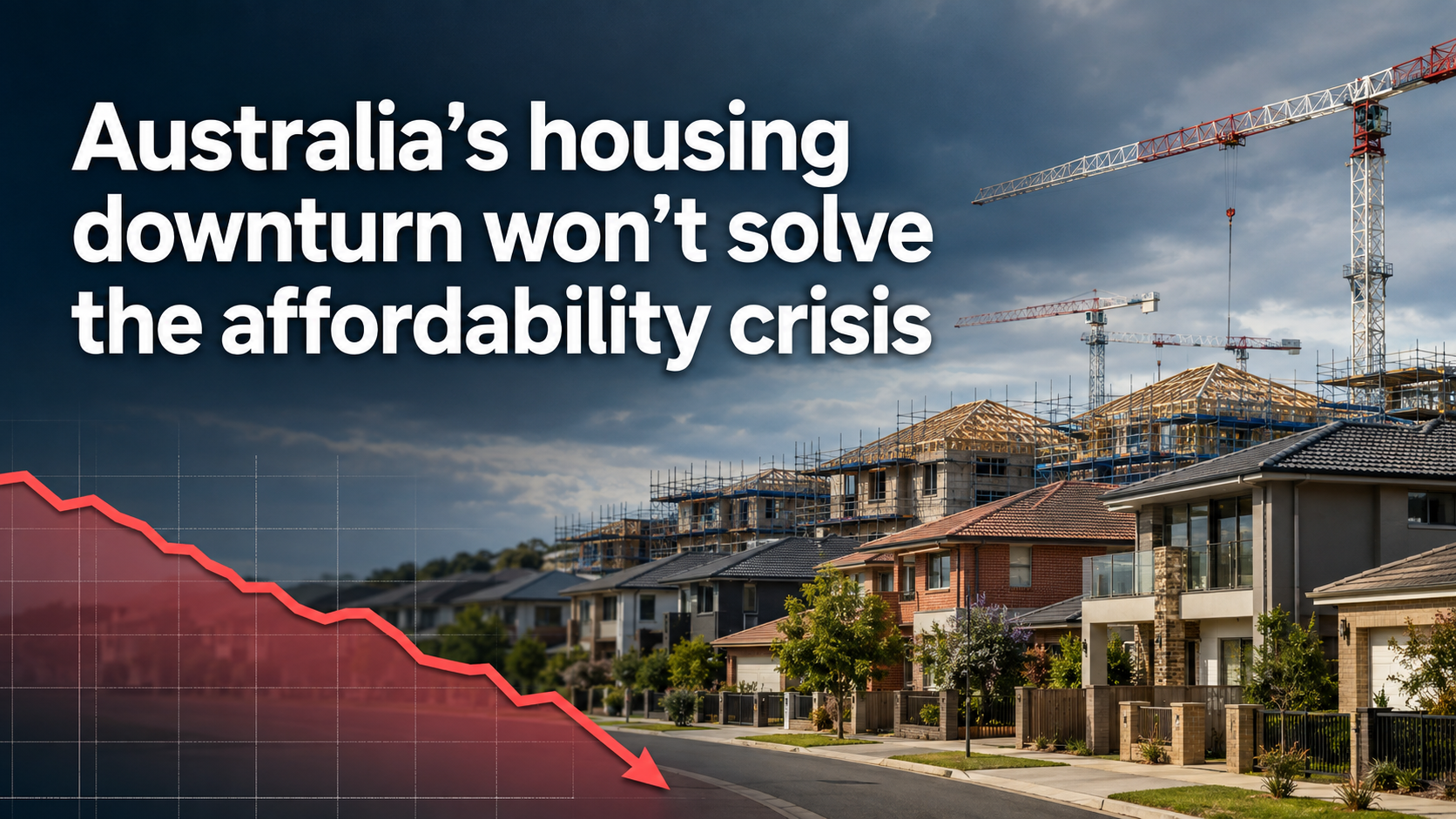
Yet even a reasonably significant fall in property values would do surprisingly little to solve Australia’s housing affordability problem.
That was the clear message delivered to the Senate Select Committee on Intergenerational Housing Inequity by some of Australia’s most respected economists.
How far could property prices fall?
NAB chief economist Dr Sally Auld expects dwelling prices across the combined capital cities to decline by around 7% from peak to trough, including a fall of approximately 5% during 2026.
NAB’s latest Housing Monitor forecasts declines of about 10% this year in Sydney and Melbourne, with falls of between 2% and 4% across the mid-sized capital cities.
Of course, those are aggregate figures, and there is no single Australian property market.
Some suburbs, price points and property types will perform much better than others, while properties in areas with weak demand or an oversupply of similar stock could fall considerably further.
Dr Auld told the Senate inquiry:
“While some will welcome the drop in prices, this will not solve Australia’s housing affordability issues.”
And I believe that she is right. A 5% or even 10% fall in property prices doesn’t necessarily make homes more affordable when mortgage rates are higher and banks are reducing how much borrowers can access.
Many buyers could find themselves paying less for a property while still facing similar or even higher monthly mortgage repayments.
Economists have been revising their forecasts
It is worth remembering how quickly housing forecasts can change.
Earlier this year, ANZ economists Madeline Dunk and Adam Boyton predicted capital-city housing prices would rise by 2.8% in 2026 and another 2.1% in 2027.
At the time, they expected small falls in Sydney and Melbourne to be offset by continued growth in some of the smaller capital cities.
Commonwealth Bank senior economists Trent Saunders and Ashwin Clarke subsequently downgraded their national forecast several times, eventually expecting dwelling prices to remain flat over 2026. They said:
“The tax changes have accelerated a slowdown that was already underway.”
CBA still expects property prices to stabilise and begin recovering in 2027 as lower values, improved rental yields and an eventual easing in borrowing constraints attract buyers back into the market.
Meanwhile, Westpac’s head of Australian macro-forecasting, Matthew Hassan, recently warned that the correction was deepening.
He noted that national dwelling values fell 0.9% in August and were 3.6% below their March peak, while 93% of capital-city suburbs had recorded price declines.
These changing forecasts show why I have always preferred to work with expectations rather than rely on precise predictions.
Forecasts create a false sense of accuracy because property markets are influenced by interest rates, credit availability, consumer confidence, government policy and unexpected economic events.
Why affordability will take a generation to repair
Dr Auld believes meaningful improvements in affordability will require a sustained increase in housing supply over a very long period.
She warned:
“This is a challenge that is likely to take the better part of a generation to resolve.”
Australia’s housing shortage has been building for decades and can’t be repaired with a few planning announcements or first-home buyer incentives.
- Also read:Melbourne housing market update | October 2026

- Also read:Australian housing market update | October 2026

- Also read:Latest Property Price Forecasts. Australian Property Market Outlook 2026-2027: Navigating a Market Correction

- Also read:Brisbane Property Market Forecast [2026 & Beyond] – What The Olympics Decade Means for Investors.
- Also read:Melbourne property market forecast for 2026 & 2027 | Separating the fundamentals from the sentiment

Dr Luci Ellis, Westpac’s chief economist and a former Reserve Bank assistant governor, explained that today’s high price-to-income ratios are partly the result of several long-term economic changes.
Lower inflation from the 1990s onwards produced lower average interest rates, while financial deregulation allowed households to borrow larger amounts relative to their incomes.
According to Dr Ellis:
“A lot of the increase in house prices to household income has been a multi-decade consequence of lower inflation and financial deregulation.”
Strong population growth then put additional pressure on a housing system already struggling to deliver enough homes.
Dr Ellis acknowledged that Australia benefits from skilled migration, but said it makes it harder to house the population when “systematic issues” prevent sufficient construction.
Approvals don’t guarantee new homes
Politicians often point to the number of projects being approved, but an approval doesn’t provide anyone with a home.
Many developments remain unbuilt because they are financially unviable. Developers are dealing with higher funding costs, expensive materials, shortages of skilled labour, slow planning processes and the cost of providing infrastructure.
Construction productivity has also deteriorated significantly. The Productivity Commission estimates that the industry now produces around 50% fewer dwellings for each hour worked than it did in the mid-1990s.
At the same time, established property prices are falling, reducing the likely sales revenue from new projects.
As Dr Auld explained, developers’ margins are being squeezed and this could create a difficult cycle.
Policies that reduce property prices or discourage investors may provide some short-term political appeal, but they can also make new housing less viable and reduce the future supply of rental accommodation.
What does this mean for property investors?
Further price falls are likely, particularly if interest rates remain higher for longer, unemployment rises, or confidence deteriorates.
However, Australia’s structural housing shortage remains unresolved, rents are still rising, population growth continues and many new developments simply do not stack up financially.
These forces should provide a floor under the better segments of our property markets and eventually support the next phase of growth.
Experienced investors should use the current downturn to become more selective rather than trying to pick the exact bottom of the market.
This is the stage of the cycle when well-located, investment-grade properties can sometimes be purchased with less competition and stronger negotiating power.
The greatest opportunities will be found in established suburbs with affluent owner-occupiers, limited new supply, good amenities and the type of properties families will want to own for decades.
Economists will continue to revise their forecasts as conditions change. Successful property investment will continue to depend on buying the right asset, in the right location, with an appropriate financial buffer and holding it through several market cycles.
Take advantage of this stage of the property cycle
Market downturns tend to create uncertainty, but they can also present opportunities for investors with secure finances, adequate cash-flow buffers and a long-term perspective.
With fewer buyers competing, properties taking longer to sell and vendors becoming more willing to negotiate, experienced investors may be able to acquire high-quality assets on more favourable terms.
However, this is also a market in which property selection will be critical because some locations and property types will recover much more strongly than others.
If you would like to understand how you could take advantage of this stage of the property cycle, speak with one of the experienced wealth strategists at Metropole and develop a Strategic Property Plan tailored to your goals, finances and risk profile.
Book your complimentary Wealth Discovery Call now by clicking here and take the first step towards building a safer, more resilient property portfolio.