
Key takeaways
Property industry confidence has fallen sharply. National sentiment is now at its lowest level since September 2020.
Property taxes have become the industry’s biggest government concern. Rising taxes and charges are adding to already difficult development costs.
Housing feasibility is becoming increasingly challenging. Higher construction, finance and government costs can delay or prevent new projects.
Uncertainty extends beyond taxation. Developers are also concerned about debt availability, economic growth and proposed trust tax changes.
Australia’s housing targets depend on viable development. Increasing supply will require planning, taxation and investment settings that make new projects financially feasible.
Australia has a housing problem that everyone seems to agree needs fixing.
We need more homes, our population continues to grow, rental markets remain tight, and governments have set ambitious housing targets.
Yet there is an uncomfortable contradiction underneath all this: while governments are asking the property industry to build more, the businesses expected to finance and deliver those homes are becoming increasingly concerned about whether projects still stack up financially.
This concern is showing up in the latest Procore / Property Council Industry Survey, which found national property industry sentiment fell to 85 index points in the September quarter, its lowest level since September 2020.
Confidence in the Federal Government's performance also fell to its lowest level on record.
Of course, this is an industry survey rather than a measure of broader consumer sentiment, but these are also the businesses expected to deliver much of the housing and infrastructure Australia will need in the years ahead.
Property taxes have become the biggest concern
For the first time, tax reform has become the most critical issue the property industry wants the Federal Government to address.
At state level, 42% of respondents nominated property taxes and charges as the critical issue requiring government attention, the highest result recorded by the survey.
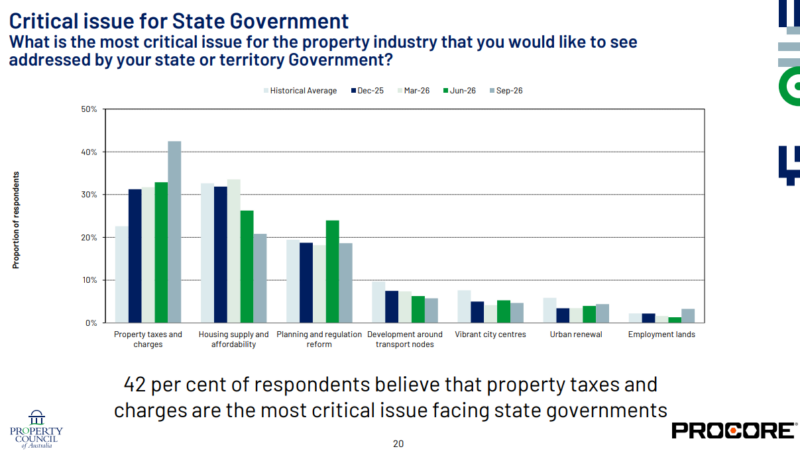
Property Council Chief Executive Mike Zorbas describes the cumulative burden of federal, state and local taxes as a "tax escalator to nowhere", arguing that it is discouraging investment at the same time as capital, material and labour costs are rising.
Whatever your view on the appropriate level of property taxation, there is an important economic issue here because property development ultimately comes down to feasibility.
A developer starts with the likely value of the completed project and works backwards, accounting for land, construction, finance, consultants, infrastructure, taxes and charges.
If there isn't an adequate return left to compensate for the risk involved, the project doesn't proceed.

Note: According to the Property Council, government taxes and charges can account for up to 40% of the cost of a new home. Increasing the cost of producing housing while simultaneously trying to encourage significantly more construction clearly makes that challenge harder.
The concerns extend beyond tax
The survey also points to broader caution across the property sector.
All markets except Victoria and Queensland recorded sentiment at a five-year low, while expectations for national economic growth fell to their lowest level outside the COVID shock of 2020.
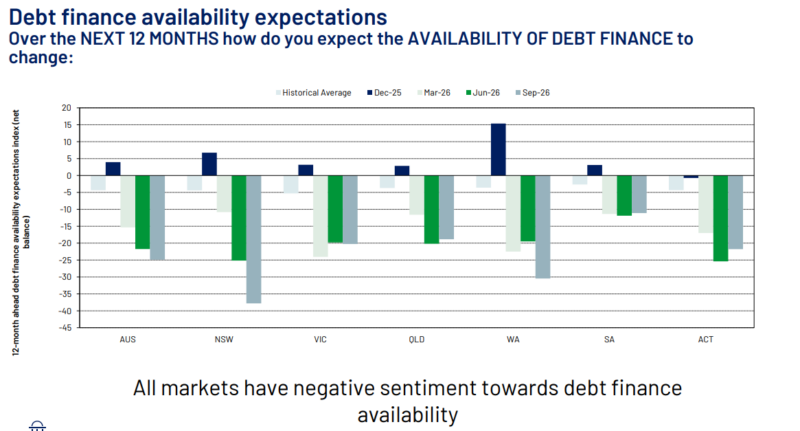
Every market reported negative sentiment towards debt finance availability, while expectations for house price growth declined across every market.
- Also read:National Weekly Auction Report – October 10th 2026 | Auction Markets Remain Generally Subdued as Listings Surge

- Also read:Latest Property Price Forecasts. Australian Property Market Outlook 2026-2027: Navigating a Market Correction

- Also read:Unsold Stock Drives 21.6% Annual Jump in Listings as Spring Season Opens | Latest SQM Listing Data
- Also read:Home Prices Down Again Over September – But Not as Much | Latest Property Market Stats

- Also read:Unemployment rises, student numbers fall and Melbourne still leads the auction market | Property Insiders

These figures don't tell us what will happen next to property prices, and sentiment can change quickly. However, they do tell us something about the environment in which investment decisions are being made.
Development requires large amounts of capital committed years before the final product is sold, so developers and financiers need confidence around costs, demand and government policy. When uncertainty increases, fewer marginal projects are likely to make it across the line.
And that matters because governments can announce housing targets, change planning regulations and identify areas for greater density, but those initiatives won't deliver homes unless someone is prepared to put capital at risk and build them.
Trust tax changes add to the uncertainty
The Property Council also points to proposed trust tax changes as another concern.
It says research conducted with industry partners found more than 60% of small and medium property developers surveyed expected the changes to affect either the timing or viability of projects.
This is particularly relevant because Australia's housing supply isn't delivered solely by large listed developers. Family-owned and mid-tier businesses also build homes and other property projects across the country.
And the effects of today's decisions may not appear immediately. Development pipelines are long, which means projects delayed or abandoned today can translate into fewer completed homes several years from now.
We need to look at the whole housing equation
I've long argued that Australia's housing problems can't be solved by concentrating solely on demand.
Population growth, migration, interest rates and access to credit certainly influence property markets, but housing affordability is also fundamentally a supply issue, and new supply depends on whether projects remain commercially viable.
This means governments need to look carefully at the total cost of delivering a new home, including planning delays, infrastructure requirements, construction costs and the cumulative impact of taxes and charges.
The encouraging news is that these problems can be addressed. Australia still has strong underlying demand for housing, desirable cities and a sophisticated property industry.
More efficient planning, appropriate higher-density development, better infrastructure and a taxation framework that encourages rather than discourages new supply would all help.
For property investors, periods like this are also a reminder to remain selective.
Market sentiment will rise and fall, governments will change the rules and economic conditions will evolve, but scarcity, location, owner-occupier appeal and the quality of the underlying asset remain important over the long term.
Australia is going to need considerably more housing in the decades ahead. The challenge now is ensuring our policies make those homes financially viable to build, because ambitious housing targets only matter if they eventually become homes Australians can live in.