
Key takeaways
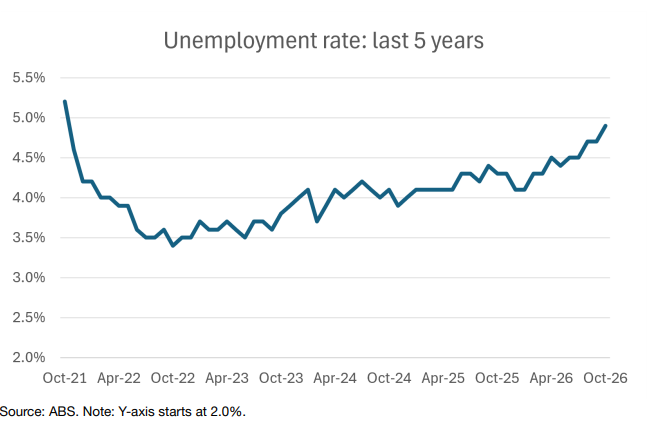
Australia's unemployment rate has risen to 4.9%, its highest level in five years, with approximately 43,500 jobs lost in October.
Rising unemployment has strengthened the case for the RBA to leave interest rates unchanged at its December meeting.
However, RBA interest rate cuts remain some way off. The major banks don't expect the first reduction until August or November 2027. Yet NAB cut its 2- and 3-year fixed mortgage rates by up to 0.28% today.
Mortgage buffers are shrinking, leaving some Australian households increasingly vulnerable to financial stress and job losses.
Rising unemployment could weaken buyer confidence and place further pressure on property prices, even if interest rates stop rising.
Properties in established, desirable locations with strong owner-occupier demand should be better positioned to withstand economic uncertainty.
Property investors should prioritise manageable debt, strong cash flow and adequate financial buffers rather than relying on future interest rate cuts.
Economic uncertainty can create opportunities for financially secure investors who take a patient, long-term approach.
Just when Australians were wondering how much more financial pressure they could withstand, the latest employment figures have delivered another warning about the health of our economy.
Australia's unemployment rate has jumped to 4.9%, its highest level in five years, with approximately 43,500 jobs disappearing in October alone.
While that's worrying news for affected households, it could also mark an important turning point in the Reserve Bank's battle against inflation.
After five interest rate increases this year, the RBA may finally be reaching the point where further tightening risks doing more harm than good.
According to Canstar, the latest employment figures have virtually cemented the case for the Reserve Bank to leave interest rates unchanged at its final meeting for 2026.
However, borrowers shouldn't confuse the end of interest rate rises with the beginning of interest rate cuts,yet NAB cut its 2- and 3-year fixed mortgage rates by up to 0.28% today.
I have found in the past when consumers believe we are at an interest rate peak, confidence and buyer and seller sentiment return.
The labour market is weakening faster than expected
The latest Australian Bureau of Statistics figures show unemployment increased from 4.7% to 4.9% in October, exceeding the Reserve Bank's expectations.
Only three months ago, the RBA forecast unemployment would finish 2026 at 4.5%. That estimate was revised upwards to 4.7% in November, yet the latest figures have already exceeded it.

This matters because the Reserve Bank has been relying on a gradual weakening of employment conditions to help bring inflation under control.
Higher interest rates reduce household spending and business investment, slowing economic activity and eventually easing inflationary pressures. However, monetary policy operates with a lag, and the full effects of this year's rate increases are still working through the economy.
Canstar's data insights director, Sally Tindall, says the figures will make uncomfortable reading for the RBA Board, particularly after three members voted against November's rate increase over concerns about the economic risks.
As Tindall explains, the RBA must balance its responsibility to control inflation with its obligation to support employment, and with unemployment already exceeding forecasts, the argument for further rate increases has weakened considerably.
Of course, one month's employment figures don't establish a lasting trend, but they give the Reserve Bank another reason to allow its previous decisions time to work.
Interest rate cuts could still be a long way away
While the latest figures make a December interest rate pause increasingly likely, borrowers shouldn't assume mortgage relief is just around the corner.
All four major banks expect the RBA's next move to be down, but Commonwealth Bank, Westpac and NAB don't anticipate the first cut until August 2027, while ANZ expects borrowers may have to wait until November.
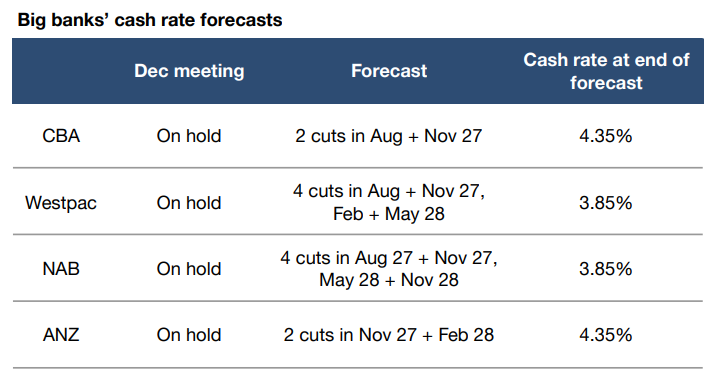
And if inflation remains stubbornly above the Reserve Bank's target range, interest rates could remain unchanged throughout 2027.
The RBA faces a difficult balancing act. Cutting rates too early could reignite inflation, while keeping them elevated for too long risks unnecessary damage to employment and household finances.
My view is that the Reserve Bank will become increasingly cautious about further tightening as evidence of economic weakness accumulates.
However, I wouldn't build an investment strategy around expectations of rapid or substantial interest rate cuts. Successful property investors understand that interest rates are only one of several factors influencing long-term investment performance.
However, as I've already said, once the market realises we are at an interest rate peak, buyer and seller confidence will return.
Mortgage buffers are becoming increasingly important
Perhaps the most concerning aspect of Canstar's analysis is what it reveals about the financial resilience of Australian mortgage holders.
- Also read:National Vacancy Rate Rises to 1.5% | SQM Research

- Also read:Investors head for the exits as lending records its biggest fall ever | Property Insiders

- Also read:This week’s Australian Property Market Update – Latest Data, State by State November 17th 2026

- Also read:Latest Property Price Forecasts. Australian Property Market Outlook 2026-2027: Navigating a Market Correction

- Also read:Adelaide housing market update | November 2026

On the surface, the figures are reassuring. Commonwealth Bank reports that 85% of its mortgage customers are ahead on repayments, with an average buffer equivalent to 32 months as at June 2026.
However, that average has fallen from 35 months just six months earlier, suggesting some households are gradually drawing down their savings.
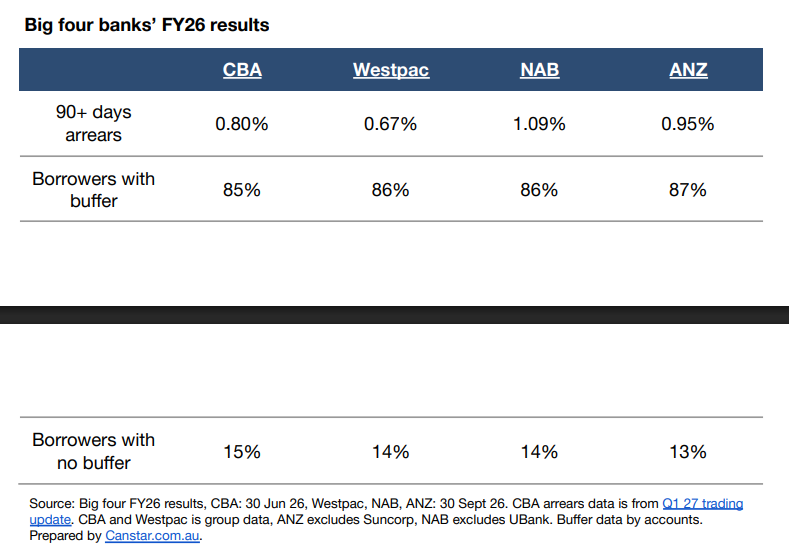
Westpac's figures tell a similar story. While 37% of mortgage customers are more than two years ahead on repayments, 28% have less than one month's buffer, including 14% with no buffer at all.
Across the four major banks, between 13% and 15% of mortgage accounts have no repayment buffer, while mortgage arrears are beginning to rise, albeit from relatively low levels.
These figures reinforce something I've been saying for years: two households can own similar properties, carry similar mortgages and earn similar incomes, yet have vastly different levels of financial security.
The difference often comes down to their financial buffers and how well they've prepared for unexpected circumstances.
With unemployment rising, those buffers could become even more important than the direction of interest rates.
What does this mean for Australia's property markets?
Higher interest rates have contributed to the recent weakness in Australia's housing markets, reducing borrowing capacity, dampening buyer confidence and making investors more cautious.
A pause would therefore be welcome news, particularly if it gives households greater certainty about their mortgage repayments.
However, rising unemployment introduces another challenge. People are understandably reluctant to make major financial commitments when they're concerned about job security, which can weaken property demand even when interest rates stop rising.
In the short term, this could mean continued pressure on property prices in some markets, although Australia's longer-term housing fundamentals remain important.
Population growth, household formation and housing supply constraints will continue to influence demand, while different segments of our property markets will respond differently to economic uncertainty.
As I've often explained, properties in established, desirable locations with strong owner-occupier appeal are generally better positioned to withstand difficult conditions than those in areas heavily dependent on investors or where new housing supply can expand rapidly.
For strategic investors, the current environment reinforces the importance of buying investment-grade properties, managing debt carefully and maintaining sufficient cash flow to weather uncertainty.
The bottom line
Australia's latest unemployment figures suggest the Reserve Bank's tightening cycle may finally be approaching its conclusion, although the timing of any interest rate relief remains uncertain.
For homeowners and investors, the immediate priority should be strengthening their financial position rather than relying on lower rates to improve their circumstances.
Canstar recommends maintaining an emergency buffer equivalent to at least three to six months of essential living expenses.
After decades of investing, I've learned that economic uncertainty is an unavoidable part of every property cycle.
Those who achieve lasting success generally prepare for difficult conditions rather than trying to predict exactly when they'll end.
There will undoubtedly be challenges as the economy adjusts to higher interest rates and a softer labour market, but Australia's long-term housing fundamentals remain important.
And while weaker market sentiment may discourage some buyers, it can also create opportunities for financially secure investors who take a patient, strategic approach.
The coming year may require greater caution and discipline, but for those with a long-term perspective, it could also lay the foundations for the next phase of Australia's property cycle.