
Key takeaways
Your suburb can cost you valuable time. Long daily commutes can consume hundreds of hours each year, reducing time for family, exercise and leisure.
Australia's sprawling cities are creating growing challenges. Population growth and car-dependent suburbs are increasing congestion, travel costs and pressure on infrastructure.
The 20-minute neighbourhood is becoming increasingly important. Suburbs with easy access to shops, schools, parks, transport and essential services offer greater convenience and lifestyle benefits.
Walkable neighbourhoods support healthier lifestyles. Walking and cycling encourage physical activity, improve wellbeing and reduce dependence on cars.
Established middle-ring suburbs have a long-term advantage. Their existing infrastructure, accessibility and amenities are likely to attract growing demand from homeowners and tenants.
Location will remain critical for successful property investment. Properties offering convenience, lifestyle appeal and strong owner-occupier demand are better positioned for long-term capital growth.
Better urban planning will shape Australia's future. Well-connected communities with appropriate housing density, public transport and local services will become increasingly desirable.
Have you ever considered how much of your life disappears simply getting from one place to another?
For many Australians, commuting has become such an accepted part of everyday life that we rarely stop to calculate its true cost.
Someone travelling 45 minutes each way to work spends around 345 hours commuting over a typical working year.
That's more than 14 entire days, and even shaving just 15 minutes off each journey would give them back almost five full days every year.
Imagine what you could do with that extra time, whether it's spending more time with your family, exercising, pursuing your interests or simply enjoying life a little more.
And this raises an interesting issue that most homebuyers and property investors rarely consider: the suburb you choose can have a surprisingly large influence on your quality of life.
Leading demographer Simon Kuestenmacher has been examining how Australia's commuting patterns are changing, why our sprawling cities are becoming increasingly difficult to navigate, and how better urban planning could improve the way Australians live.
His findings have important implications for homeowners, governments and property investors, particularly as our population grows and our cities continue to evolve.

For weekly insights, subscribe to the Demographics Decoded podcast, where we will continue to explore these trends and their implications in greater detail.
Subscribe now on your favourite Podcast player:
Australia has a rather unusual urban development story.
We live in one of the world's most urbanised countries, yet our major cities are extraordinarily spread out compared with many European cities of similar population.
For decades, we've accommodated population growth by extending our suburbs further away from established city centres, an approach that made sense when land was relatively inexpensive, cars were becoming widely available, and the Australian dream revolved around owning a detached home on a quarter-acre block.
However, the consequences of those decisions are becoming increasingly apparent.
As Simon explains, our cities have continued to grow in population without necessarily changing the basic structure of their transport networks:
"We still live in just the same cities as Australians, and we add more people to each city. So therefore that puts more pressure on a traffic system."
He points to estimates suggesting that commuters across Australia's major cities collectively lose around 200 million hours in traffic, while motorists in Sydney and Melbourne can face an annual cost of approximately $4,600 in lost time and fuel compared with more efficient journeys.
These figures depend on how congestion and travel time are measured, but they illustrate the considerable economic and personal cost of our dependence on cars.
And this is no longer exclusively a Sydney or Melbourne problem, with smaller capitals also experiencing increasing congestion as their populations grow.
Of course, hybrid working arrangements have provided some relief, allowing many office workers to avoid travelling to their workplace every day.
However, teachers, nurses, tradespeople, hospitality workers and countless others don't have that flexibility, which means the long-term solution must also involve reconsidering how our cities are designed.
Why the 20-minute neighbourhood could change everything
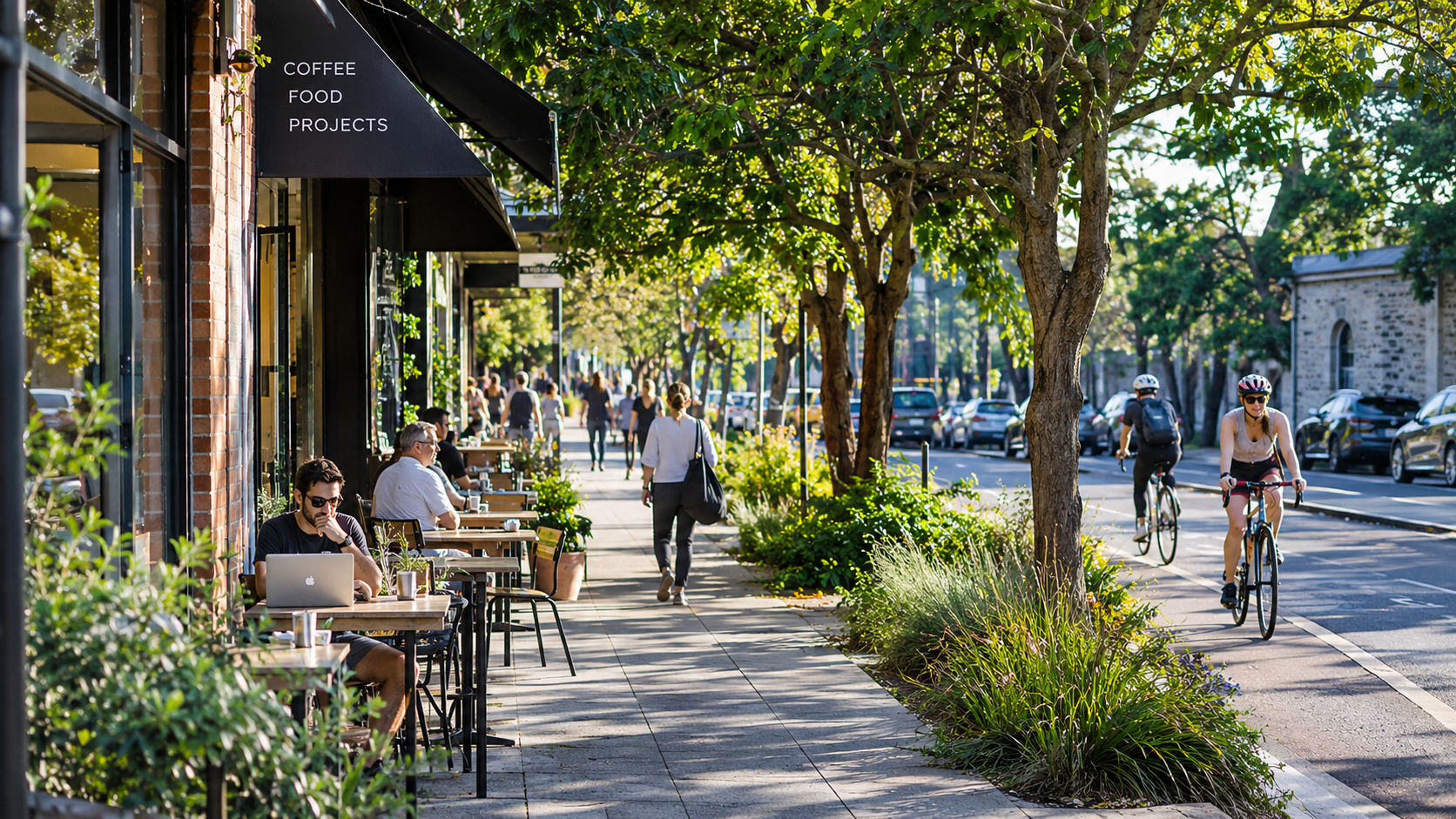
One of the most interesting ideas emerging from modern urban planning is the concept of the 15-minute city, sometimes referred to in Australia as the 20-minute neighbourhood.
The principle is relatively straightforward: imagine living somewhere where most of your everyday needs could be met within a comfortable 15- or 20-minute walk or bicycle ride from your front door.
Your local supermarket, medical centre, school, park, café, gym and perhaps even your workplace would all be conveniently accessible.
As Simon explains:
"The logic is that you start with your house and within fifteen or twenty minutes you are meant to have all your daily needs accessible to you."
The objective is to create neighbourhoods where homes, jobs, shops and services are integrated rather than separated into distinct residential and commercial zones.
Importantly, this doesn't mean restricting where people can travel or suggesting that everyone should remain within their neighbourhood. It's about creating more convenient and accessible communities.
And when you think about it, this is something many Australians already value, even if they've never heard the expression "20-minute neighbourhood".

Tip: People are naturally attracted to suburbs where they can walk to the shops, enjoy nearby parks, access public transport and find good schools and other facilities.
These are precisely the characteristics that have made many of our established inner- and middle-ring suburbs so desirable, yet they're often missing from newer outer-suburban developments.
The problem with our outer suburbs
One of the biggest challenges facing Australian cities is that we've continued to build large residential estates without always providing the services, employment opportunities and transport connections necessary to support them.
Many families move to these areas because housing is more affordable, and understandably so.
When the choice is between purchasing a spacious family home on the urban fringe or paying considerably more for a smaller property closer to the city, the outer suburbs can appear very attractive.
However, the purchase price tells only part of the story.
Once you factor in the cost of running multiple cars, longer journeys to work and additional travel for children's activities, the financial and lifestyle advantages may be considerably smaller than they initially appear.
Simon is particularly critical of the way some newer suburbs have been designed, describing them as "dormitory suburbs", where residential housing dominates but the mixture of services and activities needed to create genuinely walkable communities is missing.
There might be a school and a small local supermarket, but residents remain heavily dependent on their cars for almost everything else.
And because these suburbs often lack sufficient population density to support a wide range of local businesses, it can take many years before the necessary services arrive.
Of course, some outer suburbs will develop into thriving communities as their populations grow and infrastructure improves.

Note: However, the important lesson is that housing affordability should be considered alongside transport costs, accessibility and the lifestyle residents can realistically enjoy.
Why European cities work differently
Simon makes an interesting observation about the historical development of European cities and why many of them are naturally more walkable than their Australian counterparts.
Cities such as Paris, Copenhagen, Barcelona and Berlin developed much of their urban structure before the widespread adoption of motor vehicles.
Consequently, they were built around walking, cycling and public transport, with relatively narrow streets, mixed-use buildings and substantial populations living close to shops and services.
In many European neighbourhoods, apartments sit above ground-floor shops, cafés and other businesses, creating a natural mixture of residential and commercial activity that supports local businesses because there's a substantial customer base living within walking distance.
Australia's development followed a different path.
As Simon points out, our population was only around seven million after the Second World War, and much of our subsequent urban expansion occurred when cars were becoming affordable and widely available.
Rather than creating dense neighbourhoods around established transport corridors, we expanded outwards onto relatively inexpensive land.
The result is that Australian cities generally have much lower population densities than comparable European cities, with Simon estimating that our urban density is around four times lower.
That has important implications for infrastructure costs because lower-density cities require more kilometres of roads, railways, water pipes and electricity networks to service the same number of people.
This helps explain why governments are now encouraging greater housing density around established transport hubs and within existing suburbs.
However, retrofitting medium-density housing into established neighbourhoods isn't particularly easy.
As Simon explains, assembling enough adjoining residential blocks to create the sort of medium-density developments common in European cities can be extremely difficult and expensive.
Consequently, developers often end up building either relatively small townhouse projects or much taller apartment towers, with fewer opportunities for the attractive medium-density housing that characterises many European neighbourhoods.
- Also read:Latest Property Price Forecasts. Australian Property Market Outlook 2026-2027: Navigating a Market Correction

- Also read:Brisbane Property Market Forecast [2026 & Beyond] – What The Olympics Decade Means for Investors.
- Also read:Melbourne property market forecast for 2026 & 2027 | Separating the fundamentals from the sentiment
- Also read:Sydney property market forecast for 2026 and 2027 | Why the short-term softness is a long-term opportunity

- Also read:This week’s Australian Property Market Update – Latest Data, State by State November 10th 2026

It's one reason I believe Australia's missing-middle housing, including well-designed townhouses, terraces and boutique apartment developments, will become increasingly important over the coming decades.
Why the bicycle could become a time-saving machine
One of Simon's more interesting observations is that cycling can actually save people time, even when travelling by bicycle takes longer than driving.
At first glance, that sounds contradictory, but when you consider the entire journey, including getting the car out of the garage, navigating traffic, finding parking and walking to your final destination, cycling can be surprisingly competitive over shorter distances.
For journeys of one or two kilometres, a bicycle can sometimes be faster door to door, particularly in congested neighbourhoods, while the growing popularity of electric bicycles is extending the distances people can comfortably travel.
However, Simon argues that the real advantage comes when we consider the health benefits.
Most of us understand the importance of regular physical activity, yet finding time to exercise can be difficult when we're juggling work, family and other commitments.
If someone cycles for 30 minutes to work and another 30 minutes home, they've incorporated an hour of physical activity into their daily routine.
Compare that with someone who drives for 20 minutes each way but then needs to find additional time for exercise, and the cyclist may actually come out ahead.
As Simon explains, cycling becomes particularly valuable when we look at transport through a public health lens.
It also helps explain why electric bicycles could become increasingly important in cities such as Brisbane, where hills and warmer conditions can discourage conventional cycling.
E-bikes make cycling accessible to a wider range of people, including older Australians and those who might otherwise find regular cycling too physically demanding.
Interestingly, Simon is less enthusiastic about electric scooters, particularly when they replace walking or cycling rather than car journeys, because they may reduce the amount of physical activity people undertake.
It's a useful reminder that transport planning needs to consider health outcomes alongside convenience and efficiency.
Is commuting always wasted time?
Another interesting aspect of this discussion deserves consideration. We often talk about commuting as though every minute spent travelling is automatically wasted, but that's not necessarily the case.
For some people, the journey between home and work provides a valuable psychological transition between their professional and personal lives.
A train trip might offer an opportunity to read, listen to a podcast or simply unwind before arriving home, while a pleasant walk or bicycle ride can provide time to reflect and mentally separate the working day from family life.
Simon agrees that some commuting can actually improve wellbeing:
"It's the mode and the length of the commute that matters, not just the sheer existence."
I think that's an important distinction.
A predictable 25-minute train journey where you can comfortably read or relax is a very different experience from spending 75 minutes sitting in unpredictable peak-hour traffic.
Ultimately, what matters is having access to reliable, convenient transport options that suit different lifestyles and circumstances.
What this means for property investors
For property investors, I believe these demographic and lifestyle trends have some significant implications.
Over the years, I've consistently argued that location is one of the most important factors influencing a property's long-term performance, but location involves much more than simply measuring the distance from the CBD.
Increasingly, we need to consider how easily residents can access employment, education, shopping, recreation and essential services.
Tip: A well-located property in an established middle-ring suburb with good public transport, attractive parks, walkable shopping strips and nearby schools offers residents something that can be difficult to replicate in newer developments.
These characteristics are likely to become increasingly valuable as our population ages, household structures change and more Australians seek lifestyles that allow them to balance work, family and leisure.
Simon also points to research associating walkable neighbourhoods with better physical and mental health outcomes, including substantially lower risks of poor mental health.
While those associations are influenced by a range of factors, they reinforce the broader benefits of living in well-connected communities.
One practical tool investors can use is Walk Score, which provides an indication of how easily residents can access local amenities on foot.
Of course, a high walkability score alone doesn't make a property a sound investment.
At Metropole, we consider a much wider range of factors, including local demographics, household incomes, land scarcity, supply constraints, owner-occupier appeal and the property's potential for long-term capital growth.
Nevertheless, accessibility and walkability are increasingly important parts of that assessment.
I also believe investors should pay particular attention to established middle-ring suburbs that are likely to experience carefully managed increases in housing density.
As Baby Boomers gradually downsize or leave their family homes over the coming decades, many larger suburban blocks will eventually be redeveloped into townhouses and other medium-density housing.
This will increase local populations and potentially support more shops, cafés and community services, although it will also place additional pressure on roads, public transport and existing infrastructure.
The suburbs that manage this transition successfully, while preserving their established character and improving local accessibility, could become increasingly attractive to both homeowners and tenants.
And that should support stronger long-term demand for well-located, investment-grade properties.
Our cities need to prepare for the next generation
There's one final issue that Simon raises, and it's particularly relevant to the future of Australian cities.
Urban planning decisions are often made by individual local governments, even though commuting patterns, employment centres and transport networks operate across much larger metropolitan areas.
This can make it difficult to develop consistent cycling networks, integrated public transport systems and coordinated housing policies.
After all, a bicycle path that ends at a council boundary is of limited value to someone trying to travel across several suburbs, while encouraging more housing density without improving transport connections can simply create additional congestion.
Simon argues that our major cities need more coordinated planning, particularly as established middle-ring suburbs accommodate growing populations.
And I agree.
Note: We need to think more carefully about how new housing, employment centres, public transport and local services fit together, rather than treating each development as an isolated project.
The benefits extend well beyond transport, with more walkable neighbourhoods encouraging physical activity, supporting local businesses and making everyday life easier for children, older residents and people who don't drive.
They can also help create stronger communities, where neighbours have more opportunities to interact and residents feel connected to the places where they live.
The bottom line
When we talk about the future of Australian cities, the conversation usually revolves around housing affordability, population growth, infrastructure spending and the number of new homes we need to build.
All of those issues are important, but I think we sometimes overlook the influence that urban planning has on our everyday lives.
For property investors, these changing priorities reinforce my long-held view that buying the right property in the right location is far more important than simply purchasing something because it appears affordable today.
And for homeowners, it's a reminder that the best place to live isn't necessarily the one with the largest house or the biggest backyard, but the one that supports the lifestyle they want to enjoy.
I'm optimistic about the future because we're beginning to understand these relationships much better, and while we can't undo decades of urban sprawl overnight, we can make better decisions about where we build, how we connect neighbourhoods and the types of housing we encourage.
Over time, I believe the most successful suburbs will be those that combine attractive homes with convenient access to the things people need and enjoy.
Because ultimately, a great suburb should do more than provide somewhere to live. It should help you make the most of your life.