Key takeaways
Two in three Australians support reversing property tax changes.
New research suggests negative gearing and capital gains tax could become major election issues.
Younger Australians are questioning the reforms. Gen Z and Millennials are just as likely as Baby Boomers to support reversing the changes.
Falling property prices don't necessarily improve affordability. Higher interest rates have reduced borrowing capacity, making homeownership harder for many Australians.
Tax changes alone won't solve Australia's housing crisis. Housing shortages, construction costs, population growth and planning restrictions remain major challenges.
Investors shouldn't rely on future tax reversals. Long-term success depends on sound strategies, quality properties and adapting to changing market conditions.
Australia's property tax reforms were supposed to make housing more affordable, particularly for younger Australians struggling to get into the market.
But new research suggests the changes may have created an unexpected political problem for the Federal Government, with a surprisingly large number of Australians now willing to vote for a party promising to reverse them.
In fact, two in three Australians say they would support a political party that pledged to restore negative gearing and the previous capital gains tax concessions, according to new research from comparison platform OurTop10.
And perhaps the most interesting finding is that younger Australians, the very people these reforms were intended to help, are just as likely as older generations to support their reversal.
I've long argued that Australia's housing affordability challenges are far more complicated than simply changing the tax treatment of investment properties. While tax policy certainly influences investor behaviour, interest rates, borrowing capacity, housing supply and population growth all play important roles in determining who can afford to buy a home.
Now, with the property market adjusting to higher interest rates and the Government's new tax rules, it appears many Australians are questioning whether these reforms will deliver the outcomes they were promised.
Property taxes could become an election issue
The nationally representative survey of 1,018 Australians, commissioned by OurTop10 and conducted by PureProfile, found that 66% would vote for a party promising to reverse the negative gearing and capital gains tax changes.
Of those surveyed, 18% said that promise alone would secure their vote, regardless of the party's other policies, while a further 49% would consider the pledge alongside the party's broader platform.
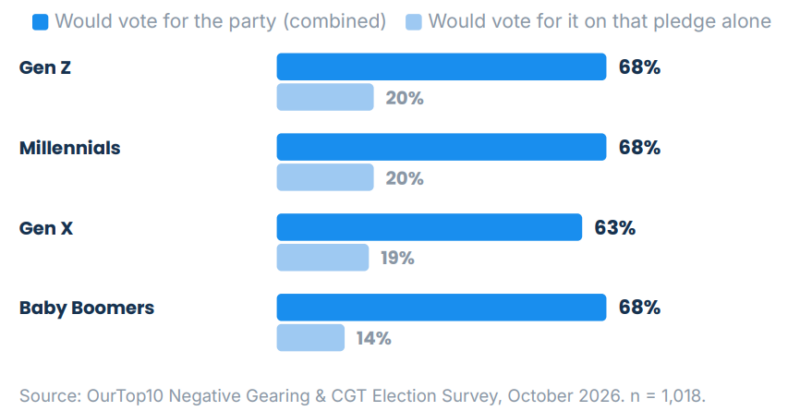
Interestingly, support was widespread across generations, with 68% of Gen Z, Millennials and Baby Boomers favouring a reversal, compared with 63% of Gen X.
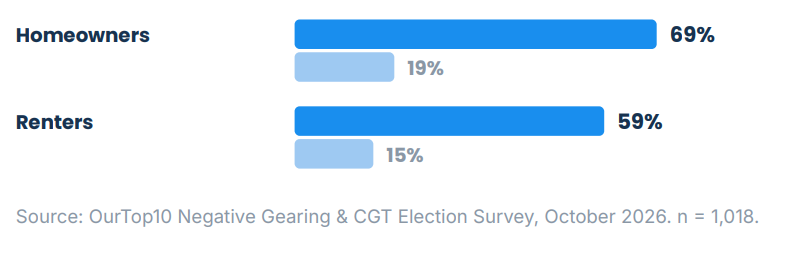
Not surprisingly, homeowners were more supportive than renters, at 69% compared with 59%.
Of course, there's an important distinction between what people tell a survey and how they ultimately vote at an election. Australians make their political decisions based on a range of issues, including the economy, healthcare, education and the cost of living.
Nevertheless, these findings suggest property taxation could become a significant battleground ahead of the next Federal election, due by May 2028.
Both the Coalition and One Nation have already pledged to restore the previous 50% capital gains tax discount and negative gearing arrangements, although One Nation proposes limiting negative gearing to two properties per investor.
Under the reforms announced in the May 2026 Federal Budget and passed by Parliament in June, residential investment properties purchased after Budget night generally lost access to negative gearing, with exemptions for new builds and properties purchased before the changes.
The existing 50% capital gains tax discount is also scheduled to be replaced from 1 July 2027, with a minimum 30% tax rate applying to capital gains under the new arrangements.
These changes represent a substantial shift in the investment landscape and, understandably, have prompted many property investors to reconsider their long-term strategies.
Younger Australians are sending an unexpected message
One of the most revealing findings from the research is that younger Australians appear just as concerned about the reforms as older generations.
In fact, 20% of Gen Z and Millennials said reversing the changes would be enough to secure their vote regardless of other policies, compared with just 14% of Baby Boomers.
Mansour Soltani, Head of Research at OurTop10, suggested these findings should concern policymakers, particularly given that improving intergenerational housing affordability was a central argument behind the reforms.
He observed that younger Australians were proving just as willing as older generations to support a reversal, despite being among the intended beneficiaries.
Soltani also pointed to the impact of four interest rate increases this year, which have reduced borrowing capacity and made homeownership more difficult for many aspiring buyers, even as property prices have softened.
- Also read:Brisbane housing market update | November 2026

- Also read:Everything you need to know about the state of Australia’s property markets in 20 charts – November 2026

- Also read:Melbourne housing market update | November 2026

- Also read:Sydney housing market update | November 2026

- Also read:Vacancies fall, rents stall and rates hit an 18-year high: what Australia’s latest property data is telling us | Property Insiders

And I think that highlights an important point.
Housing affordability is determined by much more than the price of a property.
A home may become cheaper, but if higher interest rates reduce a buyer's borrowing capacity by an even greater amount, that buyer can actually find themselves further away from achieving homeownership.
At the same time, younger Australians recognise that property investment has traditionally been one of the ways ordinary families have built wealth and financial security over generations.
It's therefore understandable that some may be concerned about changes that could make this pathway more difficult in the future.
We need to address the real causes of housing unaffordability
I've always believed that Australia's housing affordability problems cannot be solved through tax changes alone.
We have a structural housing shortage, with planning restrictions, infrastructure bottlenecks, construction costs and development delays making it increasingly difficult to deliver enough homes in the locations where Australians want to live.
Meanwhile, our growing population continues to create demand for housing, particularly in our major capital cities.
Changing the tax treatment of property investment may influence who buys existing homes and how investors structure their portfolios, but it doesn't automatically create additional housing.
In fact, if policy changes discourage investment in rental accommodation without sufficient new supply coming through, there is a risk of placing further pressure on an already stretched rental market.
That's why I believe we need a more balanced approach, one that encourages housing construction, improves planning efficiency, supports responsible investment and provides realistic pathways into homeownership.
We should also recognise that housing policy involves trade-offs. Measures designed to help first-home buyers can have unintended consequences for renters, investors and the broader housing market.
And while some argue that reducing tax concessions will level the playing field between investors and first-home buyers, we need to be careful about assuming that making property investment less attractive will automatically make housing more affordable.
What does this mean for property investors?
For investors, the latest research is a reminder that property taxation is likely to remain a contentious political issue for some time.
However, I would caution against making investment decisions based on the assumption that a future government will reverse the reforms.
Political promises are one thing, while legislative changes and their eventual implementation are another.
Successful property investment has always required a long-term perspective, a sound financial strategy and the ability to adapt as economic conditions and government policies change.
And despite the uncertainty surrounding taxation and interest rates, Australia's underlying housing fundamentals remain important.
Our population will continue to need somewhere to live, well-located properties will remain desirable, and the long-term shortage of quality housing in established suburbs is unlikely to disappear simply because the tax rules have changed.

Note: The latest survey also sends a broader message to policymakers: Australians want housing policies that genuinely improve affordability while preserving opportunities to build financial security.
Whether these findings translate into votes at the next election remains to be seen, but they suggest the debate over negative gearing and capital gains tax is far from settled.
The encouraging news is that Australia's housing challenges are solvable, provided we focus on increasing supply, improving affordability and creating a stable environment for long-term investment.
And for investors who understand the importance of buying the right properties, managing their risks and taking a long-term approach, there will continue to be opportunities to build substantial wealth through property, regardless of which political party is in government.