

Key takeaways
Nearly one in five Australians (18%) admit using AI to create or alter documents for a home loan application or negotiation.
Bank statements are the most commonly altered documents, followed by employment records, payslips and proof of income.
Younger Australians are leading the trend, with 56% of Gen Z and 36% of Millennials reporting using AI to create or alter mortgage documents.
Housing affordability pressures and tighter lending requirements may be encouraging some borrowers to manipulate financial information to secure a loan.
Falsifying mortgage documents carries serious risks, including loan rejection, legal consequences and unaffordable debt. Long-term financial security comes from responsible borrowing and sound financial planning.
Imagine spending months searching for the right property, finally finding a home you love, and then discovering the bank won't lend you quite enough money to buy it.
You've saved your deposit, done your homework, and you're confident you can manage the repayments. But the bank's calculations tell a different story.
For some Australians, the temptation to make their financial position look a little better on paper is becoming increasingly difficult to resist, particularly now that artificial intelligence can create or alter documents in seconds.
And according to concerning new research, a surprising number of Australians are already doing just that.
A national survey commissioned by comparison platform OurTop10 has found that 18% of Australians say they've used artificial intelligence to create or alter documents for a home loan application or negotiation.
That's almost one in five Australians, raising serious questions about the pressures facing borrowers, the growing potential for mortgage fraud and the risks people are prepared to take to get into the property market.
While the survey doesn't establish that every instance involved deliberate deception, it highlights how AI is creating new opportunities to manipulate the information lenders rely on when assessing borrowers.

What Australians are changing on their mortgage applications
The October 2026 survey, conducted by PureProfile among 1,018 Australians, found that bank statements were the most commonly reported documents created or altered using AI.
According to the research:
- 10% reported creating or altering bank statements.
- 9% had done so with employment documents.
- 6% reported altering payslips or proof of income.
- 3% had created or altered a competing lender's interest rate offer.
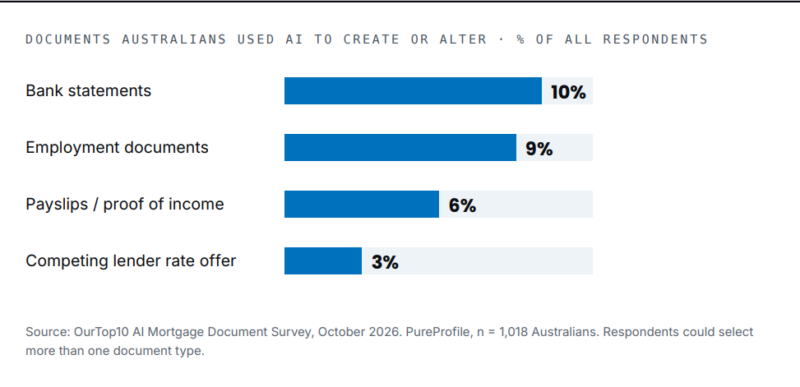
Respondents could select multiple documents, so these figures overlap.
Of course, there are legitimate reasons to use technology when preparing financial documents, but deliberately falsifying information to obtain a mortgage is another matter entirely.
Banks assess borrowers based on their income, expenses, existing debts and ability to manage repayments under more difficult financial circumstances.
If those figures are manipulated, borrowers risk obtaining loans they cannot realistically afford, potentially exposing themselves to serious financial and legal consequences.
Younger Australians are leading this worrying trend
Perhaps the most surprising finding is the enormous difference between generations.
The survey found that 56% of Gen Z respondents and 36% of Millennials reported using AI to create or alter home loan documents, compared with 18% of Australians overall.
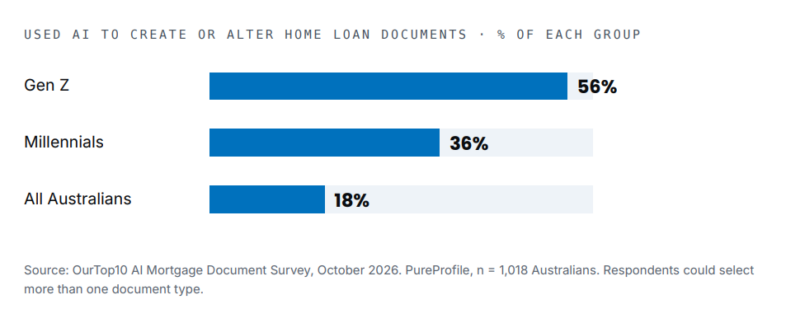
Among Gen Z respondents, 33% reported creating or altering bank statements or financial records, while 19% reported doing so with employment documents and the same proportion with payslips or proof of income.
These are extraordinary figures, although the research doesn't establish how many respondents deliberately submitted fraudulent documents or whether the altered paperwork was actually used to obtain a loan.
Nevertheless, the generational divide is revealing.
Younger Australians are generally more comfortable experimenting with technology, but they're also confronting significant barriers to homeownership, including high property prices, deposit requirements and borrowing capacity constraints.
Mansour Soltani, Head of Research at OurTop10, suggests that familiarity with AI may make younger borrowers more comfortable using these tools without fully considering the consequences.
I suspect there's another factor at work. When people believe the system is working against them, they can become more willing to justify behaviour they would otherwise consider unacceptable.
That doesn't excuse dishonesty, but it may help explain why some borrowers convince themselves that manipulating financial documents is simply a way around restrictive lending requirements.
Mortgage prison is adding to the pressure
This issue extends beyond first-home buyers.
Some existing homeowners are trapped in what's become known as mortgage prison, where they can continue servicing their current loan but struggle to qualify for refinancing under today's lending assessments.
- Also read:National Weekly Auction Report – October 31st 2026 | Quiet October Home Auction Market Ends with Signs of Improvement

- Also read:Home Prices Continue to Steady Over October | Latest Property Market Stats

- Also read:Unemployment rises, housing approvals fall and Melbourne leads the auctions again | Property Insiders

- Also read:This week’s Australian Property Market Update – Latest Data, State by State October 27th 2026

- Also read:Latest Property Price Forecasts. Australian Property Market Outlook 2026-2027: Navigating a Market Correction

Soltani explains:
"Higher interest rates are reducing borrowing capacity, particularly for first-home buyers, and leaving some existing borrowers stuck in mortgage prison because they no longer qualify for a refinance."
He suggests some borrowers manipulate documents to inflate income or understate expenses, believing they're simply finding a way around the banks' requirements.
While lending policies aren't perfect and can sometimes produce frustrating outcomes, falsifying financial information creates risks that can follow borrowers for years.
After all, lenders assess serviceability to ensure borrowers can manage their repayments, including when unexpected financial pressures arise.
Why AI could make mortgage fraud a bigger problem
One of the most concerning aspects of artificial intelligence is how easily convincing financial documents can now be produced.
In the past, altering a bank statement or payslip required technical knowledge. Today, increasingly sophisticated AI tools make manipulation much easier.
Soltani warns:
"AI tools are evolving faster than many lenders' ability to detect false documents, and some are still relying on legacy verification systems that weren't built for this."
He argues that secure data sharing between lenders and the Australian Taxation Office, with borrowers' consent, could help banks independently verify income rather than relying on potentially manipulated documents.
I think that's a sensible direction, provided appropriate privacy protections are maintained.
But borrowers also need to understand the consequences of knowingly providing false information.
Fraudulent applications can be rejected, and discovering false information after settlement may allow lenders to demand repayment. Deliberate deception can also lead to criminal prosecution.
Perhaps the greatest financial danger, however, is obtaining a mortgage that stretches your finances beyond what you can comfortably manage.
The bottom line
Over my decades of investing in property and helping Australians build wealth, I've learned that financial success rarely comes from taking shortcuts.
It comes from making sensible decisions, understanding your financial position and following a strategy that allows you to build wealth without taking unnecessary risks.
I understand why aspiring homeowners are frustrated by today's affordability challenges, and why some existing borrowers feel unfairly constrained by lending policies.
But manipulating your income or expenses to obtain a larger mortgage can turn an exciting financial milestone into a long-term problem.
For borrowers struggling to qualify, there are better options, including reducing existing debts, improving cash flow, seeking professional mortgage advice, considering alternative lenders or adjusting the timing and price range of a purchase.
For property investors, maintaining financial buffers and avoiding excessive borrowing are particularly important.
Artificial intelligence will undoubtedly transform mortgage applications and lending assessments, potentially making the process faster, more accurate and more efficient.
However, the fundamentals of successful property ownership remain unchanged.
The goal should never be to borrow the maximum amount a bank can be persuaded to lend you. It should be to borrow an amount that fits comfortably within a sound, long-term financial strategy.
Because ultimately, the Australians who build lasting wealth through property will be those who can afford to hold their assets through the inevitable ups and downs of the property cycle.
And that's a far more reliable path to financial security than trying to outsmart the bank with artificial intelligence.