


Key takeaways
When planning your next property investment, start with your budget. Understand your borrowing capacity and comfort level before deciding where and what to buy.
Location drives capital growth. Around 80% of a property's capital growth performance comes from its location, so choosing the right suburb and street is critical.
Buy quality properties, not bargains. A well-located investment-grade property will generally outperform a cheaper property in an inferior location over the long term.
Follow a proven investment strategy. Use a top-down approach to select the right market, suburb and property, rather than chasing hotspots or recent growth.
Preparation beats perfect timing. Successful investors act when they're financially ready and follow a long-term plan rather than waiting for the perfect market conditions.
Where do you start your search for an investment property?
It's the classic question every property investor asks, but the order of those decisions matters.
What should I buy, where should I buy it, and when?
At every seminar we used to run, Michael Yardney would put this question to the room.
Almost without fail, the answer was location. And while the room was right, because location matters enormously, there's a twist.
Before you think about location, there's something more fundamental to get right: the order in which you make these decisions.
Getting that right can mean the difference between a portfolio that quietly compounds and grows for decades and one that drifts sideways.

Start with your budget, not the suburb
The first thing to understand is your budget, and I don't just mean the number the bank gives you.
It's a combination of two things: your borrowing capacity and your comfort level.
A lender may tell you that you can borrow $1 million, but that doesn't mean you should. You may only feel comfortable borrowing $800,000, and that's a perfectly legitimate place to start.
Working out your true budget is critical, because everything then follows flows from it.
Once you've modelled and stress-tested that budget, you can sensibly consider location.
Location: the one thing you can't renovate
If you don't like grandma's shaggy carpet or the pink wallpaper, that's fine, you can change those.
What you can't change is where the property sits, so you simply must get the location right.
Next comes the type of property.
All things being equal, a house will generally win, but you need to look deeper. I want you to think in terms of land value rather than bricks and mortar.
You simply can’t buy a $1 million house in a suburb where the median is $3 million.
So rather than moving further out to get a house, consider a townhouse or a well-located apartment in the better area where the underlying land component is more valuable.
Moving further out can mean sacrificing location, local incomes and demographics, and ultimately capital growth and safety.
You would also be sacrificing the value of the land component, and that idea sits at the core of how we approach every purchase.
A top-down system, not a bottom-up hunt
I've lost count of the people I've spoken to who start their investing journey at the wrong end.
They begin with price, then property type, and only later consider the market. We approach it the other way around.
Our approach works from the big picture down:

- The economy. Which economies are booming and which are struggling?
- The state. What do the leading indicators, past performance and current conditions suggest about each state's next phase?
- The suburb. Where can your budget afford the best suburb in the best state?
- The location within the suburb. Which pockets of that suburb are genuinely investment grade?
- The property type.
- The price.
That fourth step is where many investors trip up.
Take New Farm in Brisbane, recently named among the top suburbs in the world.
It is a proven performer and a location that is always high on our list, yet we'd only buy in roughly half of the suburb.
Some parts are flood-prone, some are zoned for high-rise apartments, and others have major roads and cut-through streets.
Picking the best streets within a great suburb matters, because once you've bought, you can't move the property.
We estimate only around 4% of properties on the market at any one time are investment grade.
This top-down process is the funnel we use to find them.
Why so much focus on location?
Because around 80% of a property's capital growth performance comes from its location, while the remaining 20% comes from the property itself.
The property Monopoly board: four types of location
Think of the market a bit like a Monopoly board. Broadly, we see four kinds of location.
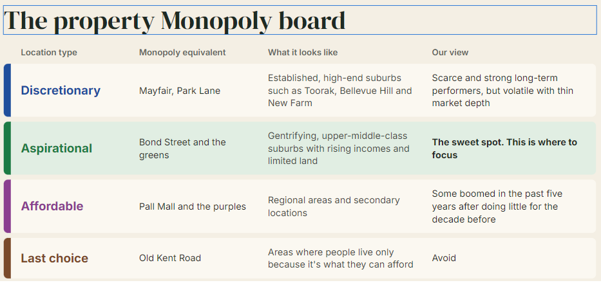
The discretionary suburbs are wonderful, but not everyone can afford a $20 million property, so fewer buyers mean more volatility, so that's not where we want to be.
Aspirational suburbs have more market depth, greater affordability and less volatility and offer the sweet spot.
Next up, the affordable end deserves a word of caution.
- Also read:Latest Property Price Forecasts. Australian Property Market Outlook 2026-2027: Navigating a Market Correction

- Also read:Brisbane Property Market Forecast [2026 & Beyond] – What The Olympics Decade Means for Investors.

- Also read:Melbourne property market forecast for 2026 & 2027 | Separating the fundamentals from the sentiment

- Also read:Sydney property market forecast for 2026 and 2027 | Why the short-term softness is a long-term opportunity

- Also read:Home Prices Down Again Over September – But Not as Much | Latest Property Market Stats

Some of these areas have done exceptionally well over the last five years, but appearances can be deceiving.
Look back over the previous decade and many performed poorly. I expect them to struggle in this part of the cycle too, as wages remain under pressure and buyers take longer to rebuild their savings.
As for last-choice suburbs, they're areas I'd avoid completely.
That is not a judgement of the people who live there, it's simply the reality of where your investment dollars won’t work as hard.
Our Six-Stranded approach
Once you're in the right location, every property we consider is tested against six strands.
- It appeals to owner-occupiers. We've perhaps glossed over this in the past, but it matters. Owner-occupiers buy with emotion and often pay more, which pushes up values. At this stage of the cycle, with few investors active, they're the ones putting a floor under the market. Areas without them are far more exposed to falls of 20% to 30%.
- It's bought below intrinsic value. That's not the same as below market value, which is hard to achieve in a rising market. It means paying less than replacement cost. In Sydney, building an average two-bedroom apartment now costs around $1 million. Buy a quality one for $850,000 or $900,000 and you've got a built-in buffer.
- The land does the heavy lifting. Whether it's a house, townhouse or unit, the value is in the land. Ideally the land component is above 50% and appreciating. That rules out high-rise towers and most off-the-plan stock, where $200,000 of land might sit under $600,000 of construction.
- It has a proven track record of capital growth. If I'm asking you to hold for 20 years, I want to know what happened over the last 20. Did it only boom recently? How did it fare through the GFC? I'm looking for consistent growth averaging 7% or more per annum.
- It has a twist. I recently explained to a client why their Sydney apartment had outperformed in a suburb full of apartments. It was 10 square metres bigger, had a generous balcony and was walking distance to the train. For apartments, a twist might be a ground-floor courtyard, extra space or separate parking. For houses, it might be development or renovation potential.
- You can add value. Hold a property long enough and you'll get the chance to manufacture growth through renovation or improvement, while using appreciation and negative gearing as the laws currently allow.
Buying cheap versus buying right
One of the costliest mistakes I see is investors chasing a bargain.
People ask me to find something $50,000 or $60,000 under market value, even though they plan to hold it for 10 or 20 years.
Over that horizon, what you pay today matters far less than what you buy.
Consider two properties, each valued at $1 million.
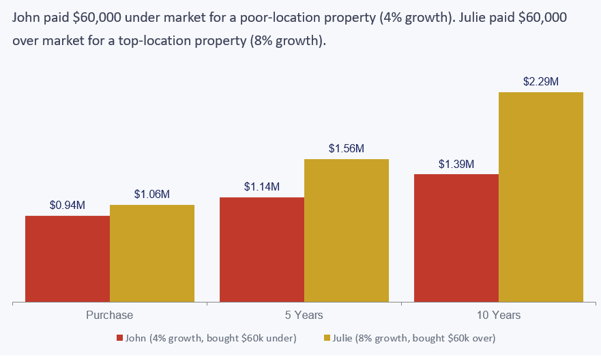
After a decade, the gap is almost $900,000.
The buyer who "overpaid" for a well-located property ends up far ahead, because quality is forgiving and compounding does the rest.
Even a 1% or 2% difference in annual growth becomes enormous over 10 or 20 years, especially with leverage.
The hidden cost of waiting
Plenty of people are sitting on the sidelines right now, waiting for a sign.
By the time the media, your Uber driver and your hairdresser are all saying property is moving again, the opportunity has largely passed.
Delay costs more than the growth you miss. It can also cost you the equity you might have used to buy your next property.
Waiting slows the growth of your entire portfolio, not just that one purchase.
When to buy: reading the property cycle
There are five forces behind every boom or bust:
- Demographic demand, including new households and immigration
- Human psychology: fear of missing out, or fear of buying too early
- The availability of credit, which is tightening again on the back of rate rises
- Government policy. Last year's home buyer grants pushed the market forward, and recent changes have pulled the rug out.
- The global economy, including fuel prices, which we're watching closely
Everyone is late to the party
Even experts like Michael Yardney and myself are late to the party sometimes.
One of the most valuable lessons Michael taught me is to invest when you are ready, with a long-term plan and the ability to act.
Markets bottom out quietly. There's never a neon sign announcing the turning point.
Nobody notices at the time, and public perception is that prices still have further to fall.
Meanwhile, strategic investors buying on research and long-term planning are already pushing prices forward.
By the time the public re-enters and sentiment turns positive, the market has already moved.
Think counter cyclically
When everyone's buying, the media is full of profit stories, FOMO is rife and prices are near their peak. Perceived risk may be at its lowest just when real risk is at its highest.
Over the past six to 12 months, we've been repositioning away from some of the markets that have done exceptionally well over the last five or six years.
Instead, we're looking at markets where sentiment is gloomy and others are selling, because we know conditions will shift.
If you already hold assets in a hot market, a countercyclical purchase elsewhere can be a powerful move.
The bottom line
So, what, where and when should you buy? Here's what it comes down to.
Preparation beats perfect timing. You don't have to buy tomorrow, but you do need to be ready.
Location does 80% of the work. Prioritise it before anything else.
Buying right beats buying cheap. A quality asset in a strong location will outperform a bargain in a weak one.
Use a repeatable system. A proven, top-down process beats gut feel, and it helps you make decisions in the right order.
The time will never feel perfect. Waiting has a real cost, and waiting for a feeling is just emotion.
Set yourself a deadline, commit to a time frame, and take action.
The investors who build lasting wealth are those who follow a strategy and take action while others are still waiting for a sign. Perfect timing is rarely part of the story.
So what are you waiting for?