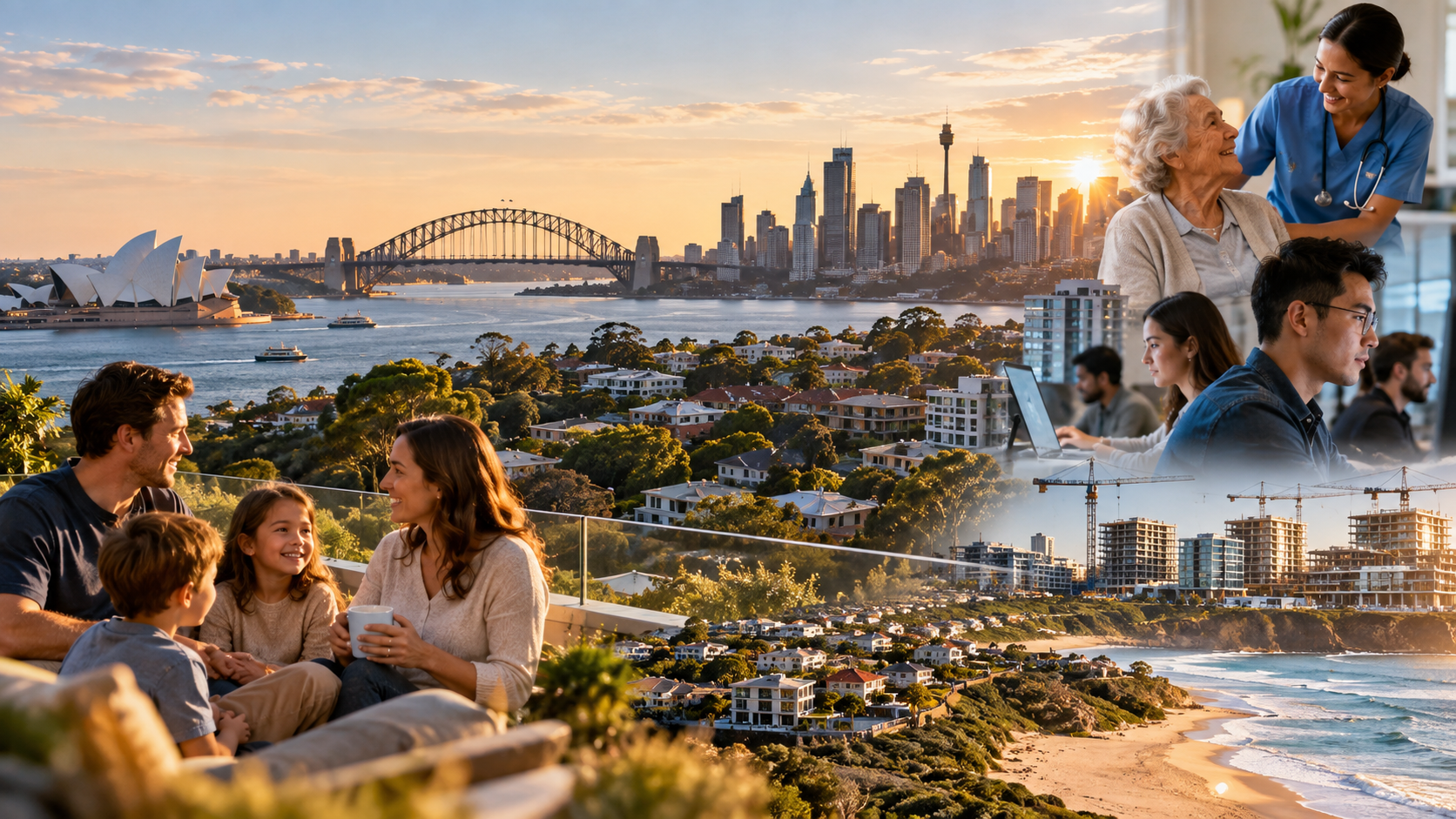

Key takeaways
Demograhics explains where we are heading...
Australia will keep growing. Millions more people will increase demand for housing, infrastructure and services.
Australia is getting older. An ageing population will reshape healthcare, aged care, housing and the transfer of wealth between generations.
Housing demand will change. Millennials forming families and shrinking household sizes will increase demand for more dwellings and different types of homes.
Migration will remain important. Migrants will continue supporting population growth, workforce needs and housing demand, particularly in our major cities.
Most population growth will remain concentrated in our major cities. For property investors, scarcity, incomes and supply constraints will matter more than population growth alone.
The care economy will become a major employment engine. Hospitals, medical precincts and other suburban employment hubs will become increasingly important.
AI will reshape the workforce. Those who combine technology with specialised knowledge, experience and human judgment are likely to benefit most.
Climate risk will increasingly affect property values. Insurance costs, insurability and infrastructure resilience should become part of every investor’s due diligence.
Long-term demographic trends matter more than short-term headlines. Investors who understand these structural changes will be better positioned for the opportunities ahead.
Every few months, another report lands telling us everything is about to change.
Interest rates, artificial intelligence, migration, climate change, tax policy - take your pick. Some forecasts will prove correct, many will be exaggerated, and plenty will eventually be forgotten.
The challenge is separating the structural changes that will genuinely reshape Australia from the short-term noise dominating the headlines.
That’s where demographics can be particularly useful.
While demographic forecasting isn’t perfect, the big underlying trends - how many people will live here, how old they’ll be, where they’ll live, how households are changing and who will enter and leave the workforce - it give us a surprisingly clear picture of where Australia is heading.
Over the next decade, we’re likely to have millions more Australians, an older population, smaller households, a much larger care economy and a workforce increasingly shaped by artificial intelligence.
Our major cities will grow, our population will become more culturally diverse, and the way Australians work, form families, choose where they live and pass on wealth will continue to evolve.
As leading demographer Simon Kuestenmacher explains, while we can never predict every twist and turn, these big demographic shifts allow us to see "the pathway pretty precisely."
So let’s look beyond next month's headlines and consider ten changes likely to shape Australia over the coming decade.

For weekly insights, subscribe to the Demographics Decoded podcast, where we will continue to explore these trends and their implications in greater detail.
Subscribe now on your favourite Podcast player:
1. Australia will have millions more people
Let’s start with the biggest number.
Australia’s population is likely to grow by more than three million people over the coming decade, taking us towards 31 million or more Australians.
Simon describes this as a near certainty, explaining that while nobody can accurately forecast whether the eventual number will be a few hundred thousand higher or lower, "it's more or less a given that we'll grow by plus three million people in the next decade."
This matters because more people create more economic activity. They work, consume, start businesses, pay taxes, use services and require infrastructure. They need schools, hospitals, roads, shops and, importantly, somewhere to live.
However, population growth on its own doesn’t guarantee greater prosperity.
Australia can have a bigger economy simply because it has more people, while individual Australians don’t necessarily become wealthier. Productivity, wages and investment still matter enormously.
For property investors, there is another important distinction.
Population growth is a powerful long-term driver of housing demand, but simply buying where the population is growing fastest is a very crude strategy.

Tip: You need to understand who is moving there, what they earn, where they work, what type of housing they want and how easily additional housing can be supplied.
In other words, population growth creates demand, but scarcity and purchasing power help determine how much of that demand eventually translates into capital growth.
2. Australia is going to become much older
If there is one demographic trend we can forecast with considerable confidence, it is ageing.
Today's Baby Boomers are tomorrow's 80- and 90-year-olds, and we already know roughly how many of them there are.
Simon calls ageing "the single most predictable population forecast you will ever hear", pointing out that Australia's 85-plus population is expected to roughly double over the next 14 years.
The consequences will extend well beyond retirement villages.
An older Australia will require substantially more healthcare, aged care and home-based support.
More Australians will draw on retirement savings and pensions, while proportionally fewer working-age Australians will be supporting the growing population of retirees.
There will also be significant consequences for housing and wealth.
Baby Boomers control a substantial share of Australia's property and financial wealth, and over the coming decades an increasing amount of that wealth will eventually pass to their children and grandchildren.
At the same time, many Boomers will remain in their family homes much longer than planners might expect, while others will seek different forms of accommodation better suited to ageing.
This will affect housing turnover, demand for suitable downsizer accommodation and the geographic distribution of wealth.
3. Millennials will reshape housing demand
While Baby Boomers move further into retirement, Australia's Millennials are moving through a very different stage of life.
They are now our largest generation and increasingly dominate the family-formation years.
Many Millennials delayed marriage, children and home ownership compared with previous generations, partly because social norms changed and partly because housing became considerably more expensive.
But delayed doesn't mean cancelled.
As Millennials move through their 30s and 40s, their careers mature, families grow and housing requirements change.
Many who were happy living in an inner-city apartment in their 20s will increasingly want additional bedrooms, a home office, storage, outdoor space and proximity to schools and family.
That doesn't necessarily mean they will all move to large detached houses on the suburban fringe.
Affordability will force compromises, which is why I believe townhouses, terraces, duplexes and other forms of well-designed medium-density housing in established middle-ring suburbs will become increasingly important.
This is one of the reasons investors need to think about tomorrow's buyer rather than today's tenant.
Tip: Some of the best investment-grade locations will be those capable of accommodating the changing aspirations of financially established Millennials while remaining close to employment, transport, education and lifestyle amenities.
4. Gen Z will change the workplace
At the other end of the employment spectrum, Gen Z is moving into Australia's workforce.
Over the next decade and beyond, older Australians will retire and Gen Z workers will increasingly take their place. That generational replacement will bring different expectations about employment, flexibility, technology and the relationship between work and personal values.
Simon expects this generation to demand greater flexibility and place more emphasis on continuous learning throughout their careers.
They are also entering employment at a time when technology is changing incredibly quickly, meaning the traditional idea that you study when you're young and then use that knowledge throughout a 40-year career is becoming increasingly outdated.
Businesses will need to adapt. Employers competing for skilled workers will increasingly need to think about flexibility, workplace culture, professional development and purpose.
At the same time, younger workers will need to recognise that flexibility works both ways and that technological disruption will require them to continuously upgrade their skills.
5. Australian households will become smaller
One of the most misunderstood drivers of housing demand is household size.
We tend to focus on population growth, yet the number of people living in each dwelling can be just as, if not even more, important.
Australia's average household size is likely to continue falling.
Families are having fewer children, people marry later, divorce is more common, single-parent households are more prevalent, and Australians are spending longer periods living alone at both ends of adulthood.
As Simon explains, this means "in order to house a million people, we need more dwellings than we had 20, 30, 40 years ago."
Think about what happens when a couple separates. The population hasn't changed, but one household suddenly becomes two.
Similarly, as elderly couples age and one partner dies, the surviving partner may remain in the family home for many years, effectively reducing the number of people occupying the existing housing stock.
And smaller households don't necessarily mean everybody wants a tiny dwelling.
People working from home want an office. Grandparents want room for grandchildren. Separated parents may need bedrooms for children who only stay part of the week.
This is another reason simplistic calculations based purely on population growth underestimate Australia's future housing requirements.
6. Migration will remain high and increasingly Asian
Migration will remain one of Australia's most politically contested issues, but demographics suggest it will also remain an important part of our economic model.
Simon believes migration will remain relatively high over the coming decade and continue to be dominated by arrivals from Asian countries.
There are several reasons...
- Also read:Latest Property Price Forecasts. Australian Property Market Outlook 2026-2027: Navigating a Market Correction

- Also read:Brisbane Property Market Forecast [2026 & Beyond] – What The Olympics Decade Means for Investors.
- Also read:Melbourne property market forecast for 2026 & 2027 | Separating the fundamentals from the sentiment
- Also read:Sydney property market forecast for 2026 and 2027 | Why the short-term softness is a long-term opportunity
- Also read:This week’s Australian Property Market Update – Latest Data, State by State September 29th 2026

Australia faces skills shortages across many industries, particularly healthcare and aged care, while migrants expand the working-age population and contribute to the tax base.
At the same time, the countries that supplied many of Australia's migrants in previous generations have themselves aged.
As Simon puts it, "there is no us turning back on the Greeks and Italians that came to Australia. It's just that there are no young Greeks or Italians left."
Increasingly, Australia's migrants come from countries such as India and other parts of Asia where there are large populations of young, educated people with the skills Australia requires.
This will continue changing our cities and housing markets.
New migrants initially add to rental demand, particularly around universities and employment hubs, before many move into home ownership.
They also tend to settle near established cultural communities, while different cultures can have very different housing preferences, including stronger demand for multigenerational living.

Note: The challenge is going to be maintaining the social licence for migration while ensuring housing and infrastructure keep pace.
At present, that's where Australia is falling short.
7. Our population will become even more concentrated
Australia is already one of the world's most urbanised countries, and that isn't likely to reverse.
More than two-thirds of Australians live in our five largest cities, and Simon points out that roughly 80 per cent of recent population growth has occurred in those major urban centres.
Over the next couple of decades, he expects growth to remain heavily concentrated in Melbourne, Sydney and South East Queensland, with Perth continuing to expand as Western Australia's economic and mining hub.
This has important implications for property investors.
A rapidly growing outer suburb can add tens of thousands of residents, yet if developers can continually release more land and build similar homes nearby, supply remains relatively elastic.
An established inner- or middle-ring suburb may experience much slower population growth but have very limited capacity to add comparable properties.
Note: That's why population growth should never be used as a standalone investment metric.
Demand matters. Supply matters. Income matters. Scarcity matters. Owner-occupier appeal matters.
The relationship between all of them is what ultimately influences property values.
8. The care economy will become an enormous employment engine
An ageing population leads directly to another major change: healthcare, aged care and social assistance will become even larger parts of Australia's economy.
Simon believes these will be among the fastest-growing employment sectors during our lifetimes.
The challenge will be finding enough people to do the work.
Many aged-care facilities already rely heavily on migrant workers, and as the number of elderly Australians grows, demand for nurses, carers, allied health professionals and support workers will rise substantially.
This also changes the way investors and businesses should think about employment hubs.
When people hear "employment centre", they often picture CBD office towers. Yet the majority of Australians don't work in the CBD.
They work in hospitals, schools, universities, shopping centres, warehouses, medical precincts, industrial areas, childcare centres, gyms, restaurants and thousands of other suburban workplaces.
As Simon says, "suburban employment is the most common employment type."
Tip: For property investors, proximity to large hospitals, medical precincts, universities and major suburban employment clusters can therefore be every bit as important as proximity to the CBD.
9. Artificial intelligence will change jobs rather than simply destroy them
Of all these trends, artificial intelligence is probably the hardest to predict precisely.
But one outcome seems increasingly likely: AI will make many tasks faster and cheaper.
Simon is relatively optimistic about what follows.
He uses architects as an example. If AI allows an architect to produce plans significantly faster, the cost of architectural services per project may fall. That could make those services affordable to more people, increasing demand rather than simply eliminating architects.
History is full of similar examples.
Technology removes some tasks, changes others and creates entirely new categories of work.
I suspect the biggest winners will be people who learn how to combine AI with specialised knowledge, judgment, relationships and experience.
Those who use technology to enhance their capabilities could become significantly more productive, while those who ignore it may struggle to compete.
This could widen income differences between workers, at least for a period, and it means education will have to change as well.
Teaching young Australians to memorise information that a machine can retrieve instantly will become less valuable.
Teaching them how to think, question, interpret, communicate and exercise judgment will become much more important.
Regulation will eventually catch up, but as Simon observes, "regulation follows innovation." We are still firmly in AI's innovation phase.
10. Climate risk will increasingly influence where Australians live
Climate change is usually discussed as an environmental issue, but it is increasingly becoming a demographic, financial and property issue as well.
The most immediate mechanism for property owners will probably be insurance.
As particular locations become increasingly exposed to flooding, bushfires and severe weather events, insurers will continue pricing that risk into premiums.
Some properties could eventually become prohibitively expensive to insure, while others may become effectively uninsurable.
That has obvious consequences for property values and finance.
A property that can't be adequately insured becomes difficult to finance and, ultimately, harder to sell.
Simon expects the resulting population shifts to occur gradually rather than through sudden mass migration. Insurance premiums rise, buyers become more cautious, fewer households choose vulnerable locations and over time settlement patterns begin to change.
Tip: For property investors, climate exposure, insurability and infrastructure resilience therefore need to become standard parts of due diligence.
A property can look cheap for a reason, and increasingly that reason may involve risks that weren't adequately priced into the market in previous decades.
The future will reward those who prepare rather than predict
Put these trends together and the Australia of 2036 starts to come into focus.
We’ll be a bigger, older and more culturally diverse country.
We'll have smaller households but need more dwellings. Millennials will reshape housing demand, Gen Z will reshape workplaces, healthcare and aged care will employ more Australians, artificial intelligence will change how many of us work, and climate risk will increasingly influence where we choose to live and invest.
Of course, the next decade won’t unfold in a straight line.
There will be property cycles, political changes, economic setbacks and unexpected events nobody currently has in their forecasts.
But beneath that short-term volatility are powerful demographic currents that move slowly and are much easier to anticipate.
That’s where investors and business owners should focus their attention.
Note: Successful investing doesn’t require predicting every turn in the economy or property cycle. It requires understanding the broad direction of change, owning assets that benefit from those long-term trends and having the financial buffers and patience to ride through the inevitable ups and downs.
Simon remains optimistic about what the demographic evidence tells us, saying that "overall the direction is great and we can move with confidence into the future in this country."
I agree.
Australia certainly has challenges ahead, particularly around housing affordability, infrastructure, productivity and the costs of an ageing population. But we also have population growth, a skilled workforce, substantial household wealth, strong institutions and the ability to attract talented people from around the world.
For investors, the lesson is to spend less time worrying about today's headlines and more time understanding the changes occurring underneath them.
The Australia of 2036 will look quite different from the Australia of today, but many of those changes are already visible.
And those who recognise them early will be better positioned for the opportunities ahead.