The property market is confused, with the finger of blame pointed straight at the Reserve Bank.
Investors and owners are asking why the RBA won’t cut interest rates, and why the Bank is even thinking of raising borrowing costs while housing prices continue to fall.
The answer is that the RBA is not concerned about the housing market. Its mandate is to promote our economic prosperity by controlling inflation and maintaining full employment.
The bank only has one tool to do this, using interest rates like a sledgehammer to control all borrowing, such as business debt, personal loans, car loans, credit card rates and mortgage repayments.

One authority has the power to stimulate the property market
However, there’s another player with the power to control the housing market without worrying about other factors such as unemployment or inflation.
It’s called the Australian Prudential Regulatory Authority or APRA, which was established to ensure the financial viability of our financial institutions.
Unlike the RBA sledgehammer, APRA has an entire box of tools to limit or promote housing finance, such as in 2014 when it introduced a benchmark requiring banks to limit growth in housing investor lending to no more than 10% per annum.
Or earlier this year when APRA introduced new debt-to-income restrictions, capping what it perceived to be high-risk loans.
The best tool that APRA has is called the buffer rate, which requires finance providers to assess the repayment capability of housing housing loan applicants at an interest rate which is currently 3% higher than their actual repayment rate.
- Also read:Sydney housing market update | November 2026

- Also read:Australian housing market update | November 2026

- Also read:Latest Property Price Forecasts. Australian Property Market Outlook 2026-2027: Navigating a Market Correction

- Also read:Brisbane Property Market Forecast [2026 & Beyond] – What The Olympics Decade Means for Investors.

- Also read:Melbourne property market forecast for 2026 & 2027 | Separating the fundamentals from the sentiment

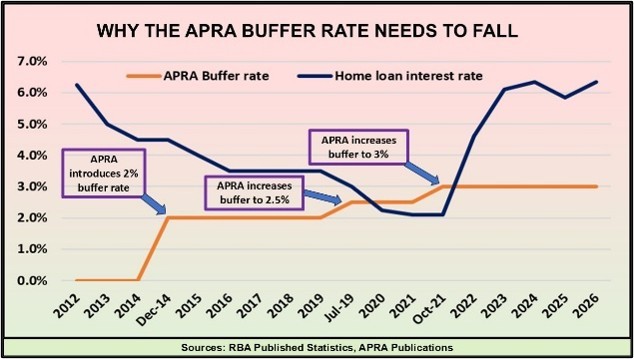
The buffer rate was introduced in 2014 at 2%, and as the graph shows, it has risen every time that interest rates have significantly fallen.
This was to protect the finance lenders from defaulting borrowers if interest rates went up again.
The graph also shows you that interest rates have risen significantly since 2021, when they were just 2%, yet the buffer rate has been kept at 3%.
So APRA increased the buffer rate when interest rates fell but has not reduced the buffer even though interest rates have increased.
They would need to jump to nearly 10% to justify a 3% buffer rate, something which no one is seriously forecasting.
Why its time to cut the buffer rate
Imagine a 1% fall in the buffer rate – it would be the same as the RBA cutting interest rates by 1%, generating a massive boost to borrowing power.
Not just first home buyers, upgraders and investors would benefit, but existing homeowners and investors could refinance at the lower buffer rate, giving them more borrowing power.
The buffer rate needs to come down.
This would not impact the RBA’s work on controlling inflation, but would kickstart the housing market back into growth, something that all property owners, investors, the banks and our governments desperately need.