
Key takeaways
Gentrification follows a predictable script, and the early signs (renovators, cafes, small businesses) show up years before prices reflect the change.
The real opportunity window is while a suburb is transforming, not once it's already "arrived" and everyone can see it.
The ripple effect means demand doesn't disappear when an inner suburb becomes unaffordable, it simply pushes outward to the next ring of suburbs.
Middle and outer ring suburbs with strong fundamentals but a lower price point are where the next wave of growth tends to show up.
Families and long term tenants are drawn to these suburbs for lifestyle reasons, not just cheaper rent, which makes them ideal for building a stable, long term portfolio.
The formula for finding the next ripple is simple: look for strong fundamentals first, then follow where affordability is pushing buyers and tenants.
You can predict a suburb's property values over the next ten years by watching what happens to its coffee.
I'm not joking. Long before auction clearance rates climb and the news outlets declare a suburb has "arrived," there's a small, unglamorous signal that tells you it's already happening.
Once you know how to read it, you'll never look at a neighbourhood the same way again.
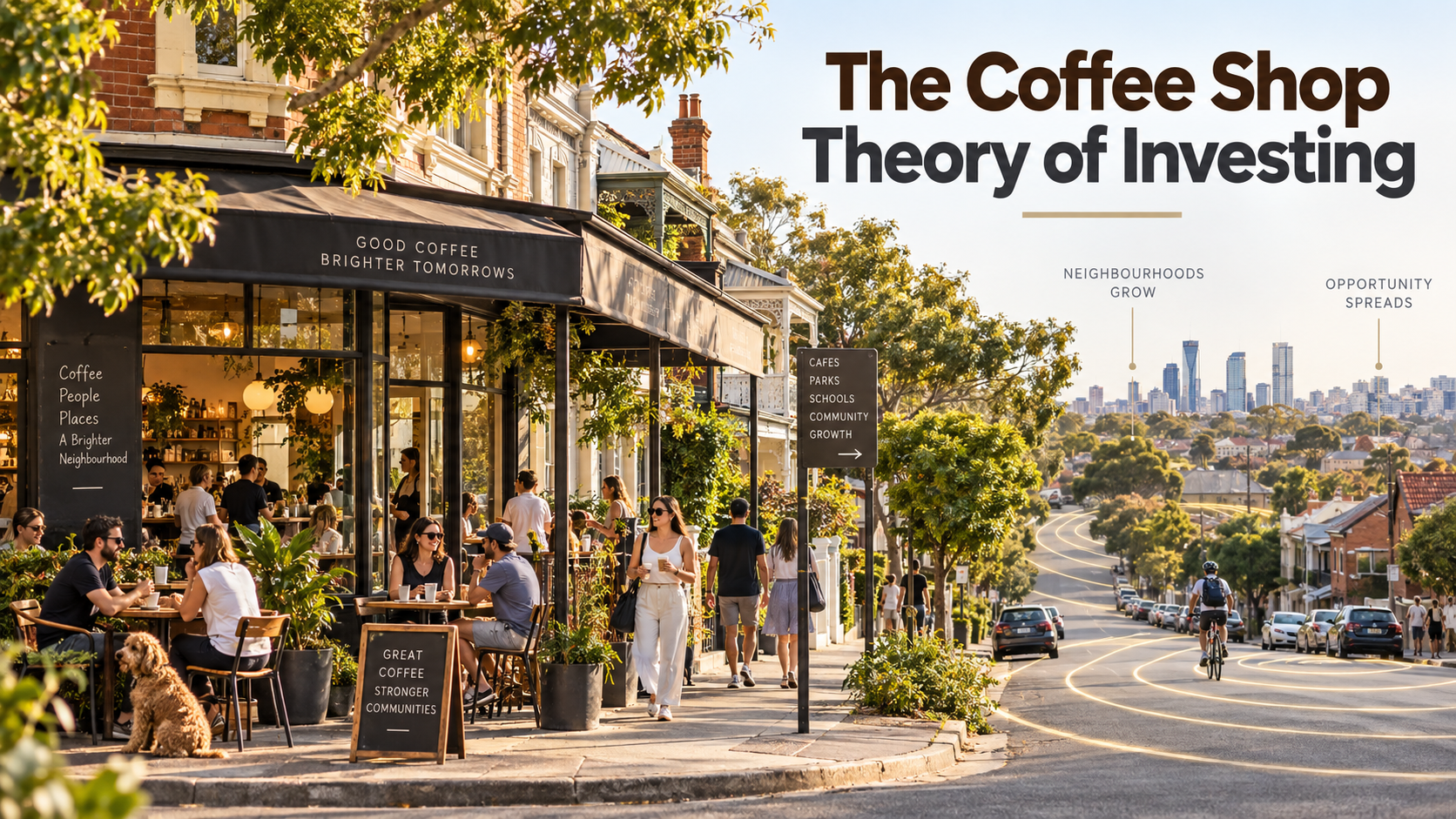
It usually starts with one decent coffee shop.
Someone with taste and a bit of courage opens up in a street that's still rough around the edges. Rents are cheap, the fit-out is basic, but the coffee is good.
Word gets around. The queue gets longer. A second cafe opens because the first one can't keep up with demand, then a bakery, then a wine bar that also sells vinyl records, then a gym that calls itself a studio.
None of this is random.
It's the visible surface of something much bigger unfolding beneath, and property investors who understand it have a genuine edge over those who don't.
This is gentrification, and it follows a pattern
I've written before about gentrification and how predictable it actually is once you understand the stages.
It isn't some mysterious force that descends on a suburb overnight. It's a process, and it tends to follow the same script everywhere from Fitzroy to Fremantle.
Young professionals and creatives move into an inner or middle ring suburb because it's close to the city and still affordable, often because it has good bones.
Think Victorian terraces, wide streets, decent transport links, maybe a bit of industrial heritage that gives it character.
They fix up the run down houses because that's what young professionals with more vision than cash tend to do.
Cafes and small businesses follow the new residents because that's where the spending power is heading.
Then comes the phase every investor should be paying close attention to.
Owner-occupiers with families start looking at the suburb because it's now attracting interest for its school catchment, cafes, and a sense of community forming, but prices haven't caught up with the transformation yet.
The real drivers are the residents arriving with higher incomes, better-paid professional jobs and greater financial capacity. They renovate older homes, support better local businesses and compete for a limited supply of well-located property.
That is gentrification. It is a change in the people and purchasing power of a suburb, rather than a cosmetic improvement or the opening of a new supermarket.
Gentrification creates its own long cycle
One reason I have always been attracted to gentrifying suburbs is that their transformation can continue for decades. A suburb doesn’t move from overlooked to highly desirable in a single property cycle.
The process often begins with people who overlook an area’s old reputation in favour of proximity and affordability. Renovation activity increases, the retail strip improves, and more owner-occupiers take notice.
As household incomes rise, buyers can pay more for housing. Their spending makes better local services viable, improving liveability and attracting further demand for scarce homes.
You can often see the evidence in Census data before the transformation is complete. Look for household incomes rising faster than the state average, more tertiary-educated residents and professionals, more dual-income households, and a growing share of owner-occupiers.
Then walk the streets. Renovations, well-maintained gardens, quality cafés, specialist grocers, upgraded parks and busy local shopping strips can confirm what the numbers are saying.
How the ripple effect carries demand next door
Gentrification also helps explain the ripple effect.
Once a desirable suburb becomes too expensive for part of the market, buyers don’t abandon the lifestyle, employment access and amenities they value. Many search for the closest affordable alternative.
- Also read:Everything you need to know about the state of Australia’s property markets in 20 charts – November 2026

- Also read:Latest Property Price Forecasts. Australian Property Market Outlook 2026-2027: Navigating a Market Correction

- Also read:Brisbane Property Market Forecast [2026 & Beyond] – What The Olympics Decade Means for Investors.
- Also read:Melbourne property market forecast for 2026 & 2027 | Separating the fundamentals from the sentiment
- Also read:Sydney property market forecast for 2026 and 2027 | Why the short-term softness is a long-term opportunity

Demand then spills into an adjoining suburb with similar housing, transport and access to the same employment hubs.
Buyers renovate there. New businesses follow the changing clientele, and the price gap between the two areas starts to narrow.
A premium suburb sets the benchmark, and adjacent neighbourhoods are reassessed as buyers recognise that a boundary road or postcode can produce a sizeable price difference without a significant lifestyle sacrifice.
The ripple can also extend across property types.
When detached houses in a preferred location become unaffordable, many buyers opt for a townhouse, villa or family-friendly apartment nearby rather than moving much farther from work, schools and their social network.
That is an increasingly important point for investors. In our larger capitals, the next stage of demand may shift inward towards more affordable accommodation rather than endlessly outward to remote housing estates.
Why the ripple eventually loses power
The image of ripples spreading across a pond is helpful, although property demand does not travel evenly in every direction and it does not continue with the same strength forever.
Natural barriers, industrial precincts, poor public transport, weak school catchments and major roads can interrupt it.
So can an oversupply of new apartments or house-and-land packages, because scarcity is an important ingredient of sustained capital growth.
There is also a point at which the savings in purchase price no longer compensate for the loss of convenience and liveability. Buyers may prefer a smaller dwelling in a better-established suburb to a large house farther away.
This is why a cheap suburb beside an expensive one does not automatically become the next success story. It needs the fundamentals that allow the lifestyle and demographic change to cross the boundary.
The strength of the ripple varies between cities, so rules based solely on kilometres from the CBD can be misleading.
How to use the theory without being fooled by it
The Coffee Shop Theory should be treated as an observation tool rather than a buying strategy on its own.
One fashionable venue may reflect the optimism of its owner, while a broad and sustained change across local businesses provides more meaningful evidence.
Start with the state’s economy, population growth and employment drivers. Then identify areas with affluent or rapidly improving demographics and strong owner-occupier demand.
Within those areas, look for suburbs adjacent to established premium locations where the price differential remains meaningful and the amenity gap is narrowing. Good transport, walkability, schools, parks and access to several employment hubs matter far more than a clever café name.
Finally, select the right street and property. I favour scarce properties with a high land-to-asset ratio, broad owner-occupier appeal and the potential to create additional value.
Be wary of buying brand-new stock at a premium simply because it is marketed as part of an emerging precinct. Genuine gentrification develops through sustained shifts in who wants to live in an area and what they can afford, and those shifts can’t be manufactured by a glossy brochure.
The bottom line
The best time to notice a changing suburb is before every indicator has become obvious and the transformation has been fully priced in.
Even so, you do not need to be the first person through the door because genuine gentrification usually unfolds over many years.
Watch where ambitious, higher-income households are moving, where their money is being spent and where affordability is pushing demand next.
The coffee shops may help you see the pattern, but the investment case must still be supported by demographics, scarcity, liveability and the right property.
That is the practical value of the Coffee Shop Theory of Investing. It turns an everyday observation into a prompt for deeper research and helps explain how gentrification and the ripple effect can combine to produce above-average long-term capital growth.
This is exactly the kind of location led, fundamentals first thinking we apply for our clients at Metropole, because spotting where the ripple is heading next is worth far more than admiring how far it's already travelled.
If you'd like help identifying where the next ripple is likely to land in your market, or you want a second opinion on a suburb you're already considering, the team at Metropole would be glad to talk it through with you. Click here now to find a time to chat with one of our Wealth Strategists.