

Key takeaways
Australians are getting angrier, but less violent. Verbal abuse, threats and hostility are rising while, interestingly, overall physical assault rates have declined.
Social media has removed the pause between anger and action. Algorithms can also reward outrage by giving provocative content greater reach.
Frontline workers are bearing the brunt of frustration. Retail workers, teachers, nurses and other customer-facing staff are increasingly targeted for problems they did not create.
Financial pressure is shortening Australians’ fuse. Cost-of-living pressures and declining optimism about the future are contributing to frustration and anger.
Businesses can help reduce unnecessary frustration. Better customer service, easier access to real people and stronger support for frontline staff can make a meaningful difference.
Have you noticed that Australians seem to have become a little more short-tempered lately?
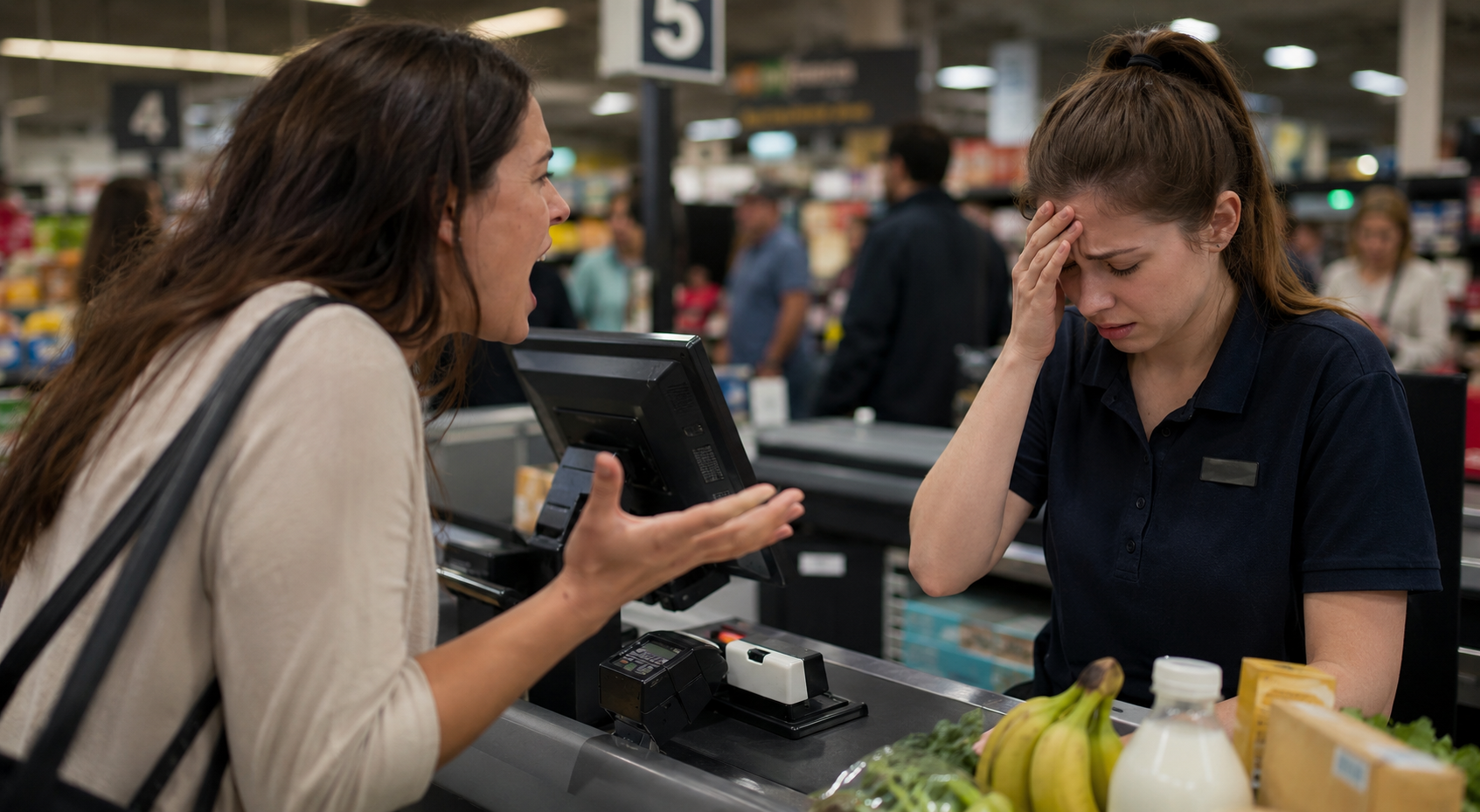
You see it in the supermarket queue when someone takes their frustration out on a teenager behind the checkout.
You hear about parents abusing teachers, nurses dealing with aggressive patients and relatives, and even junior football umpires needing escorts to protect them from angry parents on the sidelines.
And anyone who spends time online knows how quickly a reasonable disagreement can turn ugly.
It would be easy to conclude that Australia has simply become a more violent place, but when leading demographer Simon Kuestenmacher dug into the numbers, he found something more interesting.
Australians appear to be getting angrier and more willing to express that anger, yet at the same time, the country is becoming less physically violent. As Simon put it, Australia is becoming "more peaceful but still yet more angry."
So what has happened to the easygoing Australia we like to imagine ourselves living in?

For weekly insights, subscribe to the Demographics Decoded podcast, where we will continue to explore these trends and their implications in greater detail.
Subscribe now on your favourite Podcast player:
The anger is real
This isn't simply nostalgia for a supposedly friendlier Australia. There is growing evidence that hostility is becoming more common, particularly in workplaces where employees deal directly with the public.
Safe Work Australia data cited by Simon showed a 56 per cent increase in serious workers' compensation claims involving assault or workplace violence in just four years.
Women are disproportionately exposed because they are heavily represented in frontline occupations such as health, education, care, retail and public service roles.
The same pattern is appearing in schools - the proportion of principals reporting threats of violence increased from 38 per cent in 2011 to 54 per cent by 2025, while exposure to physical violence rose from 27 per cent to 48 per cent.
Healthcare workers are experiencing similar problems, with nurses, midwives and carers increasingly dealing with aggression.
What stands out is how often this anger is directed towards people who have little power to solve the underlying problem.
The teenager behind the supermarket counter doesn't determine grocery prices, the nurse didn't create the hospital waiting list, and the airline employee didn't cause the flight delay.
Simon calls this the "name badge" effect. When someone feels powerless against a large organisation or institution, they direct their anger towards the first representative wearing its name badge.
Social media removed the pause button
Human beings didn't suddenly discover anger when Facebook, X, TikTok and YouTube arrived. What changed was how easily we could express it.
Historically, there were natural barriers between feeling angry and acting on that emotion. If you wanted to complain publicly, it usually required some effort, and that delay often gave you time to cool down.
The internet removed much of that friction.
As Simon explained, it didn't create anger, but it removed the barriers that once restrained its expression.
Today there can be almost no delay between feeling offended and telling somebody exactly what you think.
According to eSafety Commissioner figures discussed by Simon, 25 per cent of Australians had seen online hate directed at them before the pandemic.
By November 2022 that figure had risen to 34 per cent. Among Australians aged 18 to 34, almost half had seen online hate and around a quarter had personally experienced it.
It's particularly concerning for children. Simon pointed to eSafety data showing valid cyberbullying reports rising from around 500 before the pandemic to roughly 3,000 in 2024, with nearly half involving children aged 13 or younger.

Note: Technology has given us extraordinary ways to connect, but it has also made it much easier to hurt people without ever seeing the consequences.
The algorithms discovered that anger pays
Social media doesn't merely make anger easier to express - in many cases, it rewards it.
Platforms generally show content to a small audience first and expand its reach if people engage with it. Unfortunately, outrage, controversy and aggressive language are particularly good at generating engagement.
As Simon explained, "the more controversial a topic is, the more angry the language is, the more people this post is being shown."
That creates a feedback loop. People discover that angry posts receive more attention, content creators learn that outrage generates views and revenue, and users end up consuming feeds disproportionately filled with material designed to provoke them.
In this week's episode of Demographics Decoded, Simon gave the example of travel bloggers who found their traditional content was no longer being promoted heavily by YouTube. Some discovered they could restore their reach and income by producing provocative videos designed to generate anger about immigration and cultural change.
The incentives changed, and their behaviour changed with them. As Simon observed, the algorithm wasn't simply uncovering existing behaviour. "It is literally creating it."
Yet Australia is becoming less violent
This is where the data becomes particularly interesting.
- Also read:This week’s Australian Property Market Update – Latest Data, State by State October 20th 2026

- Also read:Latest Property Price Forecasts. Australian Property Market Outlook 2026-2027: Navigating a Market Correction

- Also read:Brisbane Property Market Forecast [2026 & Beyond] – What The Olympics Decade Means for Investors.
- Also read:Melbourne property market forecast for 2026 & 2027 | Separating the fundamentals from the sentiment
- Also read:Sydney property market forecast for 2026 and 2027 | Why the short-term softness is a long-term opportunity
If Australians are angrier, we're inclined to assume we're also becoming more violent. The nightly news can certainly leave you with that impression, but the long-term data tells a different story.
Simon pointed out that the proportion of Australians experiencing physical assault has roughly halved, from around 6 per cent in 2008 to a little over 3 per cent in 2024. Hospitalisations associated with physical assault have also declined, while homicide rates have fallen over the longer term.
There are some important exceptions, including increases in some forms of sexual violence, domestic strangulation and hospitalisations following stranger assaults, so there is no reason for complacency.
But broadly, Australia appears to be experiencing what Simon describes as "less punching but more shouting."
Our perception is partly distorted because violent incidents receive enormous attention.
Note: In a country of around 28 million people, terrible crimes will unfortunately occur regularly, and modern media allows each event to reach us repeatedly through news reports, videos and social commentary.
Meanwhile, the longer-term trend towards lower physical violence rarely receives the same attention.
Financial pressure is shortening our fuse
Technology explains how anger spreads, but it doesn't really explain where the frustration comes from. For that, we need to look at Australian households.
The Scanlon Foundation's social cohesion research cited by Simon found that the proportion of Australians reporting difficulty paying their bills increased from 31 per cent in 2021 to 40 per cent by 2025.
Only 38 per cent believed their lives would improve in the near future, leaving the majority expecting things to remain the same or become worse. That loss of optimism matters because people behave differently when they believe tomorrow will be better than today.
Someone who feels financially secure can usually shrug off a delayed bus, a long queue or an unexpected expense. Someone worried about paying their mortgage or rent, watching grocery bills rise and concerned about job security is likely to have a much shorter fuse.
I've often said that money doesn't necessarily buy happiness, but it does buy choices, security and time, and those things remove a considerable amount of stress from people's lives.
When people feel financially trapped, their time horizon shortens.
Note: Today's problems become more important than tomorrow's opportunities, and that frustration can spill into other parts of life.
We've made everyday life more frustrating
Businesses and governments also need to accept some responsibility for the frustration they've built into everyday life.
Try finding the customer service telephone number on some company websites. When you eventually locate it, you're pushed through automated menus, chatbots and recorded messages before finally reaching a human being.
Remember, people usually contact customer service because something has already gone wrong - by the time they reach a real person, they may have spent 20 minutes arguing with technology that couldn't solve their problem.
The unfortunate employee who finally answers the phone receives the accumulated frustration.
Simon made the point that organisations often design these systems to reduce the cost of handling customer complaints, but the longer-term effect may be to alienate customers and place greater pressure on staff.
There's an important lesson here for business owners. Technology can reduce costs, but companies that make themselves almost impossible to contact may ultimately pay a much larger price through damaged customer relationships and burned-out employees.

Tip: Good service is still a powerful competitive advantage.
Perhaps Australians haven't stopped being nice after all
I don't believe Australians have suddenly become bad people. The data suggests something more complicated.
We're living through a period when financial pressures have increased, optimism about the future has weakened, technology has removed many traditional barriers to expressing frustration, and social media platforms have created powerful incentives for outrage.
At the same time, many of the systems we interact with have become less personal and more frustrating, leaving frontline workers to absorb anger created somewhere else.
Yet beneath all that noise, Australia remains a comparatively peaceful country and physical violence has broadly continued to decline.
That gives me reason for optimism because behaviour can change.
Businesses can better protect frontline staff and make it easier for customers to reach real people. Parents can teach children that online behaviour has real-world consequences.
Individuals can rediscover the discipline of creating a pause between feeling angry and expressing it, while governments have a larger role to play in creating the economic conditions in which Australians feel confident that working hard will improve their standard of living.
Simon worries that we risk losing some of the easygoing nature Australians have traditionally been known for.
I think that's a risk worth taking seriously, but the outcome isn't inevitable.
Note: When people feel secure and optimistic about their financial future, everyday frustrations become easier to tolerate, and they're more likely to give the person on the other side of the counter the benefit of the doubt.
Australia's growing anger is therefore about much more than declining manners. It's a story about technology, incentives, financial pressure and confidence in the future, and understanding those forces gives us a much better chance of reversing the trend.
Perhaps one of the easiest places to start is surprisingly simple: the next time somebody serves you at a supermarket, airport, restaurant or hospital, remember there's a person behind the name badge and say thank you.