


The Reserve Bank of Australia has left the cash rate unchanged at 4.35% as it assesses whether the three interest rate rises delivered earlier this year are doing enough to slow the economy and bring inflation back under control.
The RBA faces a difficult balancing act. Inflation remains too high and another rate rise is still possible.
But there are clearer signs that higher interest rates are slowing growth, particularly in housing, consumer spending and the jobs market.
The central bank said:
With monetary policy judged to be somewhat restrictive, the [RBA] board decided to leave the cash rate target unchanged while it assesses how the economy is evolving.
The RBA noted housing market conditions have eased “considerably”. It will now be watching to see whether the slowdown spreads to the broader economy.

Housing will be important to watch
The housing market is one of the clearest areas where the effects of past interest rate hikes are becoming visible.
For mortgage holders, higher rates mean larger repayments and less money available for other spending. Businesses also face higher financing costs, which can weigh on investment and hiring.
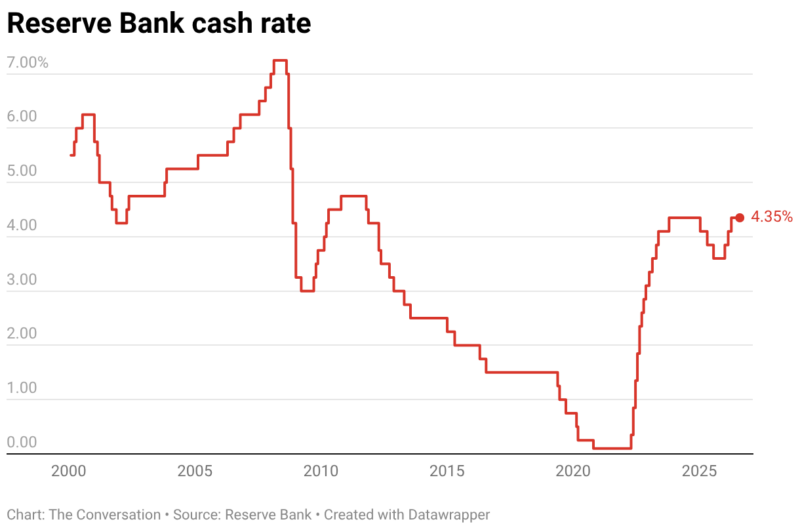
House prices have started to fall, particularly in Sydney and Melbourne, while demand for housing credit is also weakening. Westpac said on Monday mortgage applications have fallen by 20% since the federal budget in May.
The RBA highlighted this shift today, saying:
Momentum in the housing market has shifted, with housing prices falling in some capital cities and new housing loans declining noticeably.
The RBA does not target house prices, but housing matters for the broader economy.
Falling prices can make homeowners feel less wealthy and more cautious about spending, while a weaker housing market can reduce construction, renovations and spending on housing-related goods and services.
If this weakness spills over into broader household spending and economic activity, further rate hikes may not be necessary.
The RBA faces a difficult balancing act
The RBA’s latest forecasts make this trade-off clear.
Underlying inflation, which strips out volatile items, is expected to remain above 3% until mid-2027, before falling to 2.4% in 2028. This reflects continued demand pressures in the economy and higher fuel costs due to the Middle East conflict.
RBA Governor Michele Bullock told a press conference after the board meeting:
The board will raise interest rates further if that is what is required to bring inflation down in a timely way.
- Also read:Melbourne housing market update | October 2026
- Also read:National Vacancy Rate Rises to 1.4% | SQM Research
- Also read:Australian housing market update | October 2026
- Also read:This week’s Australian Property Market Update – Latest Data, State by State October 13th 2026
- Also read:Latest Property Price Forecasts. Australian Property Market Outlook 2026-2027: Navigating a Market Correction




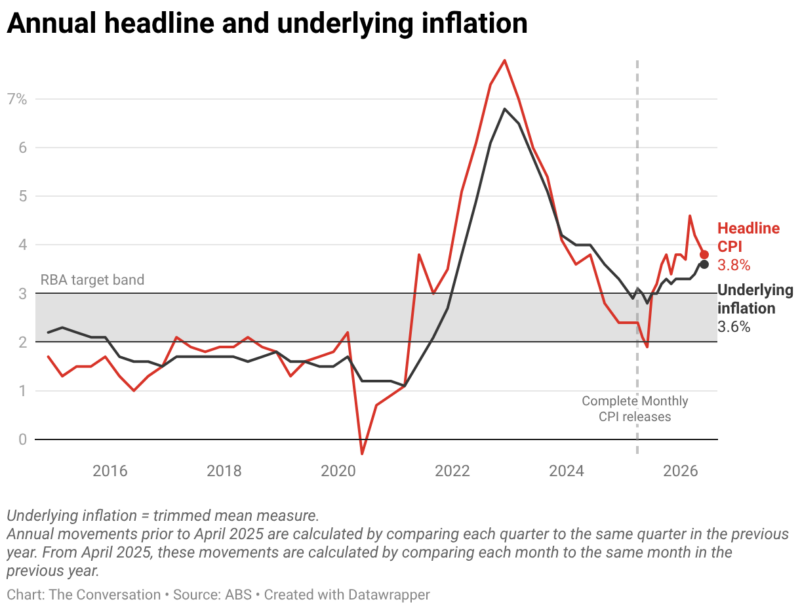
At the same time, economic growth is expected to slow significantly.
The RBA forecasts annual gross domestic product (GDP) growth to fall to just 1.4% by December from 1.9% in June, as high inflation, weaker housing conditions and this year’s interest rate rises weigh on economic activity.
This is the dilemma for the RBA. Inflation remains too high, but the economy is already slowing. Another immediate rate increase could put additional pressure on growth just as the effects of previous increases are becoming more visible.
Interest rate changes take time to flow through the economy, and the three increases delivered since the beginning of the year are still working their way through household spending, business investment and inflation.
The jobs market remains relatively healthy, with unemployment at 4.4%, but there are some signs of that changing.
The RBA said the labour market was a little weaker than it had expected in May.
Inflation risks have not disappeared
Holding rates does not mean the inflation problem is over.
Higher oil prices remain an important risk. A prolonged increase would push up petrol and transport costs and could feed into broader inflation.
This is particularly important, because the RBA does not expect inflation to return to the midpoint of its 2%-3% target range until late 2027. The risks are that inflation will remain higher than forecast.
What happens next?
The recent decision does not mean the rate rise cycle is over. The RBA explicitly left the door open to another increase, saying it:
will continue to do what it considers necessary to bring inflation sustainably back to target, including increasing the cash rate target further if upside risks materialise.
Financial markets are placing the probability of another rate rise by December at 63%.
The next few months will therefore be crucial.
If inflation remains stubbornly high, or businesses increasingly pass higher costs on to consumers, another rate rise remains possible.
But if weakness in housing spreads to household spending and the labour market, the RBA may find that the three hikes it has already delivered are enough.
For now, holding the cash rate steady at 4.35% gives the RBA time to see whether the three previous rate hikes are enough to curb inflation, without unnecessarily weakening the economy.
Guest author is Stella Huangfu, Associate Professor, School of Economics, University of Sydney
This article is republished from The Conversation under a Creative Commons license. Read the original article here.