

Key takeaways
Household purchasing power has been squeezed by inflation, interest costs and tax.
Weak productivity growth makes sustainable improvements in living standards harder to achieve.
Housing reform should help Australia build more efficiently and connect people with jobs.
Property investors need to consider residents’ earning capacity alongside housing scarcity.
A sensible wealth strategy combines quality assets, manageable debt and adequate financial buffers.
You can earn more than you did five years ago and still feel as though you’re going backwards.
For many Australian households, that’s become a familiar experience as everyday expenses, mortgage repayments and tax absorb more of their income, leaving less room to save, invest or enjoy life.
After more than 50 years of investing, I’ve seen plenty of periods when family budgets were under pressure.
What concerns me about this one is how easily we can become distracted by the next interest rate decision while overlooking the longer-term problems affecting our prosperity.
AMP economist Dr Shane Oliver explores this in his analysis, Why have Australian living standards “fallen” and how do we fix it?
His argument deserves attention, because understanding what’s happening to our economy helps us make better decisions about our own financial future.
The figures behind the frustration
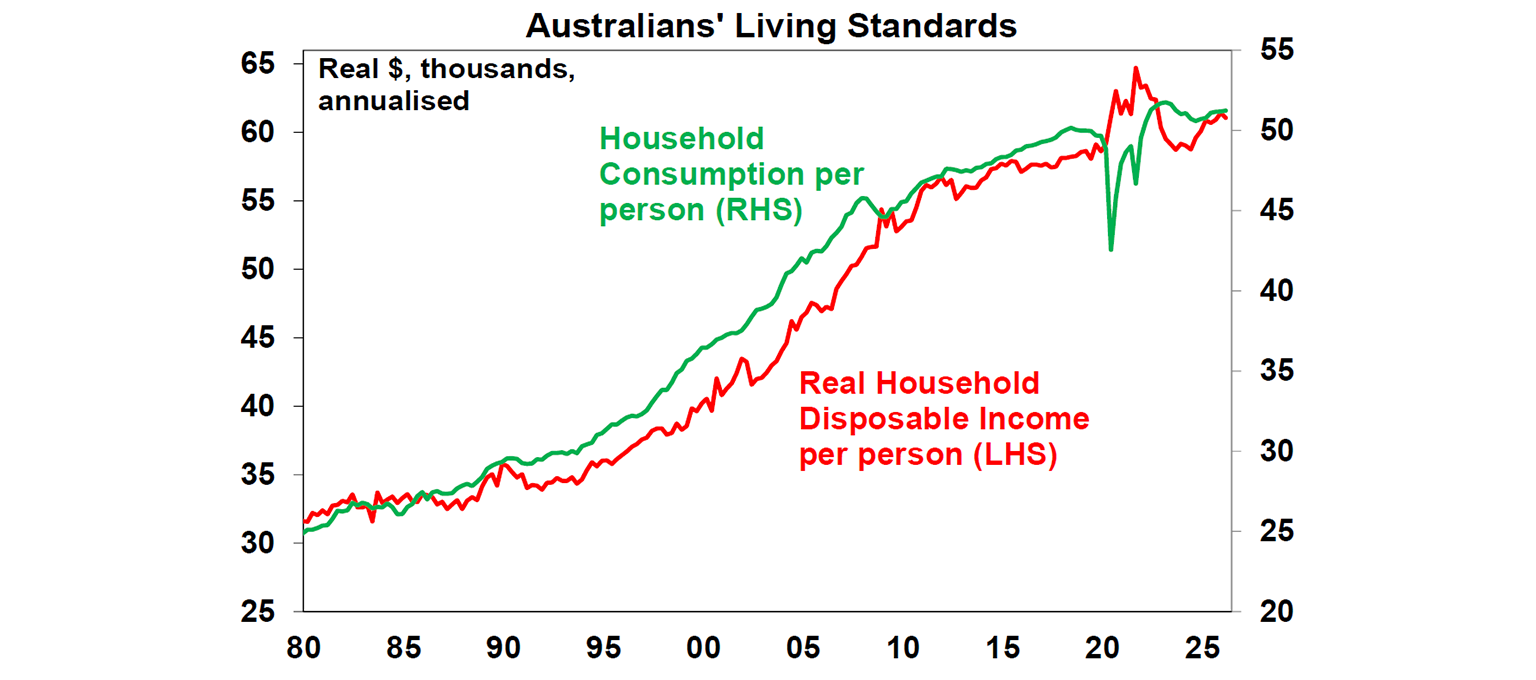
In his analysis, Oliver reported that real household disposable income per person had grown by just 0.6% a year over the preceding decade, compared with 2.3% a year over the previous 20 years.
He also noted that it remained 5.6% below its 2021 peak, although pandemic support payments had temporarily inflated that starting point.
That measure looks beyond the dollars coming in and considers what household income can actually buy after tax, interest costs and inflation.
It’s a useful distinction, because a larger pay packet doesn’t necessarily give you a better standard of living.
Of course, an average can’t describe every household’s experience.
A retiree with savings and no mortgage may have experienced these years very differently from a young family managing a large loan.
Nevertheless, the broader frustration is understandable: people expect years of working, developing their skills and earning more to produce some financial progress.
Source: Dr Shane Oliver AMP
Three things have been squeezing your wallet
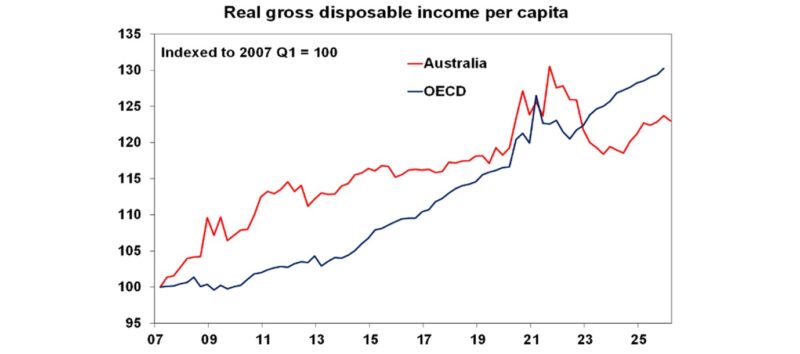
The first culprit is real wages. Since late 2020, prices have risen faster than wages, meaning your pay packet buys less than it used to even though the number on your payslip has gone up.
The second is interest rates. When the RBA lifted rates aggressively from 2022, mortgage repayments took a much bigger bite out of household budgets, particularly here in Australia where most of us are on variable rates rather than the long fixed terms common in the US.
The third is bracket creep, which is a polite way of saying the tax office has been quietly taking a bigger slice of your income as inflation pushes your wages into higher tax brackets without the thresholds moving to match. Tax and interest payments together are now eating up around five per cent more of household income than they were just a few years ago.
These three forces explain a lot of the pain households have felt. But they're not the real story.
Source: Dr Shane Oliver AMP
The deeper problem is productivity, and it's been broken for years
Oliver describes a deeper concern:
“Productivity growth is the main driver of material living standards over long periods.”
He points to a slowdown from growth above 2% a year in the 1990s to near zero since 2016.
Productivity measures how much we produce from the resources we use. Labour productivity, for example, measures output per hour worked.
A simple way to understand it is to imagine a tradesperson using better equipment, a business replacing duplicated paperwork with an efficient system, or a construction team spending less time waiting for materials and approvals.
Each can produce more useful work with the same effort.
Those improvements create room for higher incomes and better services, and the Productivity Commission identifies productivity growth as a primary driver of improvements in Australians’ material living standards.
This is why I think the debate needs to be asking how businesses and governments can make it easier for people to achieve more with their time and skills.
Weak productivity makes managing inflation harder
There’s also a connection between productivity and the interest rate pressures households experience.
When demand increases, an economy needs the capacity to supply more goods and services. If that capacity expands slowly, stronger spending can create greater inflation pressure.
The Reserve Bank explains that productivity is a key determinant of the economy’s supply capacity, and it has lowered its assumption for annual trend productivity growth from 1% to 0.7%.
Of course, there's much more to inflation and the RBA's decisions than productivity, but it means that improving efficiency matters to borrowers as well as businesses.
- Also read:This week’s Australian Property Market Update – Latest Data, State by State October 13th 2026

- Also read:Latest Property Price Forecasts. Australian Property Market Outlook 2026-2027: Navigating a Market Correction

- Also read:Brisbane Property Market Forecast [2026 & Beyond] – What The Olympics Decade Means for Investors.
- Also read:Sydney property market forecast for 2026 and 2027 | Why the short-term softness is a long-term opportunity

- Also read:Melbourne property market forecast for 2026 & 2027 | Separating the fundamentals from the sentiment
An economy that can respond more effectively to demand has a better chance of growing without repeatedly running into inflation constraints.
Why productivity growth stalled
This is where it gets interesting, because the causes go back further than most people realise.
Australia enjoyed decades of strong growth off the back of the big supply side reforms of the Hawke, Keating, Howard and Costello years.
Financial deregulation, tariff cuts, enterprise bargaining, the GST and a genuine culture of economic reform lifted our productivity and our living standards for a generation.
The Economist even ran a cover story in 2018 calling us "the wonder down under." But since around the late 2000s, that reform agenda has essentially stopped.
Governments of both colours have found it easier to spend and regulate than to reform, and for a long time strong commodity export earnings masked the damage, so nobody felt the need to fix it.
A few specific things have made it worse.
Very strong population growth has outpaced our ability to build homes and infrastructure, driving up housing costs and congestion without a corresponding increase in productive capacity.
Business investment stalled throughout the 2010s. Market concentration has increased in many industries, reducing the competitive pressure that normally drives businesses to become more efficient.
Confusion over climate and energy policy has discouraged investment in power generation, driving up energy costs for households and businesses alike.
And perhaps most significantly, government spending has ballooned as a share of the economy, partly through the growth of programs like the NDIS, which has pulled resources away from the private sector, where productivity gains actually occur.

Note: Public sector spending is now running at around 28 per cent of GDP, compared to an average closer to 22.6 per cent over the previous four decades.
This matters because the public sector is inherently less productive than the private sector, and every dollar and every worker that moves from private enterprise to government administration is a dollar and a worker not generating the kind of productivity growth that lifts everyone's living standards.
What would actually fix it
There's no shortage of good ideas floating around, and interestingly, economists across the political spectrum tend to agree on the broad direction, even if they disagree on the details.
Tax reform is usually top of the list, shifting the balance away from income tax and towards a broader consumption tax, indexing tax brackets to inflation so bracket creep stops being a silent tax hike, and scrapping inefficient taxes like stamp duty that discourage people from moving house or investing.
Capping government spending as a share of GDP would force harder choices about what governments actually deliver, rather than letting spending grow indefinitely.
Deregulating housing and labour markets to make it easier to build homes and run businesses would help enormously, particularly given that much of our housing affordability crisis is a supply problem caused by planning and zoning restrictions rather than a demand problem.
Better incentives for business investment and new technology adoption, genuine competition reform to break up concentrated markets, matching population growth to our actual capacity to build homes, and providing more certainty around energy and climate policy would round out the picture.
None of this is complicated in theory. The hard part is political will, and right now there simply isn't much appetite in Canberra for the kind of hard nosed reform that delivered our prosperity in the 1980s and 90s.
What this means for you as an investor
I think it's important to be realistic here without being pessimistic, as there's a difference between the two.
Yes, Australia's productivity performance has been poor, and our household income growth has been the weakest in generations.
That's a real structural headwind for the broader economy and partly explains why so many people feel they're working harder for less.
But this is exactly the kind of environment where owning the right assets matters more than ever.
When wage growth is weak and productivity is stagnant, the gap between those who own appreciating assets and those who don't widens rather than narrows.
Scarce, well-located properties in the inner and middle ring suburbs of our major cities continue to benefit from strong underlying demand, even when the broader economy is sluggish, because population growth, a restricted housing supply, and the ongoing preference for proximity to jobs and lifestyle don't disappear just because productivity growth has stalled.
If anything, some of the very policy failures driving our living standards lower, such as housing supply restrictions and high immigration relative to construction rates, are the same forces that support long-term capital growth for investors who own the right kind of property.
This is also why I've always argued that cash flow keeps you in the game, while capital growth is what gets you out of the rat race. In an economy where real incomes are barely moving, relying on wage growth or rental yields alone to build wealth is a losing strategy.
Compounding capital growth in scarce assets remains one of the few reliable ways to get ahead in a stagnant economy.
I'll also say this… Crises, and slow burning ones like this are still crises even if they don't feel dramatic, tend to eventually force reform.
Australia found its way out of the stagflation of the 1970s through the Hawke and Keating reforms, and history suggests we'll eventually find our way out of this productivity malaise too, even if it takes political pain we haven't seen the appetite for yet.
In the meantime, the investors who do well won't be those waiting for the government to fix the economy.
They'll be those who understand these headwinds, adjust their strategy accordingly, and keep building a portfolio of quality assets that can compound wealth regardless of what's happening with national productivity statistics.
If you'd like to discuss how to position your portfolio for this kind of environment, our team at Metropole would be happy to have that conversation with you. You can book a Wealth Discovery Session with one of our wealth strategists by clicking here now and discuss your options.