


Key takeaways
Australians are losing confidence in property as a legacy asset. More than half of Australians no longer believe they'll be able to pass property wealth on to future generations.
Affordability is making wealth creation harder. High property prices, rising mortgage costs and wages failing to keep pace are making it increasingly difficult for many Australians to enter the market.
Policy changes are influencing investor confidence. Many Australians believe changes to property tax rules and investment incentives have made property a less attractive way to build long-term wealth.
Building wealth now requires a more strategic approach. Long-term success is less about timing the market and more about buying quality assets, managing debt wisely and staying invested through market cycles.
The opportunity hasn't disappeared, but the rules have changed. Strong population growth, limited housing supply and the enduring appeal of quality property still provide solid foundations for investors who think long term.
For decades, home ownership has represented much more than having a roof over your head.
For many Australians, buying property has been the cornerstone of financial security, a way to create choices during retirement, and perhaps most importantly, an opportunity to leave something meaningful for the next generation.
That belief has shaped the financial decisions of millions of families.
But has something changed?
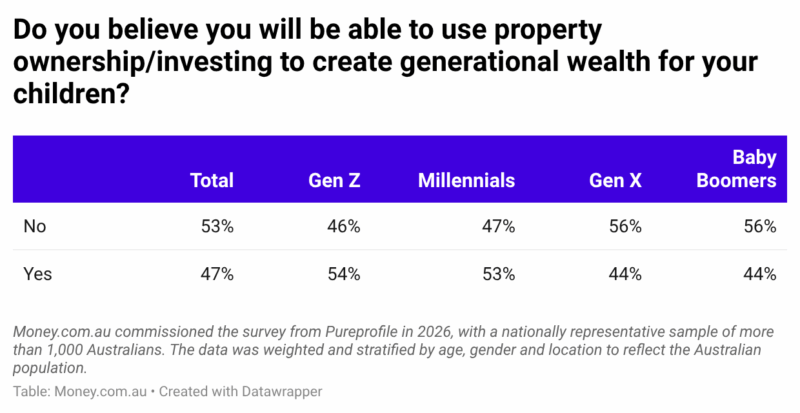
A new national survey from Money.com.au has revealed that 53% of Australians no longer believe they'll be able to pass property wealth on to their children or grandchildren in the same way previous generations did.
At first glance, that's a sobering statistic, however, I think it tells us something much bigger than simply whether Australians are optimistic or pessimistic about property.
It reflects how quickly the rules of wealth creation are changing, how much uncertainty government policy has created, and why strategic investors need to think differently going forward.

Confidence is fading, even though property remains Australia's favourite asset
Property has long been Australia's preferred wealth-building vehicle.
Unlike shares, it provides both income and the opportunity for long-term capital growth. It also allows investors to use sensible leverage, making it possible to build wealth over decades using other people's money in the form of bank finance.
Compared to other asset classes, it gives investors control and also the ability to "manufacture" capital growth through renovations and development.
For generations, that formula has worked remarkably well, yet according to the Money.com.au survey, more Australians now believe that opportunity is slipping away than believe it still exists.
Now that's a significant psychological shift because whenever confidence changes, investment behaviour follows.
People delay decisions. They wait for certainty. They assume the opportunity has already passed.
Ironically, those periods often become the moments that create the biggest opportunities for long-term investors.
Housing affordability has become the biggest obstacle
The survey found exactly what most Australians already know, with high property prices and mortgage costs identified as the biggest barrier, with 51% of respondents saying affordability has made entering the property market too difficult.
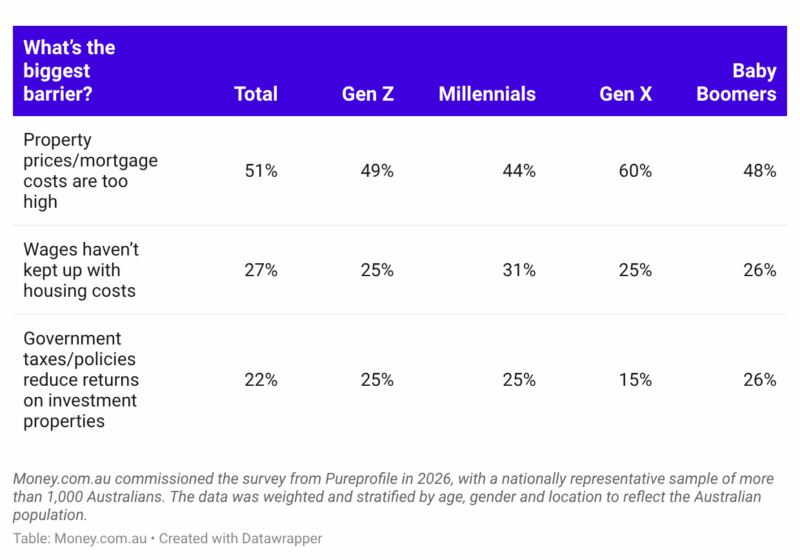
Another 27% said wages simply haven't kept pace with housing costs, while 22% blamed government taxes and policy changes for reducing the attractiveness of investing in property.
Of course, none of this should surprise us as over the past decade, property prices have generally grown faster than incomes, particularly in our major capital cities.
At the same time, borrowing capacity has been squeezed by higher interest rates and stricter lending standards.
For younger Australians trying to save a deposit, the goalposts seem to move every year, so it's understandable that many are questioning whether they'll ever achieve what their parents managed.
Government policy is adding another layer of uncertainty
Affordability isn't the only issue.
Recent government announcements have fundamentally changed how many Australians think about investing.
Restrictions on negative gearing, replacing the 50% capital gains tax discount and banning new SMSF borrowing for residential property have all sent a message that residential property investment is becoming less attractive.

Note: Whether you agree with these policies or not, they have created uncertainty, and uncertainty discourages investment.
I've seen this play out before - whenever governments change the rules, some investors retreat to the sidelines while they work out the implications.
Unfortunately, fewer investors generally means fewer rental properties being built or purchased, which only worsens Australia's already chronic housing shortage.
The most surprising finding came from older Australians
One result in the survey stood out to me.
Baby Boomers and Generation X were actually less confident than younger Australians about passing property wealth to future generations.
Around 56% of both groups believed they would not be able to do so, compared with 47% of Millennials and 46% of Generation Z.
At first, that seems counterintuitive - surely those who already own property should feel more confident?
But perhaps not...their concerns are understandable.
They're the generation currently thinking about estate planning, retirement funding and how future tax changes may affect what they ultimately leave behind.
- Also read:Melbourne housing market update | September 2026

- Also read:Australian housing market update | September 2026

- Also read:Latest Property Price Forecasts. Australian Property Market Outlook 2026-2027: Navigating a Market Correction

- Also read:Brisbane Property Market Forecast [2026 & Beyond] – What The Olympics Decade Means for Investors.
- Also read:Melbourne property market forecast for 2026 & 2027 | Separating the fundamentals from the sentiment
Many are also watching their children struggle to buy their first home and wondering whether the traditional pathway to wealth has become much harder.
Wealth creation has never been automatic
One mistake I see repeatedly is assuming previous generations had it easy.
Yes, housing was cheaper relative to incomes in many periods, but every generation faced its own challenges.
Double-digit interest rates, recessions, high unemployment, property crashes and credit rationing.

Tip: What separated successful investors wasn't that conditions were perfect. It was that they adapted.
They understood that wealth isn't created by waiting for ideal circumstances.
It's created by consistently buying quality assets and holding them long enough for compounding to do the heavy lifting. That principle hasn't changed.
The opportunity hasn't disappeared. It's evolved.
While headlines often focus on affordability challenges, it's worth remembering something important.
Australians continue to need homes, and our population continues to grow.
We're still not building enough dwellings to meet demand as quality land in desirable suburbs remains scarce.
Those structural drivers haven't gone away.
In fact, many of them have become even stronger.
The difference today is that succeeding requires more strategy than it did twenty or thirty years ago.
Investors can no longer rely on buying almost any property and expecting exceptional results.
They need to buy investment-grade properties. They need to manage debt prudently. They need to think in decades rather than election cycles.
And increasingly, they need expert advice to navigate a far more complex landscape.
The real legacy isn't just property
The survey highlights something important.
Many Australians are worried they won't be able to leave behind the same financial legacy as previous generations.
Now I understand that concern, but I also think we're looking at the issue through the wrong lens.
The greatest gift parents can pass on isn't simply a house; it's financial education, and it's teaching children how wealth is created.
It's helping them understand delayed gratification, sensible borrowing, investing for the long term and making good financial decisions.
Note: Property may well remain part of that legacy, but the knowledge of how to build wealth is even more valuable because it can be applied in any economic environment.
A reason to remain optimistic
Despite today's challenges, I remain optimistic about Australia's long-term future.
Our population is growing, our economy continues to attract skilled migrants, and quality residential property remains a scarce asset in locations where people genuinely want to live.
Yes, the path to wealth creation has become more demanding than it was a generation ago - but that doesn't mean the opportunity has disappeared.
It simply means that success will increasingly belong to those who take a strategic approach rather than chasing shortcuts.
Every generation believes it faces unique challenges, and every generation does.
Yet history shows that disciplined investors who focus on high-quality assets, ignore the noise and think long term continue to build substantial wealth.
The rules may have evolved, but the principles haven't.
Those who understand that distinction will still be well placed not only to build wealth for themselves, but to create opportunities for the generations that follow.