

Key takeaways
For financially ready Australians, the bigger risk may be delaying investment rather than taking action.
Doing nothing can quietly widen the gap between the lifestyle people want in retirement and the income they are likely to have.
Inflation means today’s idea of a comfortable retirement income will need to be much higher in 15 or 20 years.
Property remains a powerful wealth-building vehicle because it offers enduring demand, leverage and the ability to add value.
Not all property is investment-grade, and buying the wrong asset can hold investors back for years.
Investors should be cautious of high-rise apartments in large complexes, outer-fringe estates with endless land supply, and lower-income areas with limited capacity for long-term rental and capital growth.
The best investment properties are usually in established, built-up locations with constrained supply and strong owner-occupier demand.
Investors should look for areas where local residents have above-average incomes and the capacity to pay more over time.
Boutique apartments, townhouses in small complexes and well-located freehold homes can all work, provided the fundamentals are right.
Successful investing is about strategy, asset selection and time in the market, rather than chasing hotspots or reacting to short-term headlines.
The real question for many Australians is whether they can afford the long-term cost of inaction.
There’s a lot of noise around property at the moment.
Rising living costs, higher mortgage repayments, budget uncertainty and constant media commentary have left many Australians wondering whether now is really the right time to invest.
That’s understandable, but for those who are financially ready, the bigger risk may not be buying the wrong property at the wrong time.
It may be doing nothing at all.
Because while the headlines change from week to week, one thing doesn’t change: time keeps moving.
And for many Australians, the financial gap between where they are today and where they need to be in retirement is quietly getting wider.

The human side of the rental crisis
Most of the debate around property investment focuses on investors, home buyers, interest rates and government policy.
But there’s another group that often gets left out of the conversation: the people who simply need somewhere safe and secure to live.
Australia’s rental shortage is not just a property market issue; it's a human issue.
More Australians are experiencing housing stress, rental insecurity and homelessness, and one of the most vulnerable groups is middle-aged women.
Many have gone through divorce, family breakdown, illness, job loss or years out of the workforce caring for others, only to find themselves priced out of secure accommodation later in life.
That should concern all of us, but private investors provide a large share of Australia’s rental accommodation.
So when investors are discouraged, rental supply tightens further, and the people with the least financial power often feel the consequences first.
A healthy property investment market does not just help investors build wealth, it also helps provide homes for tenants.
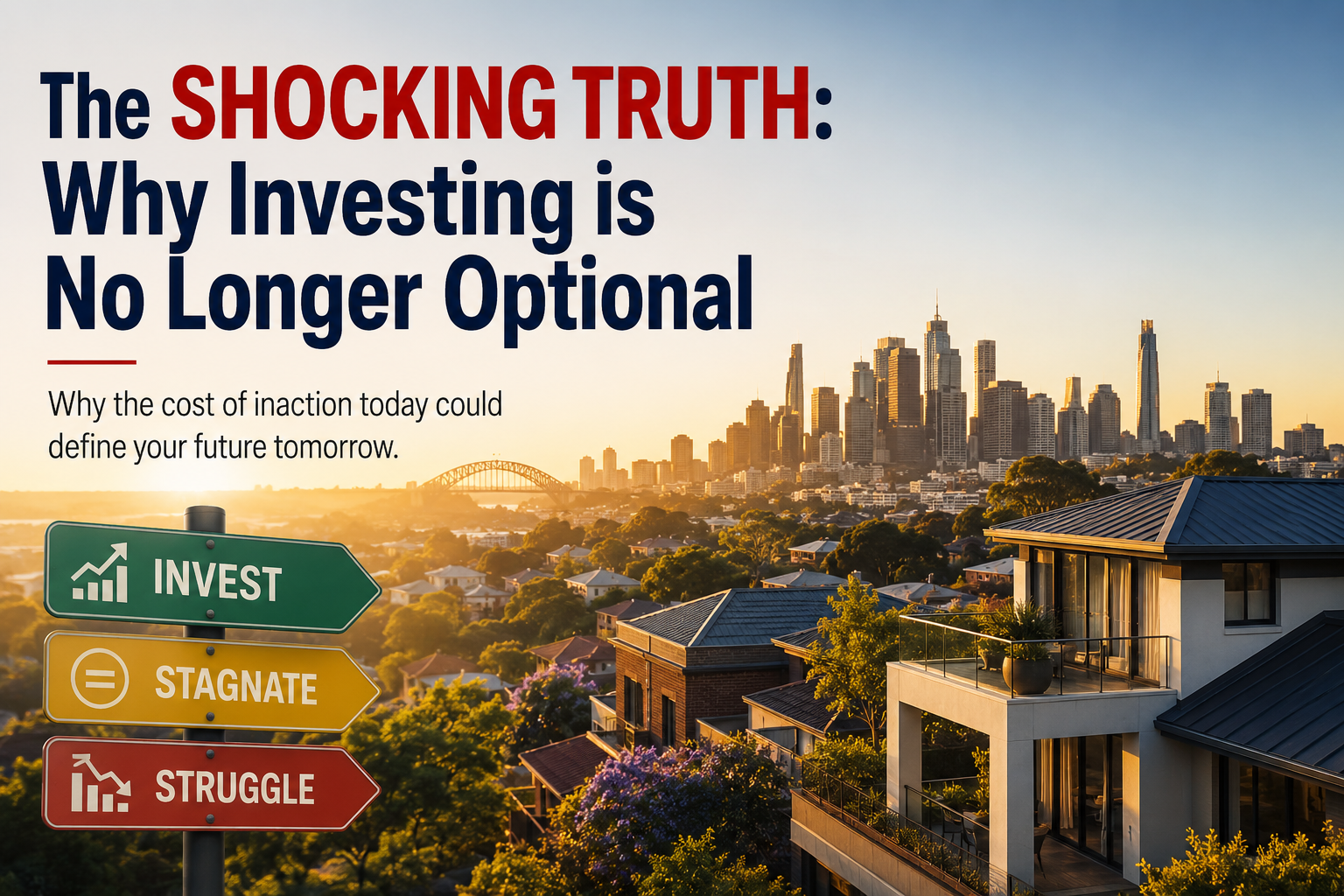
The three financial futures many Australians face
Regardless of what governments do, what interest rates do, or what the media says this month, most Australians are still heading toward one of three financial outcomes.
The first is a comfortable financial future, where they have built enough wealth and passive income to enjoy choice, freedom and security.
The second is a stagnant future, where they have some superannuation and perhaps some savings, but not enough to live the life they expected.
The third is a crisis future, where they are largely dependent on government support and forced to compromise their lifestyle in retirement.
That may sound blunt, but it’s the reality many Australians are not being encouraged to think about early enough.
A retirement income that feels comfortable today will not feel the same in 15 or 20 years. Inflation quietly erodes purchasing power.
What costs $150,000 a year today could require well over $200,000 a year in the future just to maintain the same lifestyle.
At the same time, relying on the age pension as a long-term plan is becoming increasingly risky.
The pension may still exist in some form, but it is unlikely to provide the lifestyle most Australians want after decades of hard work.
That means many people need to build their own financial future, and the earlier they start, the easier it is.
The cost of waiting
One of the biggest mistakes investors make is assuming that waiting feels safe.
In reality, waiting can be expensive.
Every year you delay, you lose another year of capital growth, rental growth, compounding and debt reduction.
A well-selected $500,000 property bought today could potentially add hundreds of thousands of dollars, or even more, to an investor’s long-term wealth position over the next couple of decades.
A better-quality $1 million asset in the right location could become worth considerably more over time, provided it has the right fundamentals supporting it.
Of course, not every property will do this. That’s why selection matters.
But the principle remains the same: time in the market, combined with the right asset, is one of the most powerful wealth-building advantages investors have.
Why property remains such a powerful wealth vehicle
There are many ways to build wealth.
Shares, ETFs, businesses, superannuation and other investments all have a role to play in a diversified financial plan.
But residential property has some unique advantages, particularly for Australians who want to build a long-term asset base.
The first advantage is demand.
Everyone needs somewhere to live. And in well-located suburbs with strong incomes, limited supply and ongoing owner-occupier appeal, demand tends to remain strong through the ups and downs of the cycle.
The second advantage is leverage.
Property allows investors to control a large asset with a relatively small amount of their own money. That means a well-selected property can amplify the return on the investor’s initial capital.
This cuts both ways, of course, which is why borrowing needs to be managed carefully. But used wisely, leverage is one of the reasons property has helped so many Australians create substantial wealth.
The third advantage is the ability to add value.
With shares, you are largely a passive participant - you buy the asset and hope the business performs well.
With property, you can often improve the outcome through renovations, better property management, improved rental returns, subdivision potential, development upside or simply buying an underperforming asset in a superior location.
- Also read:Melbourne housing market update | September 2026

- Also read:Australian housing market update | September 2026

- Also read:Latest Property Price Forecasts. Australian Property Market Outlook 2026-2027: Navigating a Market Correction

- Also read:Brisbane Property Market Forecast [2026 & Beyond] – What The Olympics Decade Means for Investors.
- Also read:Melbourne property market forecast for 2026 & 2027 | Separating the fundamentals from the sentiment
That does not mean every investor should renovate or develop, but it does mean property gives investors more control than many other asset classes.
But not all property is investment-grade
This is where many investors get into trouble.
They understand that property can be a great wealth-building tool, but they assume any property will do.
It won’t. The wrong property can hold you back for years.
Some properties look affordable, but they are cheap for a reason.
Others may offer attractive rental yields, but they lack the scarcity and owner-occupier demand needed for strong long-term capital growth.
In my view, investors should be particularly careful with large high-rise apartment complexes where there are dozens, or even hundreds, of very similar units competing against each other.
When there is little difference between one apartment and the next, scarcity disappears. And without scarcity, strong capital growth becomes much harder to achieve.
Investors should also be cautious about outer-fringe suburbs where there is an abundance of developable land.
When Stage 1 becomes Stage 10, then Stage 20, then Stage 30, there is always more supply coming. That makes it harder for values to rise strongly because buyers have plenty of alternatives.
Lower-income locations can also carry added risk.
If local household incomes are stretched, there may be less capacity for rents and property values to grow over time.
These areas can also be more exposed to mortgage stress, unemployment and affordability pressures when economic conditions become tougher.
What investors should look for instead?
The best investment properties tend to have a few common ingredients.
They are usually in established, built-up locations where there is limited new supply.
They appeal to owner-occupiers, not just tenants or investors.
They are in areas where local residents have above-average incomes and the capacity to pay more over time.
And most importantly, they have genuine scarcity.
That scarcity may come from land value, location, architectural character, school zoning, lifestyle appeal, proximity to transport, walkability, or being surrounded by amenities that cannot easily be replicated.
For some investors, that may mean a boutique apartment in a small block in an established suburb.
For others, it may mean a townhouse in a tightly held location with strong demand from downsizers, professionals, young families or executive tenants.
And for those with the right budget, it may mean a freehold house or villa-style property in a desirable school zone or lifestyle precinct.
The property type matters less than the fundamentals.
The real question is whether the asset is scarce, desirable and located in an area where people will have the income capacity to pay more for it in the future.
If the answer is yes, you are much more likely to own an asset that grows in value over time.
If the answer is no, you may be taking on more risk than you realise.
The real decision investors face
It’s easy to get caught up in short-term uncertainty.
There will always be reasons to hesitate.
Interest rates may move. Governments may change policy. Budgets may create uncertainty. The media will always find something to worry about.
But successful investors learn to separate noise from fundamentals.
They understand that wealth is built by owning the right assets for long enough, not by waiting for perfect conditions.
Of course, not everyone should invest right now.
Some people need to reduce debt, improve their cash flow, build buffers or get their financial house in order first.
But for those who are financially ready, the question is not simply whether property investing feels comfortable today.
The more important question is whether doing nothing will leave them financially exposed in 10, 15 or 20 years.
Because inaction has a cost.
And for many Australians, that cost may only become obvious when it is too late to easily catch up.
Final thought
Property investing is not about chasing hotspots or buying whatever looks affordable.
It is about making strategic decisions today that give you more choices tomorrow.
The right property, in the right location, bought with the right strategy, can help build the financial future many Australians will need but too few are planning for.
So while uncertainty may make some people pause, it should not make serious investors stand still.
The key is not just to invest. It is to invest wisely.