


Key takeaways
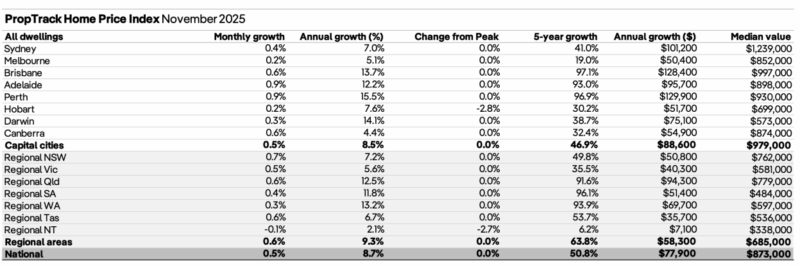
National home prices rose 0.5% in November according to PropTrack, pushing values to a new record. However, the pace of growth slowed compared to October.
Prices have risen 8.7% nationally over the past year – adding around $77,900 to the value of the median home ($873,000) – to sit 51% higher than five years ago.
Capital city prices rose 0.5% in November and were up 8.5% year on year, with values at record highs.
Perth (+0.9%), Adelaide (+0.9%), Brisbane (+0.6%) and Canberra (+0.6%) led monthly growth among the capitals.
All capitals hit record highs except Hobart (–2.8% below peak), but all saw slower monthly growth compared with October.
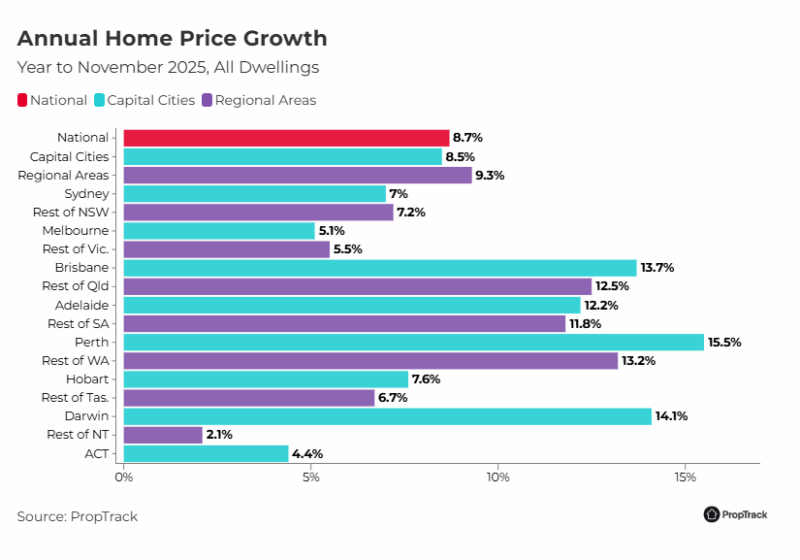
Over the past year, Perth (+15.5%), Darwin (+14.1%), and Brisbane (+13.7%), recorded the largest gains out of the capitals, while WA (+13.2%) and Queensland (+12.5%) led the regions.
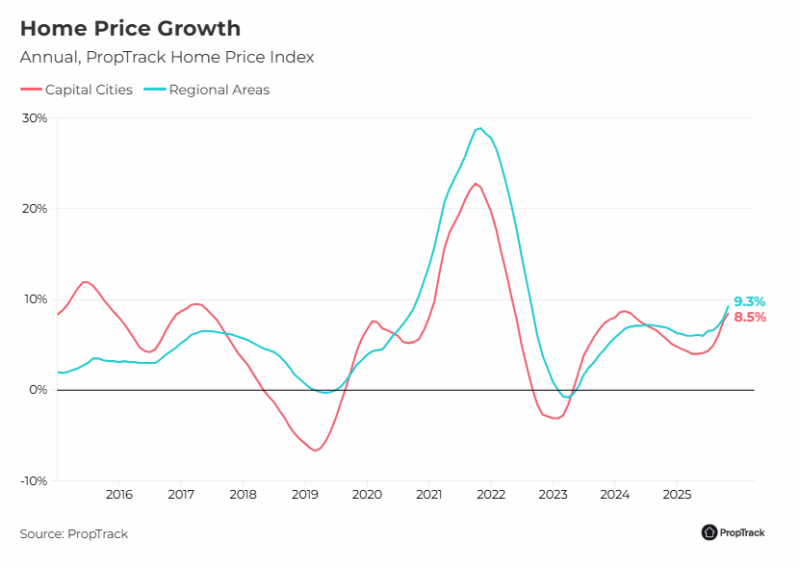
Regional prices climbed 0.6% in November and were up 9.3% year-on-year. Regional growth has outpaced the capitals over the past year (9.3% vs 8.5%) and past five years (64% vs 47%), supported by relative affordability and lifestyle appeal. However, regional outperformance is narrowing as the stronger acceleration in home prices is now coming from the capitals.
National home prices rose 0.5% in November and are now 8.7% higher than a year ago, the fastest annual growth since mid-2022, according to PropTrack.
Momentum has firmed throughout 2025, but stretched affordability means growth remains well below the 20-30% annual gains seen in past booms.
Eleanor Creagh, Senior Economist at PropTrack said:
"Lower interest rates, increased borrowing capacities, and a recovery in sentiment have underpinned this year’s reacceleration.
Darwin, Hobart, Melbourne, Canberra and Sydney have recorded a strengthening in annual growth compared with late 2024."
PropTrack data also shows that Brisbane, Adelaide and Perth continue to record strong price rises, but growth is no longer accelerating relative to this time last year.
In each of these capitals, unit growth is outperforming houses both quarterly and annually as buyers pivot toward more attainable options.
Regional prices climbed 0.6% in November and were up 9.3% year-on-year.
- Also read:Melbourne housing market update | October 2026

- Also read:National Vacancy Rate Rises to 1.4% | SQM Research

- Also read:Australian housing market update | October 2026

- Also read:This week’s Australian Property Market Update – Latest Data, State by State October 13th 2026

- Also read:Latest Property Price Forecasts. Australian Property Market Outlook 2026-2027: Navigating a Market Correction

The report also highlights that regional growth has outpaced the capitals over the past year (9.3% vs 8.5%) and five years (64% vs 47%), supported by relative affordability and lifestyle appeal.
However, regional outperformance is narrowing as the stronger acceleration in home prices is now coming from the capitals.
Key Findings
- National home prices rose 0.5% in November, pushing values to a new record. However, the pace of growth slowed compared to October.
- Prices have risen 8.7% nationally over the past year – adding around $77,900 to the value of the median home ($873,000) – to sit 51% higher than five years ago.
- Capital city prices rose 0.5% in November and were up 8.5% year on year, with values at record highs.
- Perth (+0.9%), Adelaide (+0.9%), Brisbane (+0.6%) and Canberra (+0.6%) led monthly growth among the capitals.
- All capitals hit record highs except Hobart (–2.8% below peak), but all saw slower monthly growth compared with October.
- Over the past year, Perth (+15.5%), Darwin (+14.1%), and Brisbane (+13.7%), recorded the largest gains out of the capitals, while WA (+13.2%) and Queensland (+12.5%) led the regions.
- Regional prices climbed 0.6% in November and were up 9.3% year-on-year. Regional growth has outpaced the capitals over the past year (9.3% vs 8.5%) and past five years (64% vs 47%), supported by relative affordability and lifestyle appeal. However, regional outperformance is narrowing as the stronger acceleration in home prices is now coming from the capitals.
Outlook
PropTrack reports that population inflows, a lift in investor activity, and the expanded Home Guarantee Scheme have reinforced demand, alongside this year’s series of interest rate cuts.
Ms Creagh notes:
"The federal government’s low-deposit, shared equity scheme will open for applications from Friday, December 5.
At the same time, total stock on market has been tight, and the delivery of new housing remains constrained, tilting conditions toward sellers.
These factors point to further price gains through summer.
However, monthly growth eased across the capitals from October’s stronger pace, and with interest rates now expected to remain on hold for an extended period, affordability constraints are likely to see price growth moderate throughout 2026."