

Key takeaways
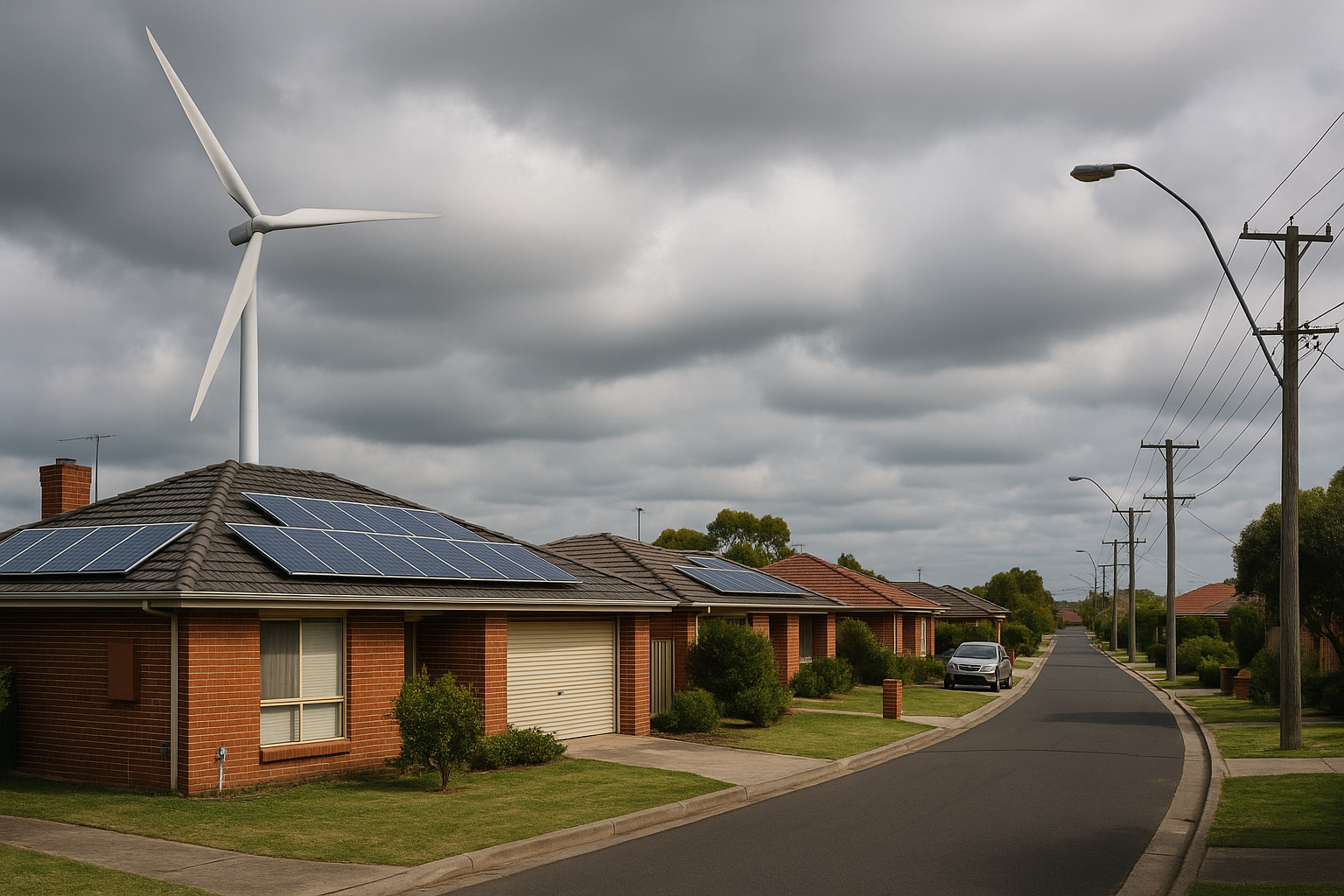
Australia’s push to reach net zero by 2050 will require around $3 trillion in investment, or roughly $100 billion a year.
That’s about 14% of current government revenue, making it one of the most expensive national projects in history, with long-term implications for taxation and government spending.
Fossil fuel taxes and royalties currently generate $70–80 billion annually, but Treasury forecasts these could fall by $40–60 billion a year by the mid-2030s.
With national debt already above $1 trillion, governments will likely raise taxes or broaden the tax base to fill the gap.
Even if much of the transition is funded privately, the costs will filter down to households through higher energy prices, new road-user charges, broader GST, and tighter housing and superannuation concessions.
This will reduce disposable income and borrowing capacity, putting downward pressure on property price growth.
Higher taxes and energy costs will mean slower, more income-linked property growth.
Australia’s race toward net zero emissions is well underway – but few people realise the enormous economic cost that comes with it, or how it could reshape the nation’s housing market for decades to come.
According to BloombergNEF data reported by Macrobusiness, Australia will need to invest around $3 trillion by 2050 to achieve net zero.
That’s roughly $100 billion every year – about 14% of the Commonwealth’s current annual revenue.
To put it simply: achieving net zero will be one of the most expensive projects in our nation’s history, and it will fundamentally alter the way governments tax, spend, and support household wealth.
And make no mistake – that includes property prices.
Politicians love to talk about clean energy, but they rarely talk about how we’ll pay for it.
Even if private investors fund much of the transition as the government hopes, governments will still be heavily involved through subsidies, tax concessions, and regulatory guarantees.
So if these plans go ahead, it will mean much more than just an environmental shift – it’s a permanent restructuring of Australia’s fiscal base.
You see…for decades, fossil-fuel royalties and taxes have quietly underwritten our national and state budgets.
The fuel excise, coal and gas royalties, and the petroleum resource rent tax (PRRT) together bring in $70–80 billion a year – around 3% of GDP.
However, Treasury’s 2025 Net Zero Economic Modelling warns these revenues could shrink by $40–60 billion a year by the mid-2030s.
Yet at the same time, our national debt has surpassed $1 trillion, and major spending commitments – from aged care to defence to the NDIS – are locked in.
So, what happens when the government loses billions in revenue but still has to spend more?
The only realistic lever left is higher taxes.
The ripple effect on households
Even if governments claim that the private sector will shoulder the net-zero bill, the truth is that those costs eventually land on households.
Investors demand returns. Every dollar poured into new renewable projects, power grids, and electrification must be recouped – often through higher electricity prices, energy tariffs, and product costs.
This means that households will likely face new or expanded taxes:
- Road-user charges replacing fuel excise
- A broader GST base
- Tighter superannuation and housing tax concessions
- And perhaps even a revived carbon pricing scheme
All of this reduces disposable income and, crucially, borrowing capacity which is the lifeblood of the housing market.
How fiscal gravity will hit the housing market
Property values are ultimately driven not by what people earn, but by what they can borrow.
When taxes rise and energy costs climb, household budgets tighten.
Combine that with a world where interest rates are structurally higher than the ultra-low settings at the beginning of this decade, and borrowing power inevitably contracts.
That means slower property price growth across much of Australia.
The effects won’t be uniform, though:
- Also read:Latest Property Price Forecasts. Australian Property Market Outlook 2026-2027: Navigating a Market Correction

- Also read:Brisbane Property Market Forecast [2026 & Beyond] – What The Olympics Decade Means for Investors.
- Also read:Melbourne property market forecast for 2026 & 2027 | Separating the fundamentals from the sentiment
- Also read:Sydney property market forecast for 2026 and 2027 | Why the short-term softness is a long-term opportunity
- Also read:Adelaide housing market update | September 2026

- Coal and gas regions – such as parts of Queensland, the Hunter Valley, and WA – will likely see job losses and weaker local economies as fossil industries decline.
- Renewable energy zones may experience short-term booms during construction but often don’t sustain population or long-term demand.
- Capital cities, while more insulated thanks to job diversity and migration, will lose some of the tailwinds that drove their long boom: cheap credit and generous tax concessions.
The result will be a flatter, more income-linked housing market, with modest nominal gains, little “real” growth, and widening performance gaps between premium and secondary property.
Why prime eastern-seaboard property still wins
Despite these headwinds, not all property markets are created equal.
The fundamentals that drive investment-grade real estate remain strong in key inner-city locations along the eastern seaboard – Sydney, Melbourne, and Brisbane in particular.
Here’s why:
- Income strength – Those with multiple streams of income or higher paying jobs will still have the borrowing power to support demand.
- Scarcity – Tight planning rules and limited land supply will keep inner and middle ring property markets resilient.
- Global appeal – Australia’s cities are seen as politically stable, climate-resilient havens, and there will be ongoing demand from migration and offshore buyers.
- Rental demand – Migration-fuelled population growth and record-low vacancy rates will keep rents rising.
Put simply, quality properties in desirable locations will outperform the average, even in a lower growth world.
From boom psychology to fiscal realism
As fossil revenues fade and spending obligations grow, governments will lean more heavily on taxpayers.
It is likely that the average Australian will face higher taxes, slower income growth, and less borrowing power – all of which suppress property inflation.
That doesn’t mean a property crash – far from it.
With strong population growth, limited housing supply, and inflation running higher for longer, prices are more likely to grow more slowly rather than fall.
But it does mean that future capital growth will depend more on property quality and location than ever before.
The new housing hierarchy
Australia’s energy transition is likely to permanently reshape property performance.
Winners:
Well-located, high-income inner-urban areas such as Sydney’s Eastern Suburbs, Inner West, and North Shore; Melbourne’s Bayside and inner-east; Brisbane’s inner-riverside precincts; and select Gold Coast locales are likely to outperform.
Losers:
Outer-suburban and regional areas reliant on fossil industries or low-income employment bases are likely to feel the pinch first as higher taxes and higher interest rates hit household budgets.
In short: geography, income resilience, and scarcity will define property performance in the net-zero era.
The bottom line
Reaching net zero is an environmental imperative – but if we pursue it at any cost, it risks becoming a fiscal and social burden too.
Australia’s transition will drain the revenues that funded our prosperity, while demanding trillions in new spending.
Without major productivity gains or genuine tax reform, households and, by extension, property markets, will bear the cost.
The next chapter of our property story won’t be a boom or a bust. It will be a slow, steady glide upwards, where quality assets outperform.
Overall prices will move roughly in line with wages, not far ahead of them.
And in that world, well-located, scarce, investment-grade properties near our major capitals will be the only true hedge against the fiscal gravity of net zero.