


Key takeaways
Australia’s population growth is increasingly driven by migration, with nearly one in three residents now born overseas. This creates strong long-term demand for housing, particularly in major capital cities.
India has overtaken England as Australia’s largest overseas-born population group for the first time. Indian migrants are concentrated in Melbourne and Sydney and tend to have strong aspirations for homeownership.
Migrants are arriving younger than in previous decades, supporting both rental demand and future first-home buyer activity. This underpins demand for apartments and entry-level housing in well-located suburbs.
Australia has one of the highest migrant populations in the developed world relative to its size. This makes population growth and housing demand more resilient than in many comparable economies.
Migrants continue to cluster in Sydney, Melbourne, and other employment-rich locations close to universities and infrastructure. This strengthens the investment appeal of inner and middle-ring suburbs with limited housing supply
Most Australians know Australia is a nation built on immigration.
But I'd wager most don't realise just how dramatically the story has shifted over the past decade - or what that shift means for property demand in the years ahead.
The Australian Bureau of Statistics just released its latest population data, and there are some interesting numbers in there.
Let me walk you through eight things worth knowing, because as a property investor, this isn't just demographics trivia.
Population is the engine behind housing demand, and understanding who is arriving, where they're settling, and how old they are gives you a real edge when making long-term investment decisions.

1. Nearly one in three Australians was born overseas
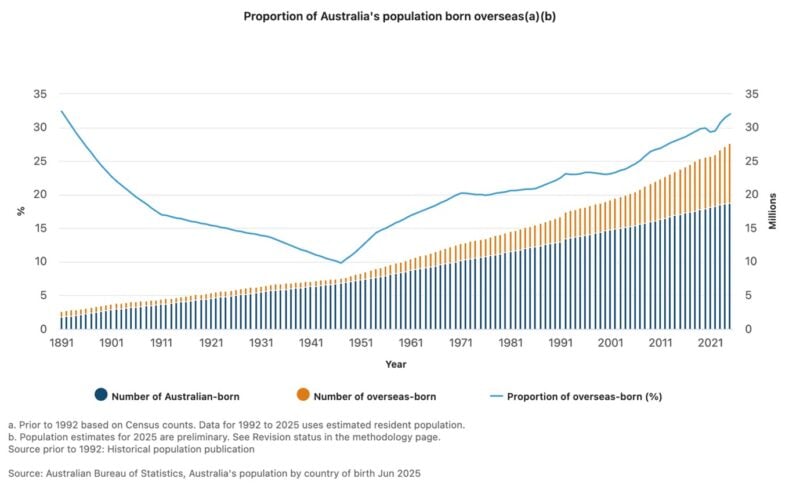
Australia's total estimated resident population is approaching 28 million, with around 32% born overseas.
To put that in perspective, that's roughly the same as the entire population of Switzerland living among us, all born somewhere else.
For a country of our size, that's an extraordinary level of diversity, and it has enormous implications for where people want to live and what kind of housing they need.
2. We're approaching a 135-year record
The proportion of overseas-born people in Australia is approaching the highest on record, which was 32.4% back in 1891.
That 1891 figure reflected the very high levels of immigration during the late 19th century gold rush era.
The proportion then fell to a low of around 10% in 1947, after migration slowed through two World Wars and the Great Depression, before climbing steadily through the post-war boom.
The fact that we're back near those 1891 levels tells you something important: the structural demand for housing from migration is about as strong as it's ever been in modern history.
3. India has just overtaken England for the first time
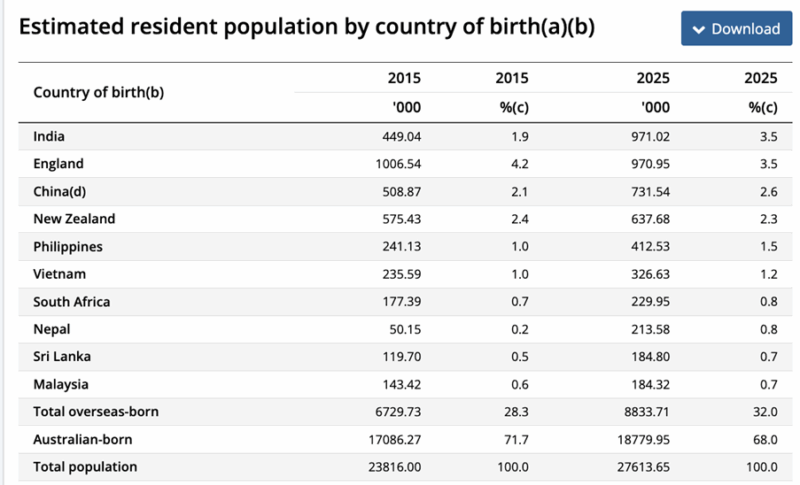
India narrowly overtook England in 2025 to become the top overseas country of birth for the first time, with both populations at around 971,000.
The India-born population has grown at a remarkable pace, rising from 449,000 in 2015 to just over 971,000 in 2025 - an increase of 522,000 people in a single decade.
That's the largest increase of any country of birth over that period, by a considerable margin.
For property investors, this matters as Indian-born migrants tend to settle heavily in Melbourne and Sydney, they have strong cultural ties to homeownership, and they arrive predominantly as skilled workers and students who eventually settle permanently.
Of course, this will mean sustained demand for housing in our two big capital cities.
4. The top five countries of birth tell a very different story to 20 years ago
India, England, China, New Zealand and the Philippines now make up the top five most common countries of birth for Australia's overseas-born population.
Nepal has also emerged as a significant and fast-growing group, rising from just 50,000 people in 2015 to over 213,000 in 2025 - a jump of 163,000 in ten years.
The shift from a predominantly European-origin migrant base to one drawn predominantly from South and Southeast Asia is one of the most significant demographic changes of our generation, and it's reshaping the cultural fabric of our suburbs in real time.
5. The European-born population is ageing and declining
People born in Italy and England had the largest decreases in their populations since 2015, and both groups have a median age of 60 or over, reflecting the very high levels of migration to Australia from these countries after World War II.
Greeks born overseas living in Australia now have a median age of 77 years, while Italian-born Australians have a median age of 74 years.
These are communities that arrived primarily in the 1950s and 1960s and are now in the later stages of life.
What this means practically is that as this generation passes on, we will see a gradual transfer of property wealth - often concentrated in inner-ring suburbs of Melbourne and Sydney - to the next generation or back into the market.
Now that's a trend worth watching.
- Also read:Melbourne housing market update | October 2026

- Also read:Australian housing market update | October 2026

- Also read:Latest Property Price Forecasts. Australian Property Market Outlook 2026-2027: Navigating a Market Correction

- Also read:Brisbane Property Market Forecast [2026 & Beyond] – What The Olympics Decade Means for Investors.
- Also read:Melbourne property market forecast for 2026 & 2027 | Separating the fundamentals from the sentiment
6. Overseas-born residents are younger than they used to be
The median age for Australia's overseas-born population was 43 years, down from 46 in 2005.
In contrast, the median age of the Australian-born population has risen from 33 to 35 over the same period.
So our migrant intake is getting relatively younger, while the locally-born population ages.
The Nepal-born population, for example, had a median age of just 30 years in 2025, while the overseas-born population aged 35 to 39 is now the largest single age cohort among migrants.
This is first-home-buyer and rental-demand territory. Younger migrants arrive, rent for a period, build savings and credit history, and then look to buy.
That cycle underpins sustained demand in our major city apartment and entry-level housing markets.
7. Australia ranks eighth in the world for migrant populations - but first proportionally among major economies
The United Nations estimated there were 304 million people worldwide residing outside their country of birth in 2024, making up 3.7% of the global population.
The USA led with 52 million, followed by Germany with 16.8 million.
Australia ranked eighth with 8.6 million migrants, representing 31.5% of its population.
Compared to the US at 15.2% and Germany at 19.8%, Australia's 32% proportion is extraordinary. We are, on a per-capita basis, one of the most migration-dependent nations in the developed world.
That structural reliance on migration to drive population growth is a key reason why our housing markets have such persistent underlying demand.
8. Where migrants settle varies significantly by state
In 2021, Western Australia had the highest proportion of overseas-born residents at 34.1%, while Tasmania had the lowest at 16.3%. Victoria and New South Wales both sat at around 31%.
At the state level, China-born residents were the largest overseas-born group in NSW, while Victoria's largest group was India-born, and Queensland's was New Zealand-born.
This geographic clustering matters for investors.
Areas with high migrant concentrations tend to have stronger rental demand, particularly for apartments and townhouses close to employment hubs, universities, and established ethnic community infrastructure.
In Melbourne, that points strongly toward the inner and middle-ring suburbs.
What does all this mean for property investors?
The headline takeaway is that Australia's population story is one of continued strong growth, driven disproportionately by a younger, primarily Asian-born migrant intake settling heavily in Sydney and Melbourne.
The overseas-born population grew by 258,000 people in 2024-25 alone, and the proportion of overseas-born residents increased from 31.5% to 32% in a single year.
Every one of those 258,000 people needs somewhere to live.
Many will rent for years before buying. And when they do buy, they'll be competing for a limited supply of well-located, quality housing in our major cities.
This is exactly why I've consistently held the view that well-located residential property in inner and middle-ring suburbs of our big capital cities remains one of the most reliable long-term investments available to Australians.
Population growth of this scale, especially concentrated in our two largest cities, is a structural tailwind that doesn't go away.
If you'd like to talk through how to position your portfolio to take advantage of Australia's long-term demographic drivers, the team at Metropole would be happy to help.
We work with investors across the country to build strategic, long-term property plans that stand up to real-world scrutiny.
We are much more than another buyer's agent. We help our clients safely grow, protect, and pass on their wealth through strategic property advice.
Click here now to lock in the time to have a chat with one of our wealth strategists at Metropole.