That headline stopped me in my tracks...
… And it should concern every Australian. In a country as wealthy as ours, that number represents far more than a housing statistic.
It speaks to economic hardship, family breakdown, poor health, mental illness, domestic violence and, increasingly, the inability of ordinary working Australians to find somewhere secure to live.
Yet, as is often the case with housing, the headline only tells part of the story.
Most Australians still think homelessness means sleeping rough in a park or under a bridge.
Those people certainly exist, but Australia’s official definition is much broader. It also includes people sleeping in cars, staying in emergency accommodation, couch surfing with friends or relatives, living in boarding houses and those residing in severely overcrowded housing.
That broader definition is important because it changes not only the size of the problem, but also the range of solutions available.
Australia isn’t alone
Australia’s homelessness rate is high by OECD standards, but we are hardly unique.
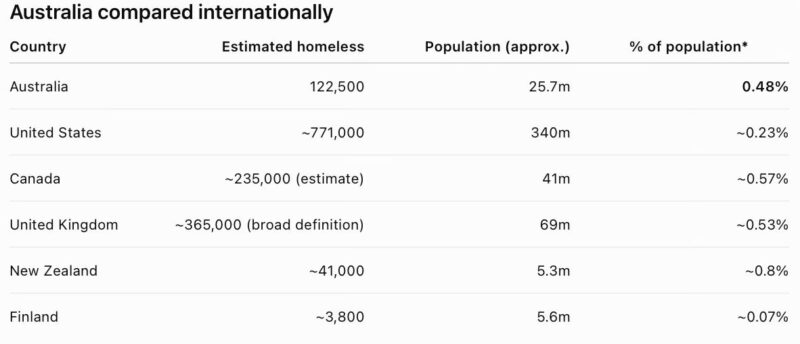
*Comparisons should be treated cautiously because each country defines homelessness differently. Australia's definition is among the broadest used in the OECD
Canada reports a broadly similar rate once its wider estimates are considered. The United Kingdom also faces persistent homelessness despite decades of social housing investment. New Zealand records an even higher proportion of its population experiencing homelessness than Australia.
The United States has by far the largest number of homeless people in absolute terms, but comparisons need to be treated carefully. American statistics focus far more heavily on people sleeping rough or living in shelters, whereas Australia’s measure captures many forms of insecure housing.
Then there is Finland.
Whenever homelessness is discussed internationally, Finland inevitably comes up. It now has one of the lowest rates of homelessness in the developed world, despite facing many of the same demographic and economic pressures confronting other advanced economies.
That success deserves closer attention.
The countries getting results didn’t just build more homes
The easy political answer is always to announce more housing.
Australia certainly needs more homes. Anyone who has read my Matusik Missive posts over recent years knows I have argued repeatedly that we are simply not building enough dwellings to keep pace with demand.
But increasing housing supply is primarily a medium and long-term solution.
It doesn’t necessarily help the person sleeping in a car tonight.
What makes Finland interesting is that it approached homelessness differently. Rather than insisting people first overcome addiction, secure employment or resolve mental health issues before qualifying for permanent accommodation, it reversed the sequence.
Housing came first. Support followed.
That philosophy has become known as Housing First, and over the past two decades it has dramatically reduced long-term homelessness while lowering spending on emergency accommodation, policing and hospital services.
Note: The housing itself provided stability. Everything else became easier afterwards. 
Sometimes a small amount of money changes everything
One of the more fascinating studies came from Canada several years ago.
Researchers provided recently homeless people with an unconditional payment of around C$7,500. Predictably, critics argued that much of the money would simply disappear on alcohol or drugs.
Instead, researchers found something quite different.
- Also read:Guide to Downsizing a House in Australia

- Also read:Latest Property Price Forecasts. Australian Property Market Outlook 2026-2027: Navigating a Market Correction

- Also read:Brisbane Property Market Forecast [2026 & Beyond] – What The Olympics Decade Means for Investors.
- Also read:Melbourne property market forecast for 2026 & 2027 | Separating the fundamentals from the sentiment
- Also read:Sydney property market forecast for 2026 and 2027 | Why the short-term softness is a long-term opportunity

Recipients secured accommodation sooner. They bought food, clothing and furniture. Many paid rental bonds, purchased transport or caught up on overdue bills. Most re-entered the workforce.
Importantly, the research found little evidence that recipients increased spending on drugs or alcohol.
The lesson wasn’t that cash solves homelessness. Rather, many people experiencing homelessness don’t necessarily need years of support. They simply need enough capital to get back on their feet.
Note: The gap between sleeping on the street, or in a car, and finding adequate and secure shelter can sometimes be surprisingly small.
Speed matters more than bureaucracy
The United States has developed another interesting approach known as Rapid Rehousing.
Rather than leaving people in emergency accommodation for months while applications slowly move through the system, assistance arrives almost immediately. Rental bonds, temporary rent assistance, landlord guarantees and intensive case management are provided within days of someone losing housing.
The objective is straightforward.
Prevent temporary hardship becoming chronic homelessness.
Several European countries have taken a similar approach by investing more heavily in prevention than crisis management. Rental arrears assistance, family mediation, legal advocacy before eviction and domestic violence intervention all aim to stop people entering homelessness in the first place.
That might sound obvious.
Note: Yet governments often spend far more dealing with homelessness after it occurs than preventing it from happening at all. The common thread running through almost every successful overseas program isn’t necessarily more spending. It is faster intervention.
Australia needs two housing conversations
This is where I think Australia sometimes confuses two related but separate issues.
Yes, we desperately need more housing supply. Without more profitable development there will never be enough homes to meet demand. Private investment remains the backbone of Australia’s housing system, and unless development becomes commercially viable, supply will continue to fall short.
That remains one of the country’s biggest long-term economic challenges.
But homelessness is often an immediate human crisis. Building another subdivision over the next five years won’t necessarily help someone sleeping in a car this evening.
For mine, governments should stop treating homelessness as one policy challenge.
It is really three.
The first is prevention - helping households before eviction or family breakdown occurs through rental assistance, mediation and short-term financial support.
The second is rapid rehousing - providing practical help quickly enough that temporary hardship does not become long-term homelessness.
The third is supporting those experiencing chronic homelessness through permanent housing integrated with health, addiction and mental health services.
Each group requires different policies. Each requires different funding. And each delivers different economic and social returns.
The last word
Housing supply remains one of Australia’s defining economic issues. Without significantly more homes, affordability will continue to deteriorate and the number of Australians at risk of homelessness will inevitably rise.
But homelessness itself deserves its own conversation.
Note: The international evidence is increasingly clear. The countries making the greatest progress don’t simply build more housing. They intervene earlier. They respond faster. They understand that homelessness isn’t one problem with one solution.
And perhaps that is the biggest lesson Australia should borrow. Not because it is cheaper - although it often is - but because it gives more people the chance to rebuild their lives before temporary hardship becomes permanent disadvantage.