


Key takeaways
Investor lending has surged across Australia, with 205,533 new investor loans issued over the past year: a 9% increase year-on-year, and the highest level on record.
This signals sustained confidence in property as a long-term investment vehicle despite higher interest rates.
NSW has the largest average loan sizes and highest volume of investor loans (62,501), but its lead is shrinking.
Victoria recorded 13% annual growth in investor loans, the strongest of any major state.
While still strong, QLD’s investor growth has halved from 17% to 7.9% annually.
There’s been a dramatic shift in Australia’s mortgage market over the last year, and if you’re a strategic investor, it’s worth paying attention.
According to the latest data from Money.com.au, we’ve just witnessed a record-breaking year for investor loans, with over 205,000 new loans issued nationally.
That’s a 9% year-on-year increase, surpassing the previous peak set in 2022.
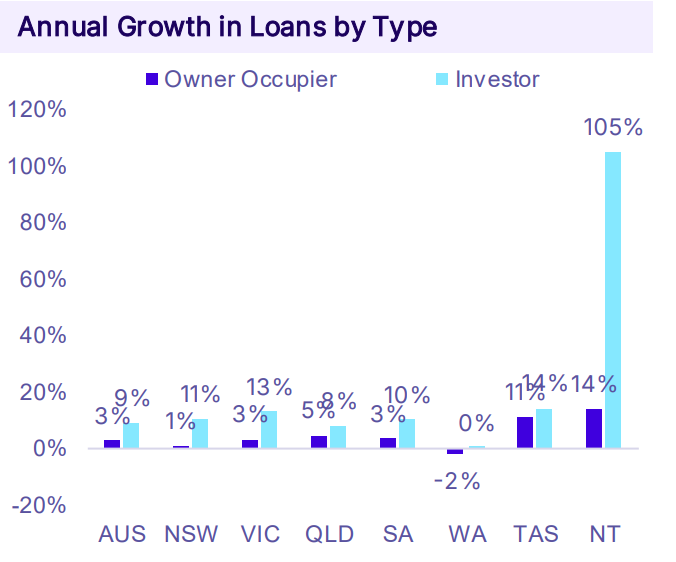
But what’s more fascinating isn’t just the headline figure; it’s what’s happening under the surface, state by state, that tells us where smart money is moving.
So let’s look at the trends and what they might signal for the future of Australia’s property landscape.
NSW: still the giant, but its lead is shrinking
NSW is still the heavyweight when it comes to loan sizes, but its dominance is being eroded.
Investor lending in NSW has surged to a record 62,501 loans, with growth of 10.5% annually.
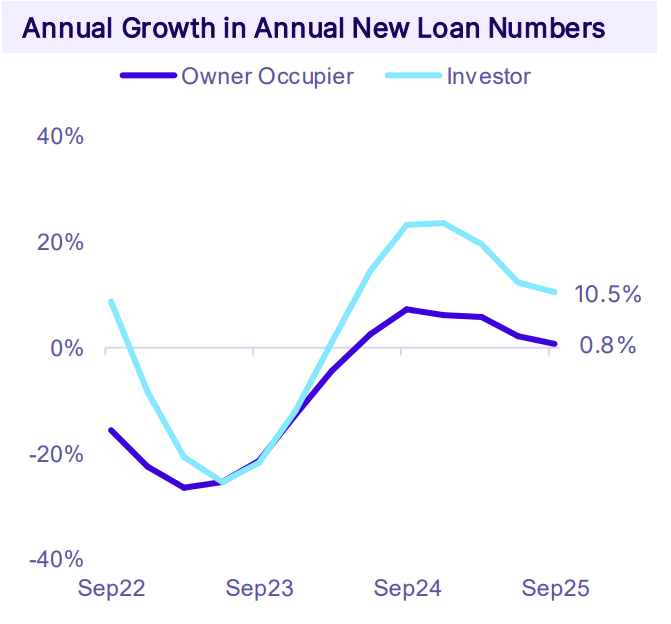
What's notable is that this growth is being fuelled by investors buying existing dwellings, up 13.2% year-on-year.
This makes sense in a high-interest environment—immediate rental returns are more attractive than the risk and delays associated with new builds.
However, even though NSW leads in dollar terms, the gap is closing.
Owner-occupier loan sizes outside NSW grew by 9%, compared to just 6% within the state.
As a result, NSW’s premium over the rest of the country has dropped from 36% to 29% in just two years.
That’s a big shift.
According to Debbie Hays, Property Expert at Money.com.au:
“Rather than chasing a single strategy, investors are diversifying across property types. That’s typically a sign of a mature market, where buyers are balancing yield, future growth and development potential.”
And she’s right, this is classic portfolio hedging at play.
Investors in NSW are not just buying established homes but also land and construction options. They’re spreading risk in an increasingly fragmented market.
Victoria: the underdog is catching up fast
Victoria has quietly become the fastest-growing investor loan market in the country, with a 13% annual increase and 47,732 new loans issued, its biggest quarter on record.
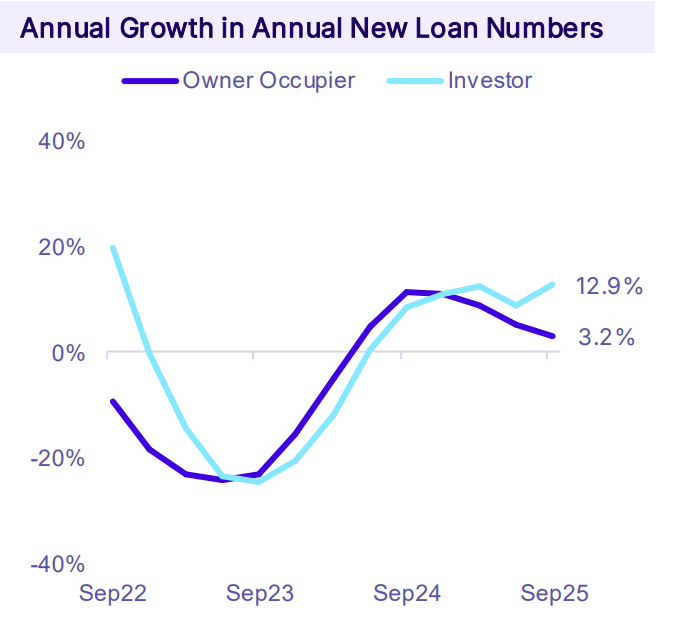
Fact is, investor loans for existing homes in Victoria jumped 19% year-on-year.
According to the report, in the most recent quarter, Victoria issued 695 more investor loans than Queensland, closing the gap between the two and potentially positioning itself to reclaim the #2 spot nationally.
Since 2021, investor lending in Victoria is up 10.4%, and that momentum doesn’t look like it’s slowing anytime soon.
For investors, this suggests a reinvigorated confidence in Melbourne’s long-term growth prospects, possibly driven by improved affordability and rising interstate migration.
Queensland: cooling but still resilient
Queensland has been a darling for investors post-COVID, but the tide may be shifting.
Money.com.au's data show that investor loan growth in the Sunshine State has halved, from 17% down to 7.9% annually, falling below the national average.
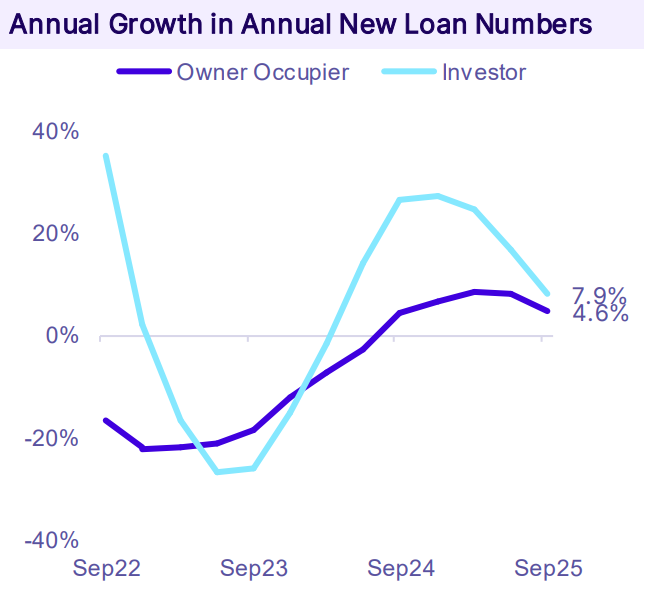
Yet this isn’t a sign of weakness as much as a market maturity shift.
Many QLD investors are now turning inward: refinancing, upgrading, or extending their current properties rather than expanding portfolios.
Loans for alterations and refinancing hit record highs, with 47,339 loans issued across these categories.
Interestingly, QLD remains one of the strongest owner-occupier markets, with lending up 4.6%, showing that demand from residents remains robust, especially as we head toward the 2032 Brisbane Olympics.
South Australia: quiet achiever in new builds
South Australia is outperforming in both owner-occupier and investor segments, with lending growth of 3.5% and 10.1% respectively.
But what’s even more remarkable is its dominance in new housing.
According to the report, new-build loans for owner occupiers jumped by 56.6%, and 25.2% for investors. That’s not a typo.
The affordability and price stability in SA are encouraging more buyers to build rather than compete for existing stock.
This is a standout stat: 1 in 11 loans in SA is for new builds, compared to a national average of 1 in 16.
It’s clearly a different game over there.
WA: momentum falters
Western Australia has bucked the national trend, with both owner-occupier and investor lending declining or stagnating.
Investor activity peaked in December 2024 and has since stalled.
Data shoes that loan volumes have flattened, and WA’s share of national investor loans has dropped from 12.8% to 12.2%, with investor capital flowing eastward, particularly into NSW and Victoria.
It appears WA may have reached a saturation point, at least for now.
Investors seem to be reallocating funds to markets with more upside.
Tasmania: high growth, low base
Tassie saw the strongest home loan growth across all states: 11.1% for owner occupiers and 14.1% for investors.
But don’t be fooled, loan volumes are still 25% below 2022 levels, so the state is in recovery mode rather than full-blown boom.
Investors account for just 27.3% of all lending in Tasmania, compared to the national average of 38.3%.
Final Thoughts: Where Should Investors Be Looking?
The big takeaway is that we’re seeing a rebalancing across Australia’s property markets:
-
NSW remains dominant, but price growth elsewhere is catching up fast.
-
Victoria is the one to watch, with strong investor momentum and rising confidence.
-
Queensland is shifting into consolidation mode—still resilient, but less aggressive.
-
South Australia is benefiting from affordability and leading in new builds.
-
WA may be on pause, while Tasmania offers a contrarian opportunity.
As the market continues to evolve, investors need to stay nimble, diversify strategies, and pay close attention to these underlying lending trends.
Because as I always say, it’s not just about location: it’s about timing, strategy, and knowing where the smart money is going.