


Key takeaways
Australia's housing market is experiencing a correction, not a collapse. Property cycles are normal, and previous downturns have taken years to recover.
First home buyer lending has fallen 8.6%. Higher interest rates and government incentives that brought forward demand have contributed to the slowdown.
Investors are shifting towards new housing. Lending for established investment properties fell 39.1%, while investor lending for new housing increased 8.6% between March and September 2026.
Mortgage stress is increasing but remains relatively contained. Only 0.78% of Commonwealth Bank mortgage customers are reportedly more than 90 days behind on repayments.
Property values have fallen, but earlier gains remain substantial. National median dwelling values declined approximately 5.2% between April and September 2026 but remain around 18% above 2022 levels.
Distressed property listings are rising. However, they remain a relatively small proportion of Australia's overall housing market.
Expects further market weakness. There's another 12 to 18 months of adjustment, with national dwelling values potentially falling 20% from their late-2025 peak.
Housing taxation and planning reforms could improve long-term affordability. Reduce speculative investment incentives and encourage more new housing construction.
The RBA faces a difficult balancing act. Rising wages are adding inflationary pressure, while increasing unemployment suggests the economy is weakening.
Investors should maintain perspective during market downturns. Short-term headlines often exaggerate market conditions, while housing cycles eventually turn as confidence returns.
I am pretty sure you are also getting a little tired of the relentless negative housing commentary.
If it bleeds, it leads. And when it comes to Australian housing, there appears to be no shortage of people willing to supply the blood.
Some of the loudest complaints are coming from housing industry rent seekers who made substantial wealth during the Covid years, courtesy of government largesse, extraordinarily low interest rates and a massive expansion in the money supply.
Now they want the good times back.
Well, housing is cyclical. Always has been. Always will be.
We are entering a difficult period. But it isn’t unprecedented. The 1970s and 1990s - for example - were tough, too. Credit was tight, confidence was weak and housing markets took years to recover.
More importantly, some of the Albanese government’s changes to property taxation are starting to influence behaviour. For mine, that is largely welcome. Yes welcomed. The proposed reforms are directionally right, although I would go considerably further.
Which brings me to one of the leading articles in The Weekend Australian, 14–15 November 2026, titled Housing howler at odds with life.
It makes seven points about the deteriorating housing market. Most are factually based. But the interpretation, in my view, is unnecessarily alarmist.
Let’s work through them.
1. First home buyers are disappearing.
Yes, first home buyer loans fell 8.6% during the September quarter.
But why is anyone surprised?
Interest rates have risen and substantial demand was brought forward by government assistance.
Since early 2020, around 320,000 first home buyers have reportedly accessed the federal deposit guarantee arrangements. The expanded 5% Deposit Scheme commenced on 1 October 2025, with approximately 106,000 buyers assisted during its first year.
Those schemes, combined with ultra-low Covid interest rates, helped pull future demand into earlier years.
Our first chart illustrates the extraordinary lending surge during 2020 and 2021.
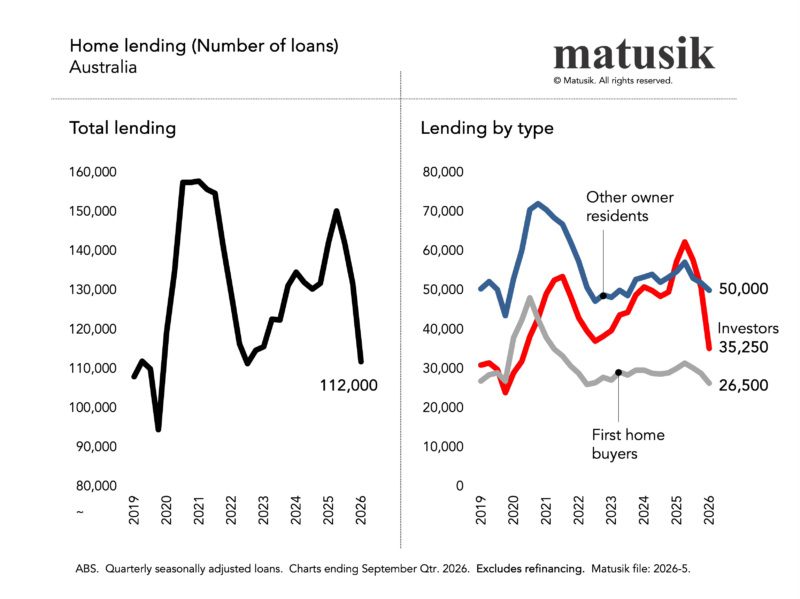
The September quarter decline is substantial. It is also part of the normal adjustment following an extraordinary period of stimulus.
2. Lending for new housing has collapsed.
Construction costs remain high. Development charges, taxes, regulatory delays and rising interest rates have damaged feasibility.
Increasingly, developers are also looking beyond traditional banks towards private credit and other funding arrangements. Westpac’s lending book is not the entire market.
It also pays to analyse the latest lending finance results calmly.
My colleague, Robert Sobyra, at Bellwether did a deep dive into the numbers earlier this week and when looking at the change in home lending between March qtr 26 and Sept qtr 26 he found that the latest ABS figures show:
- Investor loans for new housing rose 8.6%
- Owner resident loans for new housing rose 0.3%
- Business loans for new dwelling construction rose 43.3%
- Investor loans for established housing fell -39.1%
- Owner resident loans for established housing fell -0.2%
So new mortgage commitments have fallen. That’s hardly a surprise. The interesting bit is where buyers are pulling back.
Established homes. Investor loan numbers fell 39% from March to September. Owner-occupier loans were flat.
New housing. Investor loans to buy new or build actually rose 9%. Owner-occupiers flat.
Note: The levels are weak across the board but the pattern is pretty much what the tax reform was designed to do - strip investors out of the established market, pivot them to new builds. While leaving owner-occupiers untouched. 
An interesting additional data point - business lending to build homes rose 43% in dollar terms. Higher construction costs may explain some of that. Even so, the rise suggests some developers still see opportunities worth pursuing.
These are early signs, rather than proof the reforms have worked. But they are worth acknowledging.
And our second chart puts the latest downturn into a longer historical context.
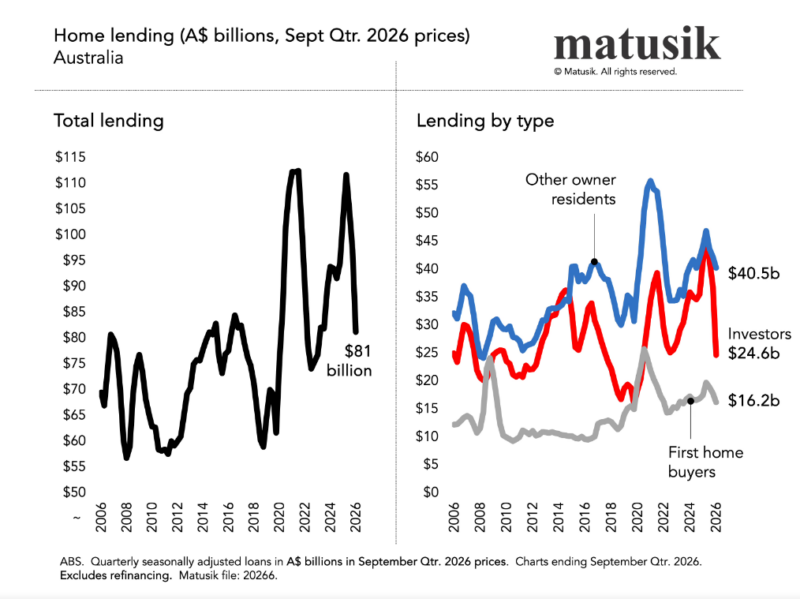
3. Mortgage arrears are rising.
The article reports more than 15,000 Commonwealth Bank customers at least 90 days behind on repayments.
Sounds terrible.
Until you realise that represents approximately 0.78% of its 1.9 million home-loan customers.
Of course, individual hardship matters. But that is not evidence of widespread mortgage failure.
4. Five years of housing gains have been wiped out.
No, they haven’t.
My figures suggest the national median dwelling value has risen around 18%, or approximately $138,000, since 2022. Remember housing values, again across the national and as a median result, rose some 37% between 2020 and 2022.
A correction after a substantial price boom is not the same as losing five years of gains.
5. Dwelling values are collapsing.
My settled-sales analysis, which currently extends to September 2026, suggests the national median dwelling value fell approximately 5.2%, or around $50,000, between April and September.
That is a meaningful correction. Particularly for recent purchasers.
But it is a long way from a housing market catastrophe.
6. Hundreds of homeowners are being forced to sell.
SQM Research estimates roughly 277,000 dwellings are listed nationally, around 22% more than a year ago.
Let’s generously interpret ‘hundreds’ as say 2,500 forced sales.
That would represent less than 1% of all properties currently advertised.
Context matters.
7. Distressed listings have jumped 42%.
Yes. SQM Research reports 5,368 distressed listings in October 2026.
That is an increase worth monitoring. And SQM Research does a great job in this regard.
But Australia is likely to record approximately 560,000 settled dwelling transactions this year. The distressed-listing count is equivalent to less than 1% of that annual volume, although listings and settlements are different measures.
- Also read:Top tactics to help you win a property at auction

- Also read:Latest Property Price Forecasts. Australian Property Market Outlook 2026-2027: Navigating a Market Correction

- Also read:Brisbane Property Market Forecast [2026 & Beyond] – What The Olympics Decade Means for Investors.
- Also read:Melbourne property market forecast for 2026 & 2027 | Separating the fundamentals from the sentiment

- Also read:Sydney property market forecast for 2026 and 2027 | Why the short-term softness is a long-term opportunity

And exactly what qualifies as distressed?
A vendor accepting a lower price? A mortgagee sale? A household choosing to sell before financial pressure becomes serious? A divorcing couple? Someone a few months behind in their mortgage payments?
Definitions matter as much as headlines.
In summary, please get a grip.
What I would do differently
The bigger issue is not whether house prices fall another 5% or 10%. It is the role housing plays in the Australian economy.
Our third chart is perhaps the most important of the lot.
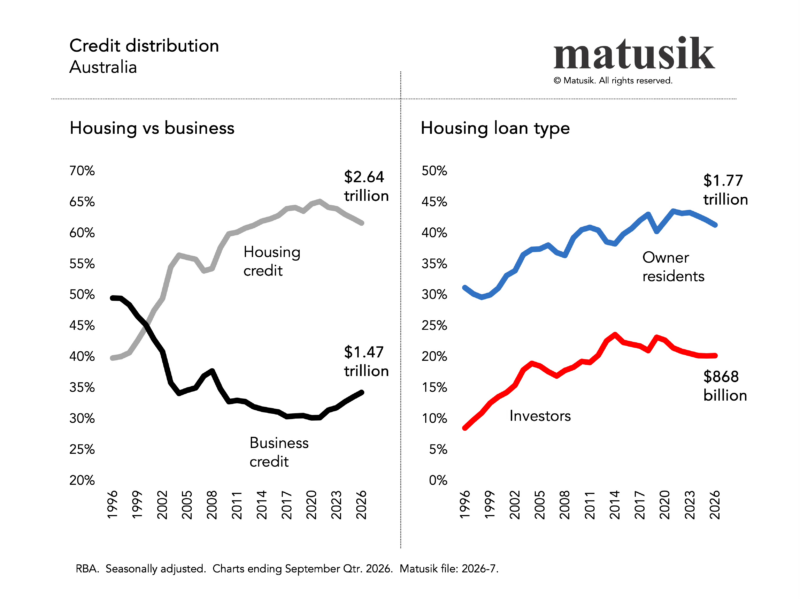
Housing accounts for approximately 62% of domestic credit, compared with 34% for business. Back when I started my housing market consultancy business, these proportions were reversed.
We have spent decades encouraging Australians to borrow against existing property rather than invest in productive enterprise.
For mine that needs to change.
Last year, I republished my ten-point plan for what I would do if I were the federal housing minister. I haven’t substantially changed my mind.
Here are those ten reforms, updated slightly.
1. Reform property taxation. Abolish stamp duties and remove negative gearing concessions and the capital gains tax discount for established investment homes, with appropriate transitional arrangements. Limit negative gearing concessions for new housing to five years. Almost exactly what Federal Labor has done.
2. Introduce a broad-based land tax. Charge between 1% and 5% annually, depending on ownership, use and tenure, with higher rates for foreign interests. Discourage land banking and also get people to get a more productive return on the land, by for example, taking in a tenant or building a backyard home.
3. Tax capital gains according to holding periods. Higher rates for short-term ownership, declining progressively with time held. Discourage speculative flipping.
4. End first home buyer grants and subsidies. They inflate purchasing power without necessarily increasing supply. I would also increase government backed housing-development funds and encourage more institutional rental delivery.
5. Limit SMSF property exposure. No more than 50% of self-managed superannuation assets invested in residential property.
6. Standardise development rules. One national framework for planning and building, with sensible variations for climate. Wind back, and big time, the ESD and disability mandates. If the market wants an environmentally friendly home or one that suits a wheel chair then they can pay for it.
7. Reform infrastructure charges. Set contributions at 5% of the final vacant-land or new-dwelling selling price, payable at settlement.
8. Strengthen accountability. Purchasers must undertake proper due diligence, including off-plan, while builders and developers remain accountable for defective workmanship.
9. Restrict foreign purchasing. My proposal remains: no Australian passport, no residential property purchase. Stop the boats so to speak.
10. Make housing forecasts accountable. Publicly promoted research, including predictions of both price growth and price crashes, should face independent peer review and carry an equally prominent counterargument. Or maybe journalists could just do their job!
Some of these changes would be unpopular. Others would require considerable negotiation between governments.
Note: But the objective is straightforward: make housing less speculative, improve the delivery of new homes and redirect more capital towards productive investment.
End note
We need to chill.
The Australian housing market is undergoing a downturn. I expect another 12 to 18 months of adjustment, and national dwelling values could ultimately fall by as much as 20% from their late-2025 peak.
That would hurt some households. But it would not be unprecedented. Nor would it mean the housing market was permanently broken.
Markets correct. Credit tightens. Speculation retreats. Eventually, confidence returns.
And hopefully, this time, we emerge with a housing system that is less dependent on government handouts, speculative investment and ever-rising dwelling prices.
The housing market needs a reset. Not another rescue.
But wait there is more!
Just when everyone thinks they have the economy figured out, along comes another set of numbers to spoil the narrative.
Last week delivered two beauties.
On Wednesday, the ABS reported wages rising 1.1% during the September quarter, the strongest quarterly increase since late 2023. Annual wage growth reached 3.5%.
Higher wages. More inflationary pressure. Less chance of cheaper money.
Then Thursday arrived.
Employment fell by 43,500 in October, while unemployment climbed to 4.9%, already above the RBA’s December quarter forecast of 4.7%.
Fewer jobs. Weaker household confidence. Perhaps less need for another rate rise.
Two economic signals. Two seemingly contradictory messages. Just 24 hours apart.
And herein lies the problem with much of today’s economic commentary.
One statistic becomes a headline. One headline becomes a prediction. And before long, everyone is marching in the same direction.
For mine, these figures suggest the RBA has an increasingly uncomfortable balancing act. Inflation remains troublesome, but the labour market is showing signs of strain.
Neither another rate rise nor an early cut is guaranteed.
The lesson?
Economies don’t move in straight lines. Neither do housing markets.
And certainty is often just opinion wearing a louder shirt.