

The expanded 5% Deposit Scheme has had a big first year. Since the changes introduced on 1 October 2025, the government reports 102,594 Australians supported. Income caps were removed, property price limits lifted and the number of places uncapped.
For someone trying to save a deposit while paying rent, that is a sizeable leg-up.
My indicative state comparison is below. The percentages are my estimates based on lending activity to first home owner residents rather than official scheme take-up rates.
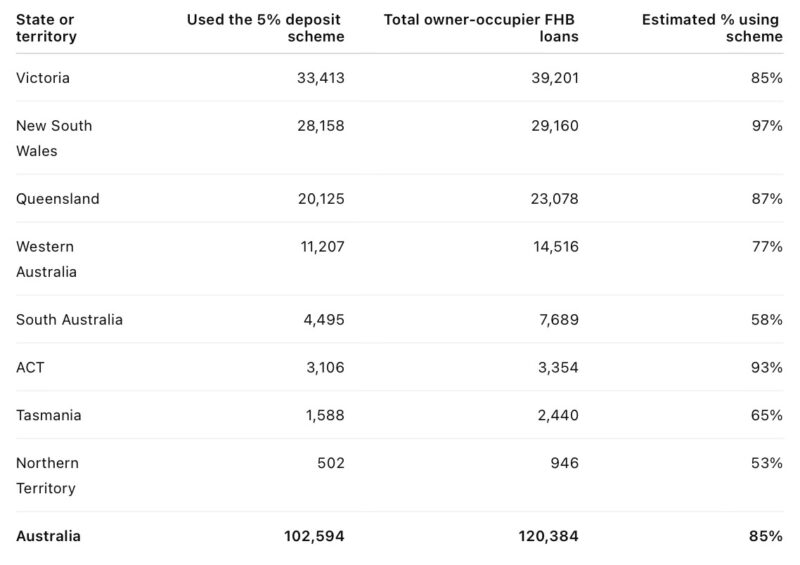
Victoria, NSW and Queensland account for almost four in five people supported. This assistance is now a substantial part of the first-home buying landscape.
But getting into the market and comfortably staying there are two different challenges.
The scheme allows eligible first-home buyers to purchase with a deposit as low as 5%, without paying lenders mortgage insurance. It reduces the upfront savings hurdle. Buyers still need to satisfy their lender that they can afford the repayments.
And with the cash rate now at 4.60%, that repayment test matters.
The accompanying charts show how much borrowing has changed. The average owner-occupier first-home-buyer loan reached approximately $627,000 in the June 2026 quarter, compared with about $543,000 in September 2025. That is roughly $84,000 more.
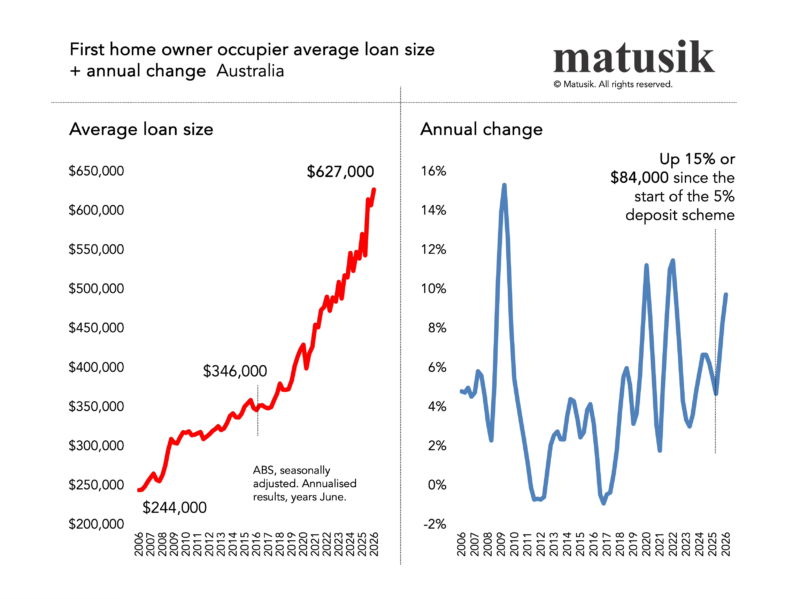
These figures cover all such loans, including buyers outside the scheme, but as the table above suggests, some 85% of first home intending owner occupier buyers used the 5% deposit scheme.
- Also read:Latest Property Price Forecasts. Australian Property Market Outlook 2026-2027: Navigating a Market Correction

- Also read:Brisbane Property Market Forecast [2026 & Beyond] – What The Olympics Decade Means for Investors.

- Also read:Melbourne property market forecast for 2026 & 2027 | Separating the fundamentals from the sentiment

- Also read:Sydney property market forecast for 2026 and 2027 | Why the short-term softness is a long-term opportunity

- Also read:Home Prices Down Again Over September – But Not as Much | Latest Property Market Stats

And why wouldn't you if you were starting out. But - like usual when a government incentive is supplied - the scheme saw prices rise as demand was brought forward whilst resale housing supply was tight.
True a smaller deposit can get you started sooner. But a larger mortgage can keep you working harder for longer.
Also, this scheme applies to buyers intending to live in the property. It cannot be used to purchase an investment property. Buyers must move in within six months of settlement and continue living there while the government guarantee applies.
Moving out and renting the property can end the guarantee, potentially triggering lenders mortgage insurance or additional lender costs.
The RBA reports that arrears among scheme participants remain contained. I will add “for now”. However, recent buyers with small equity cushions are more exposed to negative equity if (when) housing values fall. Being able to keep making repayments remains crucial.
My two bobs worth
I don’t begrudge young buyers a leg-up. Saving 20% while paying rent can be a hard ask. Most of us in our later years member that struggle too.
But easier entry doesn’t automatically deliver cheaper housing. Helping more buyers compete for limited stock and sellers can capture much of the benefit. Meanwhile, the newest buyers start with the thinnest equity cushions.
For mine, the missing half of this equation is making more attainable priced homes feasible to build. Support the buyer, certainly. But also tackle serviced land, delivery costs and development finance.
A smaller deposit can change who gets through the door. It cannot create another door.