Back in May, the Grattan Institute released Wasted Space: Axe Car-Parking Rules to Ease the Housing Crisis.
It received a reasonable burst of media and LinkedIn attention, but three months later I fear its central message has been filed under too hard, not quite right, or politically impossible.
That would be a mistake.
Because this is not really a story about cars.
It is about housing feasibility, construction capacity and whether we continue forcing apartment buyers to pay for something many neither need nor want.
And Brisbane provides a very good example of why this matters.
And one of the eight things that could be done to help apartment delivery - as outlined earlier this week - was to loosen the regulations regarding car parking.
The $5.2 billion parking problem
Grattan’s proposition is pretty simple: stop mandating minimum car-parking requirements for new housing and allow developers and buyers to determine how much parking is actually required.
That doesn’t mean building no parking.
It means building parking according to demand rather than a planning formula largely inherited from another era.
The numbers are substantial.
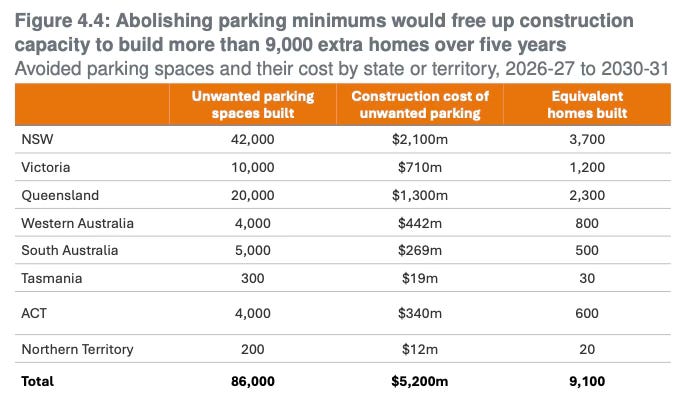
Grattan estimates that removing parking minimums could avoid building some 86,000 unwanted car spaces across Australia over five years, freeing around $5.2 billion of construction capacity. That labour, concrete, steel, excavation, waterproofing and finance could instead help deliver the equivalent of about 9,100 additional homes.
Queensland alone accounts for about 20,000 unnecessary spaces, $1.3 billion of construction cost and the equivalent capacity of 2,300 additional homes.
And remember, this is not government spending. Much of the benefit comes simply from stopping ourselves from requiring something to be built.
Parking isn’t free
This is where the discussion often goes wrong.
Someone says: “But people need somewhere to park.” Of course they do.
The question is whether every new dwelling should be forced to provide a prescribed amount of parking regardless of whether the eventual household wants it.
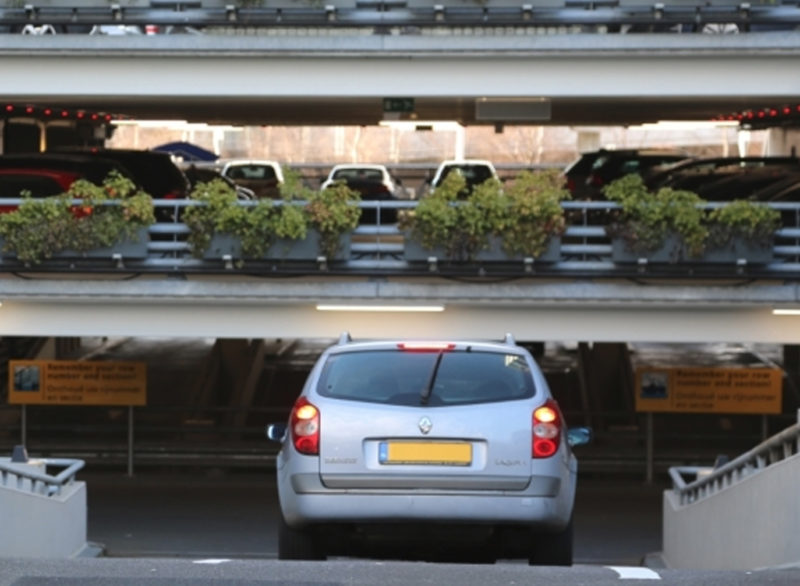
Grattan estimates around 40% of households living in studio or one-bedroom apartments don’t own a car. Even amongst two-bedroom apartment households, 19% don’t own one. As much as 40% of apartment parking can sit vacant each night.
Yet somebody paid to build those empty spaces.
And in Brisbane that bill is particularly large.
Grattan estimates current minimum parking requirements add around $113,000 to the construction cost of a typical new two-bedroom Brisbane apartment. Basement parking itself can cost roughly $79,000 to $120,000 per bay.
That isn’t loose change. It is housing affordability.
My work over the years - actually visiting apartment carparks during weekday evenings across various locations - both urban and regional - has found, consistently, a much higher result.
In some Melbourne inner city apartment projects my findings exceeded 70% vacancies. This work was done to help ascertain how much car parking was actually used and to help the developer argue for lower parking provisions that the rule book said in order to help make the project stack up. In also all instances the local council in question did not play ball.
Hence my interest in the study and general topic.
Let’s make it real
Consider a hypothetical 1,200m² assembled Medium Density Residential site in Brisbane’s inner-middle ring.
A five-storey scheme might accommodate around 22 apartments.
Under current-style parking provisions, it could require about 28 spaces across two basement levels, costing roughly $2.5 million.
And that can be enough to kill the project.
- Also read:Latest Property Price Forecasts. Australian Property Market Outlook 2026-2027: Navigating a Market Correction

- Also read:Brisbane Property Market Forecast [2026 & Beyond] – What The Olympics Decade Means for Investors.
- Also read:Melbourne property market forecast for 2026 & 2027 | Separating the fundamentals from the sentiment
- Also read:Sydney property market forecast for 2026 and 2027 | Why the short-term softness is a long-term opportunity
- Also read:Adelaide housing market update | October 2026

Reduce parking to around 0.6 spaces per dwelling, with no visitor minimum, and only about 13 spaces may be needed. Suddenly a single basement or partial at-grade solution becomes possible.
Our indicative modelling suggests that could save around $1.2 million, potentially allow another two or three apartments and, most importantly, move the development from marginal to feasible.
That last word matters. Feasible.
We don’t have a shortage of development approvals in Australia nearly as much as we have a shortage of projects that actually stack up.
Then there is HDR
The impact changes as projects get larger.
Take a hypothetical 3,000m² High Density Residential site around Bowen Hills or Woolloongabba capable of supporting approximately 180 apartments over 20 storeys.
A conventional outcome might require around 220 parking spaces, spread across four basement levels, with an estimated cost approaching $18 million to $20 million.
Ultimately somebody must pay for that.
Usually the project responds by increasing apartment prices and shifting the dwelling mix towards larger two- and three-bedroom apartments where the parking cost can be better absorbed.
Our indicative example suggests parking alone could add around $100,000 per apartment.
Reduce the requirement to 0.5 spaces per dwelling and remove mandatory visitor parking, and perhaps only 90 spaces are required.
Four basement levels potentially become two.
The indicative saving? Around $8 million to $10 million.
More importantly, the project can potentially deliver more one- and two-bedroom apartments at lower entry prices.
So parking rules don’t just influence where cars sleep. They influence what housing gets built.
Brisbane has been here before
There is also a useful Brisbane history lesson.
In 2019, Brisbane increased minimum parking requirements across substantial suburban areas. Grattan cites research finding that parking supplied per new dwelling subsequently increased by around 23%.
Council has since started moving back in the other direction, particularly in well-connected inner-city locations.
Good. But I think we should go much further.
In locations with strong public transport, walkable amenity and reasonable access to employment, we should seriously consider zero parking minimums, accompanied where appropriate by maximum parking rates.
Let developers provide parking where buyers will pay for it. Importantly Brisbane allows parking to be sold separately from the apartment.
So why not tackle the issue from both ends? By managing genuinely scarce street parking through permits, time restrictions and pricing rather than forcing every new apartment buyer to subsidise basement construction.
The cheapest dwelling is sometimes the thing we don’t build
Australia keeps looking for enormous solutions to its housing shortage.
Billions in subsidies. Planning authorities. Targets. Funds. Guarantees. More schemes layered upon existing schemes.
Yet sometimes housing reform is much simpler. Remove something.
Grattan’s report suggests we could avoid $5.2 billion of unnecessary construction and potentially redirect enough industry capacity to build more than 9,000 additional homes over five years.
I think its findings deserve much more attention than they have received. Not because every Australian should give up their car. They won’t.
But because people who want parking should be able to buy it. And people who don’t need it shouldn’t be forced to.
We keep talking about making housing cheaper to build. Here is one practical way to actually do it.