
Key takeaways
Gold Coast property prices are slowing, but current asking-price data does not prove a major downturn. Most September-quarter sales have yet to settle.
A 20% annual fall would be unprecedented in the modern Gold Coast market. Even past recessions and the GFC failed to produce a decline of that magnitude.
Today’s Gold Coast is larger and more diversified, with strong employment and significant interstate migration. Wealthier buyers with substantial equity are also supporting the upper end.
Rising construction costs are making new housing increasingly difficult to deliver. This could constrain supply and provide a floor beneath established property values.
Higher rates, rising listings and softer demand create genuine headwinds. The market is slowing, but it is too early to declare a property crash.
There is an old newsroom saying: if it bleeds, it leads. And of late, housing increasingly seems to qualify.
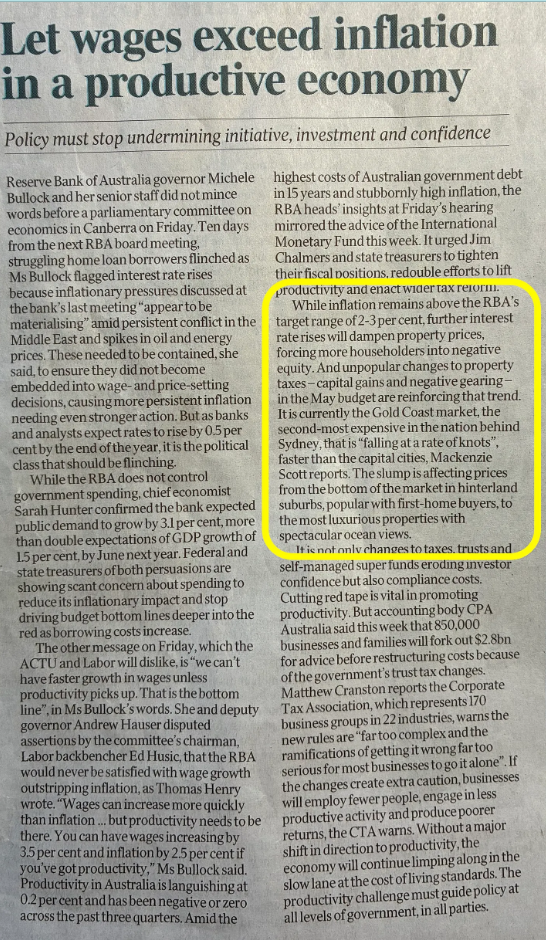
The Weekend Australian has weighed into the Gold Coast housing market, reporting prices as “falling at a rate of knots” and discussing the prospect of substantially lower values.
The underlying evidence includes asking-price data showing Gold Coast house asking prices down from their March peak and units weaker again.
Asking prices matter - I have written many times that they are a useful lead indicator - but they are not settled sales.
And that distinction matters right now.
Only about 20% of September-quarter Gold Coast transactions have settled.
We simply do not yet have a complete September-quarter picture. Late October or early November will tell us much more.
I wasn’t planning to write about this until then. But a bunch of emails and calls asking for my two bob’s worth have forced my hand.
What actually makes prices fall?
At the start of this year I outlined the five things I watch when assessing the risk of a meaningful housing correction:
- Interest rates rise and borrowing capacity falls.
- Housing credit becomes harder or more expensive to obtain.
- Unemployment rises and household incomes come under pressure.
- Listings increase faster than buyer demand, especially forced listings.
- Investor, migration and buyer demand weaken at the same time.
As I write later this week, some of these lights are now flashing.
The cash rate is 4.35%, and the RBA meets on 28–29 September and again on 2–3 November. Markets have been pricing a significant chance of another increase.
I have said from the outset that this tightening cycle could require another four or five quarter-point increases before it is done. I also thought the three cuts during 2025 were unwise.
So yes, Gold Coast price growth is likely to slow.
Sales volumes are easing. Listings are rising. Vacancy has drifted higher, albeit still below 2%. Yet new housing supply remains well below underlying demand.
So a 20% fall would be something else altogether.
History matters
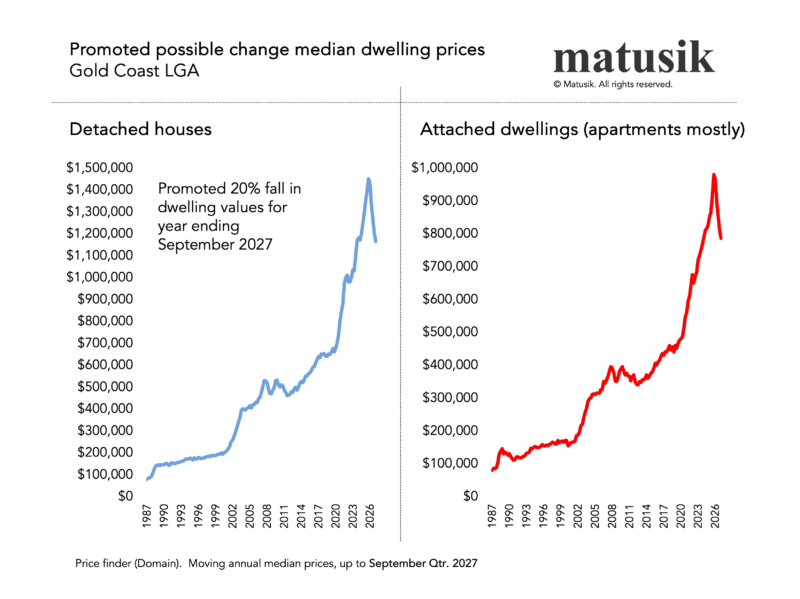
Look at the charts.
Since 1987 there have been surprisingly few sustained annual falls in Gold Coast detached-house or attached-dwelling prices. Quarterly movements are another matter entirely. They jump around like a frog in a sock.
That is why I prefer annual change.
A quarterly fall can look dramatic and disappear several months later. Asking-price movements can move faster again because vendors adjust expectations before transactions settle.
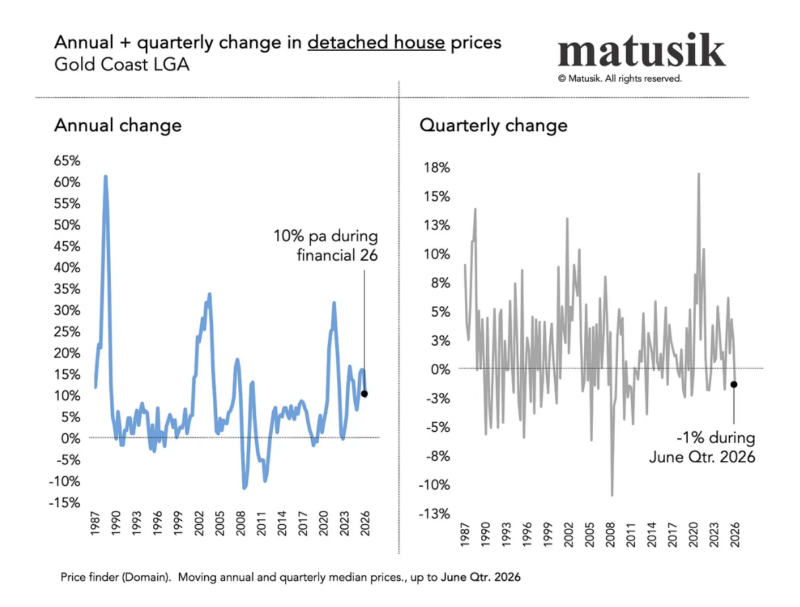
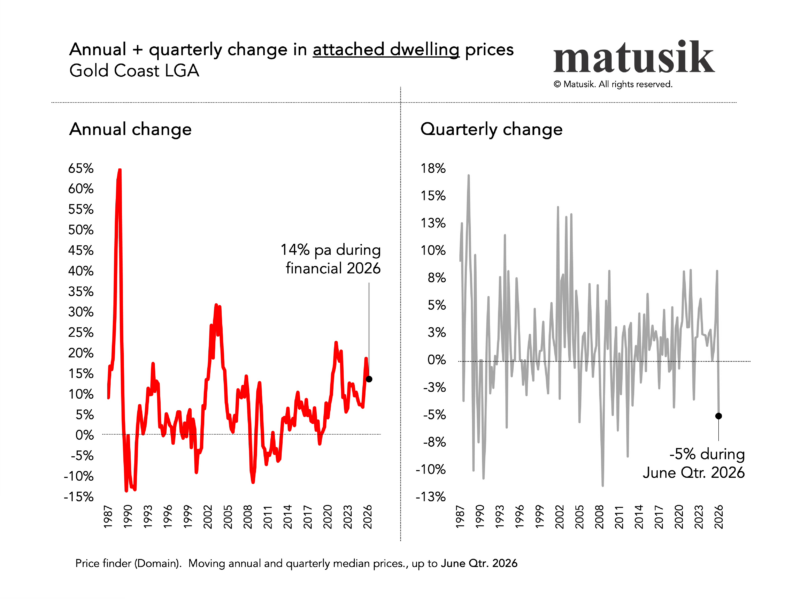
A genuine 20% annual decline would therefore be unprecedented in the modern Gold Coast series.
You might have expected one in the early 1990s, when Australia was in recession and Japanese capital was retreating rapidly from Gold Coast property.
You might also have expected something similar after the GFC.
- Also read:Latest Property Price Forecasts. Australian Property Market Outlook 2026-2027: Navigating a Market Correction

- Also read:Brisbane Property Market Forecast [2026 & Beyond] – What The Olympics Decade Means for Investors.
- Also read:Melbourne property market forecast for 2026 & 2027 | Separating the fundamentals from the sentiment
- Also read:Sydney property market forecast for 2026 and 2027 | Why the short-term softness is a long-term opportunity
- Also read:Adelaide housing market update | September 2026

It didn’t happen.
I have worked on the Gold Coast since the late 1980s. My earliest consulting years were spent there and, even today, about 10% of my consultancy workload is Gold Coast-based.
It is a market I know well - and one I think is still frequently misunderstood from Sydney and Melbourne.
This isn’t the old Gold Coast
The Gold Coast today is an economy worth about $58 billion, roughly one-third larger than before Covid. Some 385,000 people work there, with around 89,000 jobs added since Covid.
Its unemployment rate is around 3.1%.
About 700,000 people now live there. It is Australia’s sixth-largest urban area and its economy is now larger than Newcastle’s and reveals Canberra’s.
Tourism remains important - 5.8 million overnight visitors last year spent about $7.2 billion - but the Gold Coast is no longer simply tourism, speculative apartments and overseas money.
It has scale. And importantly, about one in five new residents since Covid came from wealthier Australian LGAs. Many are older households arriving with substantial housing equity.
That helps explain something else in the charts.
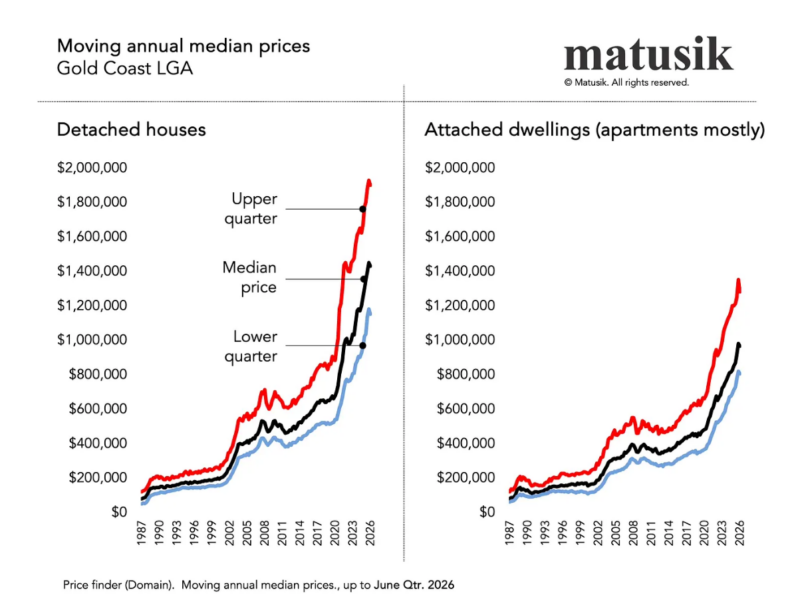
The upper end has been doing much of the heavy lifting. Wealthier migrants, including many baby boomers, can buy with much less sensitivity to local wages or mortgage serviceability.
That does not mean the Gold Coast isn’t expensive. It is.
Values have gone on a tear since Covid and local affordability has deteriorated sharply.
The supply catch
There is another brake on how far established prices can fall: replacement cost.
Our latest construction work suggests Gold Coast housing construction costs could rise around 7% in FY2027, 8.5% in FY2028 and 9.5% in FY2029, reflecting tight labour, apartment demand and increasing competition from rail, hospital and Olympic-related construction.
Falling resale prices therefore make new housing harder to deliver.
The cheaper existing stock becomes relative to replacement cost, the more projects become unfeasible. Supply gets deferred or cancelled. That eventually creates a floor beneath established values.
Recent industry polling found almost one-quarter of smaller and mid-sized property developers were considering cancelling projects as higher taxes, financing pressures and costs bite.
On the Gold Coast, I suspect the proportion of marginal projects could be considerably higher.
Bottom line
I don’t know where Gold Coast prices will be in 12 months. Nobody does.
Maybe they do fall 20%. If so, it would be historic.
But even such a fall would largely take median values back to around where they were two years ago. Most owners who bought before 2024 would still have substantial equity. Those who bought before Covid would, in most cases, remain very well ahead.
The Gold Coast market is slowing. It probably needs to. But slowing isn’t crashing.
For now, I see the headlines as more storm in a teacup than blood on the streets.
And before declaring a Gold Coast property crash, I would prefer to wait until the sales have actually settled.