

Key takeaways
More than 60 per cent of surveyed small and medium residential and commercial developers expect the proposed discretionary trust changes to affect project timing or viability.
Among developers expecting an impact, 37 per cent anticipate cancelling at least one project.
The changes would impose a minimum 30 per cent tax on the taxable income of discretionary trusts from 1 July 2028.
The Federal Government argues that more than 90 per cent of small businesses will be unaffected and that rollover relief will help businesses restructure.
Australia is already well behind the pace required to deliver 1.2 million homes under the National Housing Accord.
Further project cancellations would deepen the shortage, add pressure to rents and support the value of established investment-grade property.
Australia’s housing shortage is already serious, construction costs remain elevated, finance is expensive and too many proposed developments struggle to stack up financially.
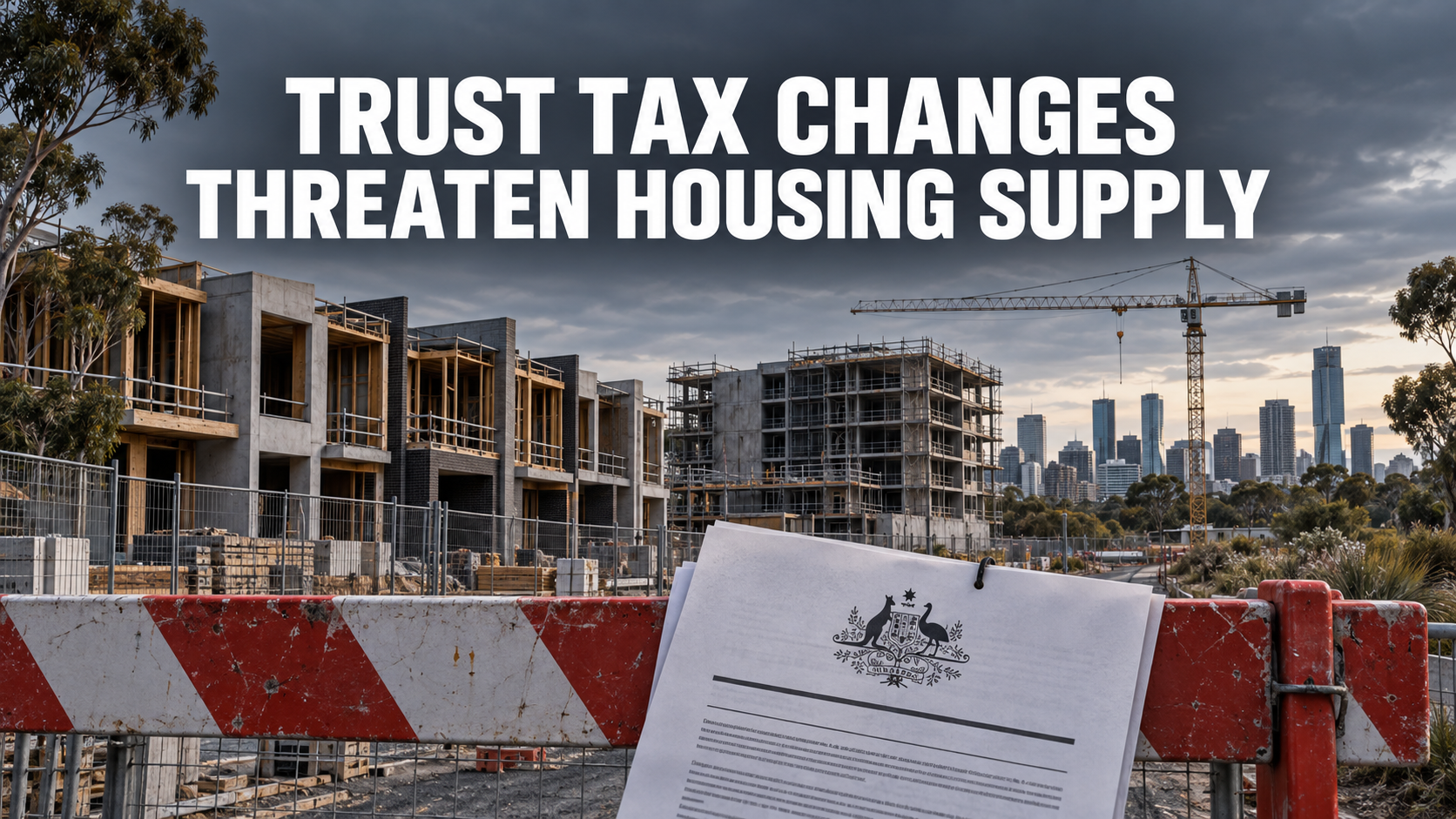
Now the Federal Government’s proposed changes to the taxation of discretionary trusts are creating another potential obstacle for the small and medium-sized developers responsible for delivering much of Australia’s new housing.
New industry polling suggests some developers are preparing to delay or cancel projects if the changes proceed in their current form.
That would mean fewer homes being built, more pressure on rents and an even wider gap between housing demand and supply.
And while this could underpin the value of well-located established properties, it would come at a substantial social and economic cost.
What is the government proposing?
The Federal Government announced in its May Budget that trustees of discretionary trusts would be required to pay a minimum tax of 30 per cent on the taxable income of the trust from 1 July 2028.
Beneficiaries would continue to declare their trust income, with non-corporate beneficiaries receiving non-refundable credits for tax already paid by the trustee.
The government says the measure is intended to reduce the tax benefits of income splitting and bring the taxation of trust income closer to the tax paid by wage and salary earners.
It also argues that around half of discretionary trusts will not be affected in any given year because they already distribute income to beneficiaries paying tax at rates of 30 per cent or more.
Expanded rollover relief is proposed for three years from 1 July 2027, allowing eligible businesses to move into structures such as companies or fixed trusts without triggering immediate income tax or capital gains tax consequences.
However, the property and construction industries argue that this assessment overlooks how extensively trusts are used for legitimate commercial purposes, including managing risk, holding development land, separating individual projects and bringing different investors into particular ventures.
For smaller developers, restructuring can also involve legal, accounting, financing, stamp duty and administrative complications that extend well beyond the headline tax treatment.
Developers are reconsidering their projects
Accent Research surveyed almost 1,200 small and medium business owners for a group of peak industry bodies, including the Housing Industry Association, Master Builders Australia, the Property Council of Australia, the Real Estate Institute of Australia and the Urban Development Institute of Australia.
The findings suggest the proposed changes are already influencing business decisions, even though the minimum tax is not scheduled to begin until 2028.
More than 60 per cent of small and medium residential and commercial developers said they expected the changes to affect the timing or viability of their projects.
Among the developers who expected an impact, 37 per cent said one or more projects would be cancelled. A further 17 per cent expected projects to be delayed by six to 12 months, while 7 per cent anticipated delays exceeding a year.
Only 1 per cent expected projects to be brought forward.
Expected impact on project timing
| Expected response | Percentage of affected developers |
| One or more projects cancelled | 37% |
| Delayed by 6 to 12 months | 17% |
| Delayed by less than 6 months | 13% |
| Delayed by more than 12 months | 7% |
| No impact on timing | 2% |
| Projects brought forward | 1% |
| Unsure | 16% |
| Not applicable | 7% |
Source: Accent Research polling commissioned by HIA, MBA, PCA, REIA and UDIA. The project-timing results relate to 95 property developers and builders who expected the changes to affect project timing or viability.
Just to be clear…the survey does not establish that 37 per cent of all the development projects across Australia will disappear.
It shows that among the surveyed developers who believe they will be affected, more than one-third expect to cancel at least one project.
Across all surveyed property and development businesses, the industry bodies say the result equates to almost one in four expecting one or more cancellations.
That is still a concerning figure in a market where every viable new dwelling counts.
Confidence affects supply long before the tax begins
Property development requires a series of financial commitments well before construction starts.
Developers need to acquire land, fund consultants and planning applications, negotiate finance, secure builders and, in many apartment projects, achieve minimum presales.
If the expected return no longer compensates for the risk, the project will usually be redesigned, delayed or abandoned.
That means the effects of a future tax change can appear in today’s land purchases and investment decisions.
The broader survey found 20 per cent of business owners aware of the Budget changes were considering reducing investment, while 18 per cent were considering restructuring and 15 per cent were looking at deferring expansion.
Nine per cent were considering delaying a project, 7 per cent were delaying land acquisitions and 5 per cent were contemplating cancelling a project.
Small business responses to the Budget changes
| Business response | Percentage |
| Reducing investment | 20% |
| Considering restructuring | 18% |
| Deferring business expansion | 15% |
| Delaying a project | 9% |
| Downsizing or reducing staff | 7% |
| Reducing hiring | 7% |
| Delaying land acquisition | 7% |
| Cancelling a project | 5% |
| Other action | 5% |
| No action planned | 54% |
Source: Accent Research. Respondents could nominate more than one action.
Among businesses using discretionary trusts, 77 per cent reported reduced confidence because of the proposed changes.
Across the wider sample, 54 per cent said the policy had reduced their confidence in their industry’s outlook, compared with only 3 per cent who said confidence had improved.
Confidence can sound like a soft measure, but development pipelines are built on confidence in future sales, costs, finance and policy settings.


When confidence falls, projects tend to disappear from the pipeline quietly. The housing consequences become visible several years later.
Australia can’t afford another blow to housing supply
The National Housing Accord targets 1.2 million new homes during the five years from July 2024, requiring an average of 240,000 homes a year.
According to the National Housing Supply and Affordability Council’s August 2026 report, approximately 308,000 homes had been completed during the first seven quarters of the Accord period.
That represents around one-quarter of the target after 35 per cent of the available time had elapsed.
The Council now estimates that the 1.2 million homes will be completed in the December quarter of 2030, which is well beyond the Accord’s original mid-2029 deadline.
It also reports that construction costs for houses increased by 2 per cent during the June quarter of 2026 and remain 51 per cent higher than before the pandemic.
There were 244,000 dwellings under construction in the March quarter, the highest level since records began in 1984. This is encouraging, but the pipeline remains vulnerable to rising costs, interest rates, labour shortages and deteriorating feasibility.
Why small developers matter
Large listed developers receive much of the public attention, but a significant share of Australia’s medium-density housing comes from smaller operators.
These businesses deliver townhouses, boutique apartment projects, land subdivisions and infill developments in established suburbs.
Many use separate trusts for individual projects to contain risk and clearly separate assets, liabilities and investors.
If these developers stop purchasing sites or reduce the number of projects they undertake, Australia could lose part of the very housing supply that planning reforms are trying to encourage.
Medium-density housing is especially important because it helps bridge the gap between detached houses and high-rise apartments.
It allows more people to live in established suburbs close to employment, transport, schools and existing infrastructure, where housing demand is usually strongest.
The government faces a policy contradiction
The government wants to improve tax fairness, and there is a reasonable debate to be had about income splitting and whether people with similar incomes should face broadly comparable tax rates.
At the same time, Australia urgently needs private capital to build more housing.
Those objectives need to be reconciled carefully.
A tax policy may appear sound when examined purely through the lens of revenue and equity, yet create unintended consequences when it interacts with development structures, lending requirements and already-thin project margins.
The sensible response would be to test the proposed rules against real development scenarios before the legislation is finalised.
Consideration could be given to genuine project-specific development trusts, active trading businesses and structures used primarily for commercial risk management rather than passive income splitting.
Clear transitional arrangements will also be essential because property developments frequently run across several financial years.
What this means for property investors?
Reduced construction will not cause property prices to rise automatically, and factors such as interest rates, credit availability, employment and consumer confidence will continue to influence markets in the short term.
However, the longer-term relationship is clear. If population and household formation continue to grow faster than the housing stock, competition for existing homes intensifies.
Vacancy rates remain tight, rents come under further pressure and well-located established properties become increasingly valuable.
New housing also establishes the marginal replacement cost in a market. When it becomes substantially more expensive or risky to deliver a new townhouse or apartment, the relative value of comparable established properties tends to improve.
This reinforces the importance of owning properties with strong owner-occupier appeal in locations where demand is deep and new supply is difficult to deliver.
However, investors should not assume that every property will benefit equally. High-rise precincts with large pipelines, locations dependent on one buyer group and inferior properties with weak owner-occupier demand can continue to underperform.
The bottom line
Australia’s housing shortage has been created over many years and will take years to repair.
Planning reform, faster approvals and infrastructure investment are important, but they will achieve little if developers cannot make projects financially viable.
The survey findings do not prove that every threatened cancellation will occur, and the government maintains that most small businesses will remain unaffected.
However, policymakers should take the warning seriously.
If the proposed trust changes cause viable projects to be delayed or abandoned, Australia will move further away from its housing targets.
That will leave home buyers and renters competing for a smaller pool of properties, while supporting the long-term value of scarce, well-located established homes.
Tax reform should be designed with an understanding of how housing is actually financed and delivered because once a project falls out of the pipeline, the homes it would have provided cannot be recovered quickly.