Earlier this month I had the pleasure of speaking at the Brisbane branch of the Urban Land Institute (ULI) Australia.
The organisers asked me a dozen or so questions covering everything from affordability and population growth through to construction costs, infrastructure and the Olympics.
Looking back on the discussion, four themes seemed to emerge.
1. The market isn’t broken. It is expensive.
The first two charts tell a story that is becoming increasingly difficult to ignore.
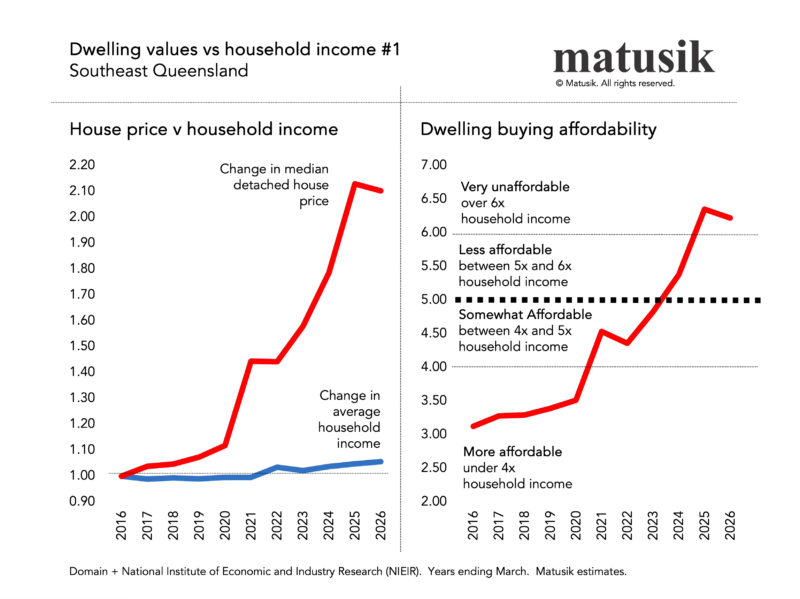
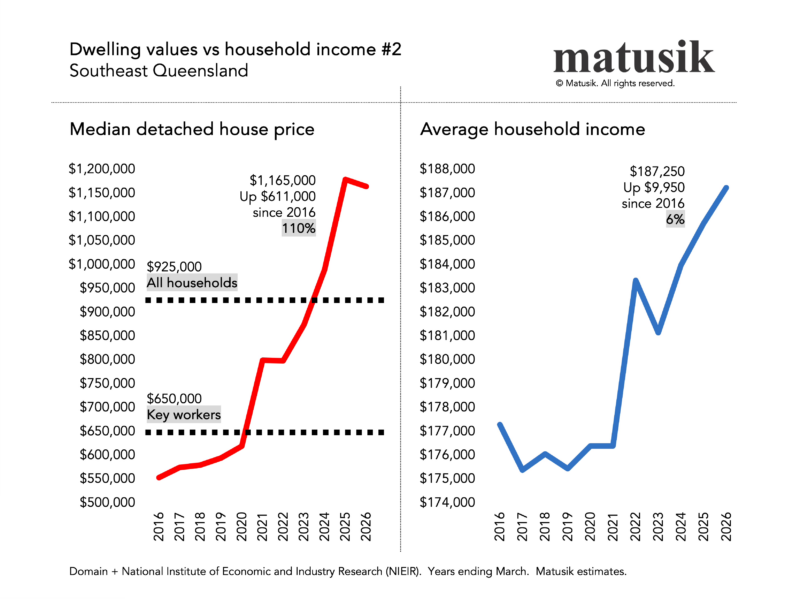
Since 2016, the median detached house price across Southeast Queensland has risen from around $554,000 to approximately $1.17 million.
Over exactly the same period, average household income has increased by only about six per cent.
The result is that buying a typical detached house now requires more than six times the average household income, compared with just over three times just a decade ago.
This is far more than an affordability issue.
It is changing who can live where, who can buy, and ultimately how our cities function.
Increasingly, the people who teach our children, care for us in hospitals, patrol our streets, build our homes and keep local businesses operating cannot afford to buy a detached home (or even a attached one) in the communities they serve.
Markets eventually adjust to this sort of imbalance, but rarely in the way people expect.
The answer is unlikely to be widespread price falls. Instead, the adjustment is more likely to come through different housing products, smaller dwellings, greater density and alternative ownership and rental models.
In other words, the future of housing in Southeast Queensland is unlikely to look like its past.
2. Population growth still matters. But understand where it comes from.
Population growth was another topic that generated considerable discussion.
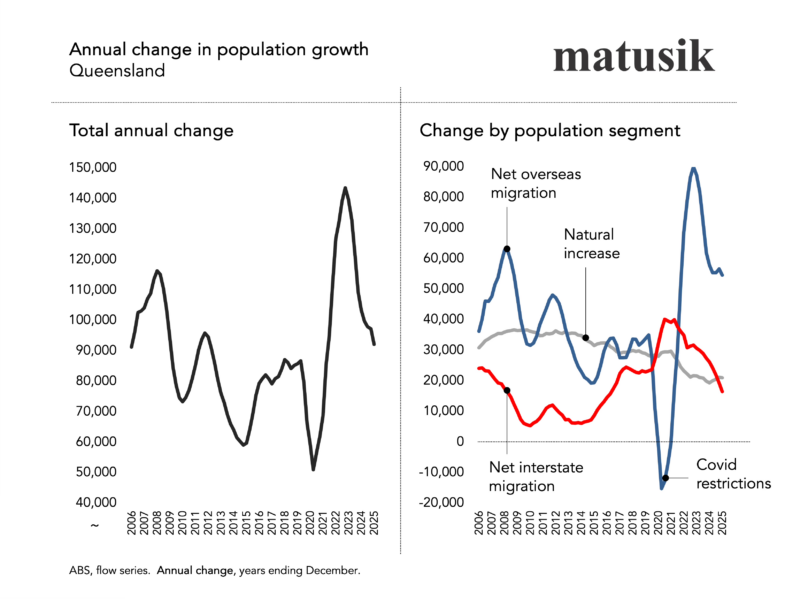
Queensland continues to grow strongly, but the composition of that growth has changed markedly.
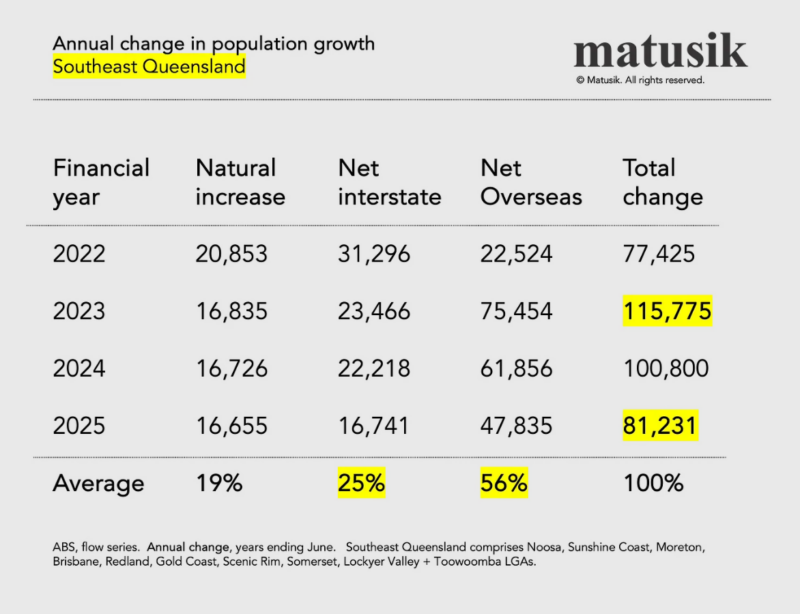
The accompanying charts show that over the past four financial years, more than half of Southeast Queensland’s population growth has come from overseas migration.
Interstate migration, while still positive, has eased considerably from the extraordinary levels recorded during the Covid years.
That distinction matters.
Too often, commentators quote a single population growth figure without considering who is actually arriving. Different groups have different housing needs. Overseas migrants are generally renters first.
- Also read:Latest Property Price Forecasts. Australian Property Market Outlook 2026-2027: Navigating a Market Correction

- Also read:Brisbane Property Market Forecast [2026 & Beyond] – What The Olympics Decade Means for Investors.
- Also read:Melbourne property market forecast for 2026 & 2027 | Separating the fundamentals from the sentiment
- Also read:Sydney property market forecast for 2026 and 2027 | Why the short-term softness is a long-term opportunity
- Also read:Home Prices Down Again Over September – But Not as Much | Latest Property Market Stats

Interstate migrants are often purchasers sooner. Younger migrants typically accept apartments or shared accommodation before moving into larger homes, while retirees relocating from southern states have entirely different housing preferences.
If we genuinely want to understand future housing demand, then we need to stop looking only at the total number of people arriving and pay much closer attention to where they are coming from and how they are likely to live.
3. Supply doesn’t respond to need. It responds to feasibility.
One of the questions asked what I believed was the biggest misconception in today’s housing debate.
My answer was simple.
Too many people believe that underlying demand creates new housing. It doesn’t. Capital creates housing. In Australia, for the vast majority of cases - some 95%+ - developer profit creates new homes.
Demand is necessary, but it is not sufficient.
Developers, builders and investors only commit capital when projects stack up financially.
Rising construction costs, higher finance costs, planning delays and increasing delivery risks all reduce the number of projects that proceed, regardless of how many households are looking for somewhere to live.
Australia spends an enormous amount of time talking about housing shortages and nowhere near enough time discussing development feasibility. We often assume that because more homes are needed, they will somehow appear.
Housing simply doesn’t work like that. Unless projects generate an acceptable commercial return, they remain drawings on paper rather than homes people can actually live in.
4. The Olympics won’t solve housing.
Naturally, the Brisbane Olympics became part of the conversation.
There is no doubt the Games will create economic activity. Infrastructure spending will rise significantly, thousands of construction workers will be required and additional households will relocate to Southeast Queensland as projects gather pace.
The presentation included several charts highlighting the size of Queensland’s infrastructure pipeline and the labour required to deliver it.
But there is another side to that equation.
Large infrastructure programs compete directly with residential construction for skilled labour, subcontractors and materials.
Unless the construction workforce expands substantially, the likely outcome will be higher building costs and reduced housing delivery at precisely the time additional homes are needed.
The Olympics themselves are neither the hero nor the villain. They simply place further pressure on an industry that is already operating close to capacity.
That is why I continue to argue that the real legacy of the Games will depend less on stadiums and more on whether we can house the workforce needed to build and support a larger Southeast Queensland. Before, and especially after, the Games.
End note: What I left Brisbane thinking.
Walking away from the discussion, one observation stayed with me.
Everyone agrees we need more housing. Far fewer are willing to accept that we will probably need different housing.
The next decade will not simply require us to build more detached houses on the urban fringe. Or very tall things in and around major urban centres.
It will require smaller dwellings, medium-density neighbourhoods, alternative rental models, different financing structures and, perhaps most importantly, housing that key workers can actually afford.