


Key takeaways
Auctions are losing favour as buyer competition weakens. The share of capital-city listings going to auction has fallen sharply since the market peak.
Sydney and Melbourne have seen the biggest shift. Sellers are increasingly choosing private sales as prices soften and clearance rates weaken.
Private sales give buyers more negotiating power. Buyers have more time for finance, due diligence and price negotiations.
Property quality matters more than the discount. A cheaper secondary property can still be a poor investment if it lacks scarcity and long-term growth potential.
Strategic investors may find opportunities in softer conditions. Rather than trying to pick the market bottom, focus on buying investment-grade assets at sensible prices for the long term.
For years, auctions have been the preferred selling method in Australia’s largest property markets, particularly in Melbourne and Sydney.
When buyer demand is strong, an auction can create urgency, competition and fear of missing out, encouraging emotional buyers to push the price beyond where a private negotiation may have ended.
However, auctions rely on one essential ingredient: several motivated buyers who are prepared to compete against each other.
That ingredient is becoming increasingly scarce in the current market.
As higher interest rates, tighter borrowing capacity and economic uncertainty weigh on buyer confidence, more sellers are abandoning auctions and choosing private sales instead.
According to Cotality data reported by the Australian Financial Review, the proportion of newly listed capital-city homes scheduled for auction has fallen from 40.4 per cent when the national market peaked in March to around 25 per cent.
That is a significant change in a relatively short period, and it tells us a great deal about the balance of power between buyers and sellers.

Auctions work best in a rising market
Auctions are particularly effective when there are more buyers than good properties available.
Several interested bidders turn up on the day, the auctioneer creates momentum, and buyers can see their competition standing beside them.
Under those conditions, bidding can quickly move beyond the level some buyers originally intended to pay.
Today, however, auction clearance rates are sitting around the low 50 per cent range and sometimes falling below that level. Open-home attendance has also weakened, while agents are reporting that some auctions attract only one or two registered bidders, and occasionally none at all.
An auction with one genuine buyer is really just a public negotiation, and it gives that buyer considerable power.
Vendors are also exposed to the risk of their property passing in and then carrying the stigma of a failed campaign. Once buyers know a property has failed to sell, they may assume the vendor’s expectations were unrealistic or that something is wrong with the property.
That can make the subsequent negotiation even more difficult.
Sydney and Melbourne sellers are changing course
The change is most obvious in our two largest auction markets.
In Sydney, only about 32 per cent of homes for sale are now scheduled for auction, compared with 56.7 per cent near the peak of the market last year.
Sydney property values have fallen about 5.3 per cent from their peak, and the higher-priced segments of the market have generally experienced the greatest declines.
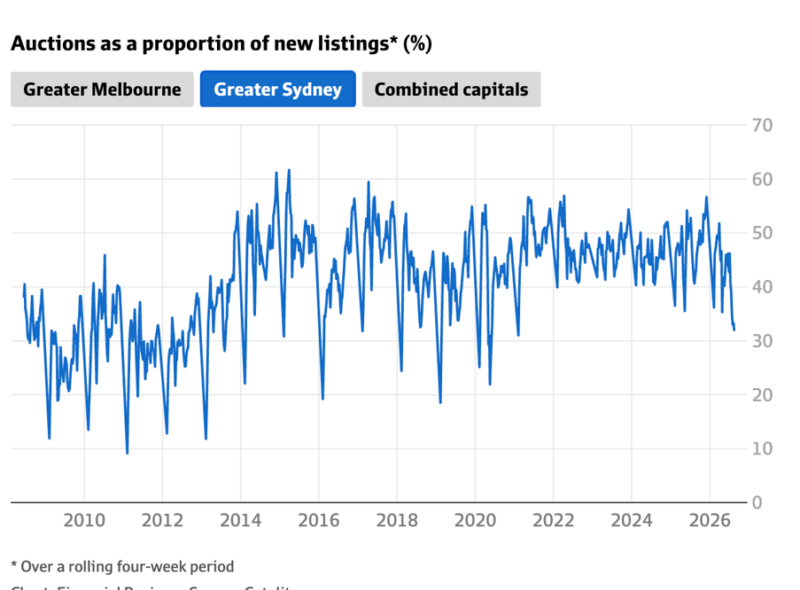
Source: Cotality data published in the AFR.
Melbourne has followed a similar pattern. Around 37.9 per cent of new listings are now going to auction, down from a high of about 61 per cent in 2025.
Melbourne values have fallen approximately 5.5 per cent from their peak, although its lower median price gives the market a slightly broader pool of potential buyers than Sydney.
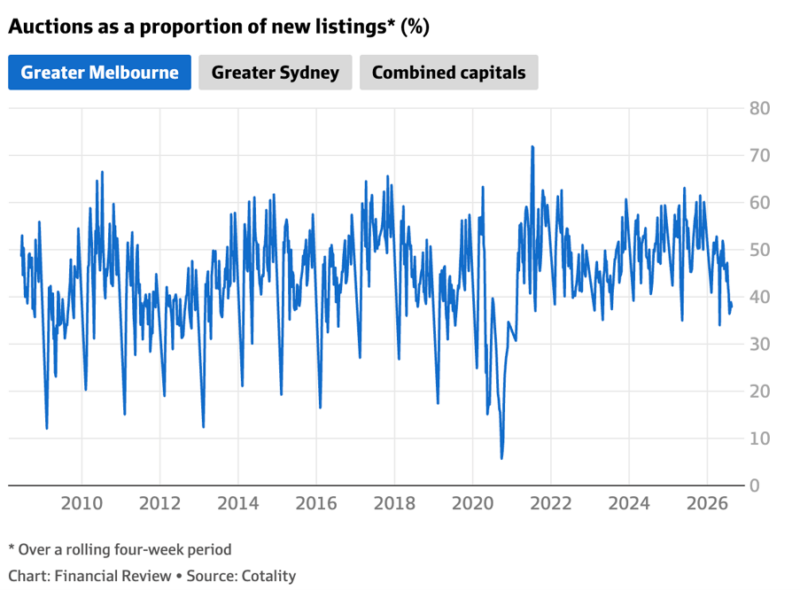
Source: Cotality data published in the AFR.
These charts show clearly how quickly seller behaviour has changed.
Vendors and selling agents are responding pragmatically to weaker conditions because they understand that an auction campaign is unlikely to manufacture competition when that competition doesn’t already exist.


Why private sales become more attractive
A private sale gives sellers greater control over the negotiation.
They can test the market without having their result played out publicly, consider offers as they arrive and adjust their asking price without the drama of a property being passed in on auction day.
It can also give buyers more time to organise finance, conduct due diligence and negotiate conditions.
In a market where borrowing capacity has been reduced and purchasers are becoming more cautious, that additional flexibility can expand the pool of prospective buyers.
Of course, private treaty campaigns come with their own risks.
Without a firm auction date, a listing can drift. If a property remains advertised for 40 or 50 days, buyers begin to wonder why it has not sold and may assume the vendor is becoming increasingly motivated.
That is why correct pricing matters more than ever.
Vendors who base their expectations on what a neighbour achieved near the top of the market may find themselves chasing prices down. Meanwhile, well-priced properties with an element of scarcity can still attract strong interest and sell quickly.
The market is becoming increasingly fragmented, which means broad headlines about prices or clearance rates can be misleading.
Investment-grade properties in desirable, supply-constrained locations will continue to attract buyers, while secondary properties with compromises will generally take longer to sell and require greater price adjustments.
Buyers now have more time and negotiating power
The shift towards private sales gives buyers something they have lacked for much of the past few years: breathing room.
There is less pressure to make an unconditional decision in a matter of minutes, and buyers often have more opportunity to negotiate the price, settlement terms and other conditions.
However, this doesn’t mean every property on the market is a bargain.
Some vendors remain anchored to yesterday’s prices, while many properties are cheap for a reason. They may be in the wrong location, have poor layouts, sit on inferior streets or lack the scarcity needed to support long-term capital growth.
A softer market can tempt buyers to focus on the size of the discount rather than the quality of the asset. Yet a 10 per cent discount on the wrong property rarely makes it a good investment.
Experienced investors understand that the quality of the property will matter long after the current market conditions have passed.
Waiting for the bottom can be costly
Buyers are understandably cautious today. When prices are falling, many people delay making a decision because they fear buying before the market reaches its bottom.
The difficulty is that property market bottoms are only obvious in hindsight.
By the time the data confirms that prices have stabilised, buyer confidence is usually improving, competition is returning, and some of the best opportunities have already disappeared.
Strategic investors don’t need to pick the exact bottom of the cycle. They need to buy the right property at a sensible price, protect themselves with appropriate financial buffers, and hold the asset long enough to benefit from several property cycles.
At present, many discretionary sellers are likely to delay listing rather than accept a lower price. That could gradually reduce the supply of properties for sale and help the market find a floor, although the adjustment may take time as buyers absorb the effects of higher interest rates and changing tax settings.
In my view, the decline in auctions is another sign that buyers have gained the upper hand, at least for now.
For investors with secure finances, adequate buffers and a long-term perspective, this creates an unusually useful window. They can negotiate without the same level of emotional competition, take the time to conduct thorough due diligence and selectively acquire high-quality assets from motivated vendors.
There will always be reasons to wait, particularly when the headlines are gloomy.
Yet history suggests that some of the best investment decisions are made when other buyers lack confidence. This is a great time for strategic investors to take advantage of the opportunities the market presents, provided they remain focused on investment-grade properties and keep their eyes firmly on the long term.