

Key takeaways
Years of underperformance have left Melbourne apartments relatively affordable despite the city's strong long-term fundamentals. That gap could create opportunities for patient investors.
New apartment construction is slowing, but population growth and rental demand continue to rise. Over time, this imbalance should support prices and rents.
Focus on investment-grade apartments in established suburbs with scarcity, quality construction and strong owner-occupier appeal. Avoid high-density developments with abundant supply.
Property markets move in cycles, and today's weakest performer can become tomorrow's strongest. Long-term investors should focus on fundamentals rather than headlines.
Buying a well-located apartment at fair value is more important than simply buying something cheap. Investors who think a decade ahead are more likely to build lasting wealth.
For the last few years, Melbourne has been the forgotten child of Australia's property market.
While Brisbane, Perth and Adelaide enjoyed extraordinary price growth, Melbourne seemed stuck in neutral.
Investors looked elsewhere, headlines focused on the city's higher taxes and weaker short-term performance, and many concluded that Melbourne had simply lost its shine.
I believe that conclusion is short-sighted - in fact, whenever I see a high-quality market fall out of favour while its long-term fundamentals remain intact, I start paying much closer attention.
That's because property investment isn't about chasing yesterday's winners, it's about identifying tomorrow's opportunities before they become obvious to everyone else.
Recent research from JLL suggests Melbourne's apartment market may now be Australia's most undervalued residential property sector, with years of underperformance creating a rare disconnect between price and underlying fundamentals.
Of course, that doesn't mean every Melbourne apartment represents a bargain - far from it.
But it does suggest that selective investors willing to separate investment-grade apartments from the thousands of mediocre units on the market could be looking at one of the better buying opportunities we've seen for some time.
Melbourne has fallen behind, but that's exactly what creates opportunity
Property markets move in cycles. Cities don't remain the best performers forever, and they don't stay at the bottom indefinitely either.
Over the past few years Melbourne has significantly underperformed most other capital cities.
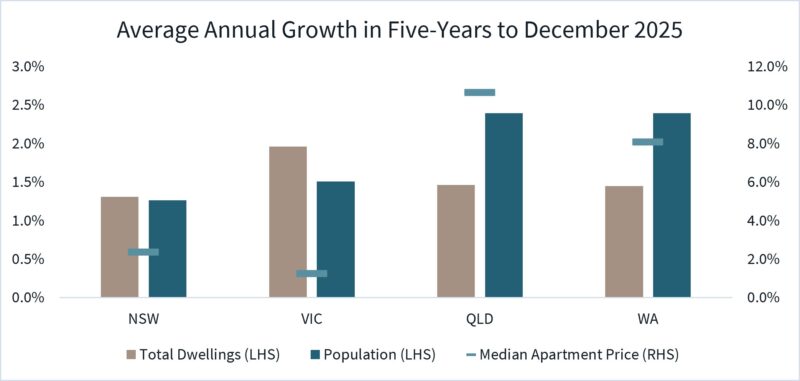
Source: JLL Research
Home values have remained below previous peaks while Brisbane, Perth and Adelaide surged ahead, changing Australia's property rankings in a way that would have seemed unimaginable only a few years ago.
Reasons behind much of this weakness has been well documented - higher land taxes, increased investor costs, affordability pressures, changing government policies and cautious buyer sentiment all combined to suppress demand.
More recently, the 2026 tax changes have further reduced investor activity across Melbourne.
As a result, many investors simply crossed Melbourne off their shopping list, but ironically, that's often when opportunities begin to emerge.

Tip: Markets rarely reward investors for following the crowd. They tend to reward those who are prepared to buy quality assets when sentiment is weak, but the underlying fundamentals remain strong.
Apartments have become even more overlooked
The interesting part of the current story isn't simply that Melbourne appears relatively affordable; it's that apartments have become even cheaper relative to houses than usual.
According to JLL, Melbourne apartments are now trading at substantial discounts compared with equivalent stock in Sydney and are also comparatively affordable against Melbourne houses.
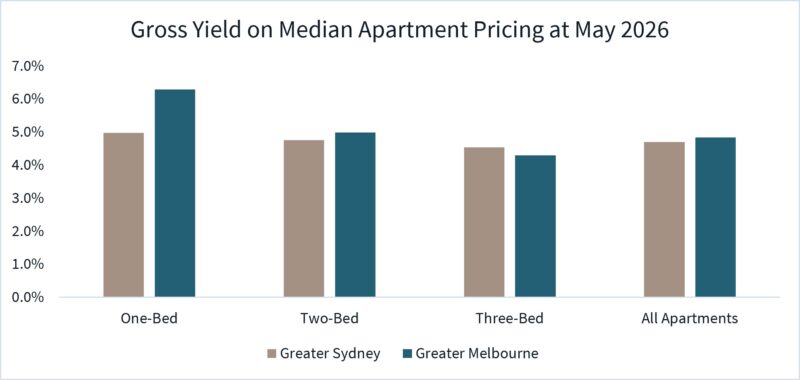
Source: JLL Research
At the same time, rental demand continues to strengthen while new apartment supply is slowing sharply.
That combination should immediately catch the attention of experienced investors. When prices remain subdued while supply tightens and demand continues growing, markets often reach an inflection point.
Of course, timing these turning points perfectly is impossible, but successful investors have never relied on perfect timing.
Instead, they focus on buying quality assets before the broader market recognises their value.
Population growth hasn't disappeared
One of the biggest mistakes investors make is confusing short-term sentiment with long-term fundamentals.
Despite its recent housing market weakness, Melbourne remains one of Australia's largest, most diversified and fastest-growing economies.
Population growth continues to underpin long-term housing demand, driven by overseas migration, interstate movement and natural population growth.
Employment opportunities, world-class universities, transport infrastructure and lifestyle continue to attract new residents.
People still want to live in Melbourne. Businesses continue investing in Melbourne. International students continue returning.
These are exactly the ingredients that support long-term housing demand.
Tip: Markets can ignore those fundamentals for a while, but they rarely ignore them forever.
The supply story could become even more important
Property prices are ultimately driven by supply and demand. That's hardly revolutionary, but many investors underestimate how quickly the balance can shift.
For years Melbourne experienced relatively strong apartment construction -that pipeline is now drying up.
Industry research suggests new apartment completions are expected to fall towards multi-year lows as higher construction costs, financing difficulties and reduced project feasibility discourage developers from bringing new projects to market.
At the same time, Australia's broader housing shortage remains unresolved.
When fewer dwellings are being built while the population continues expanding, vacancy rates generally tighten and rental pressure increases.
- Also read:Latest Property Price Forecasts. Australian Property Market Outlook 2026-2027: Navigating a Market Correction

- Also read:Unsold Stock Drives 21.6% Annual Jump in Listings as Spring Season Opens | Latest SQM Listing Data

- Also read:National Weekly Auction Report – October 3rd 2026 | October Auction Market Begins with More Generally Subdued Results

- Also read:Home Prices Down Again Over September – But Not as Much | Latest Property Market Stats

- Also read:Unemployment rises, student numbers fall and Melbourne still leads the auction market | Property Insiders

We've already seen Melbourne's rental market strengthen considerably, even though rents remain among the lowest of the mainland capitals.
That's not a combination likely to persist indefinitely.
But let's be clear - not all apartments are investment-grade
This is where many investors get themselves into trouble. They hear that Melbourne apartments are undervalued and assume every apartment must therefore represent a good investment.
Nothing could be further from the truth. You see.. there are two very different apartment markets.
One consists of scarce, well-located properties in established suburbs, close to transport, employment, lifestyle amenities and strong owner-occupier demand.
The other consists of high-density investor stock where hundreds of almost identical apartments compete against one another.
One has scarcity. The other has abundance.
One attracts emotionally driven owner-occupiers. The other relies largely on investor demand.
Those differences matter enormously because owner-occupiers drive long-term capital growth. Investors generally follow growth rather than create it.
That's why I'd continue avoiding large high-rise developments in oversupplied precincts, regardless of how attractive they appear on paper.
Instead, I'd focus on investment-grade apartments with genuine scarcity value.
Boutique developments. Larger internal floorplans. Quality construction. Excellent locations. Strong owner-occupier appeal.
These characteristics have always mattered, and they matter even more when buying apartments.
Value alone isn't enough
Another mistake investors make is assuming cheap automatically means good value. It doesn't.
Sometimes markets are cheap for very good reasons.
The challenge is identifying whether today's discount reflects temporary pessimism or permanent structural weakness.
In Melbourne's case, I believe much of the recent weakness reflects cyclical factors rather than a deterioration in the city's long-term prospects.
After all, Melbourne hasn't stopped being Australia's cultural capital. It hasn't lost its economic diversity. It hasn't lost its educational institutions. It hasn't stopped attracting migrants.
Nor has it stopped creating jobs.
Those fundamentals remain remarkably resilient. Eventually markets tend to recognise that.
Smart investors think beyond the next year
Too many investors spend their time trying to predict what property prices will do over the next six or twelve months.
Professional investors think differently.
They're asking what a city will look like over the next decade. Will more people want to live there? Will quality housing remain scarce? Will incomes continue growing? Will infrastructure improve accessibility? Will owner-occupier demand remain strong?
When I apply that framework to Melbourne, I remain optimistic.
Yes, the city faces challenges. Every major city does.
But challenges create opportunities for investors prepared to take a longer-term perspective.
The bottom line
I wouldn't buy Melbourne apartments simply because they're currently cheaper than many alternatives.
I'd buy carefully selected investment-grade apartments because I believe the gap between today's prices and Melbourne's long-term fundamentals has become unusually wide.
History shows that markets rarely stay disconnected from fundamentals forever.
Eventually quality assets are recognised for what they are.
That doesn't mean Melbourne apartments will suddenly boom next month, and it certainly doesn't mean every apartment represents a sound investment.
However, for investors prepared to ignore short-term sentiment, focus on quality and adopt a long-term view, Melbourne's apartment market may well prove to be one of Australia's most compelling opportunities over the next property cycle.
As always, the winners won't be those who buy the cheapest property available. They'll be the investors who recognise enduring value before everyone else does.