

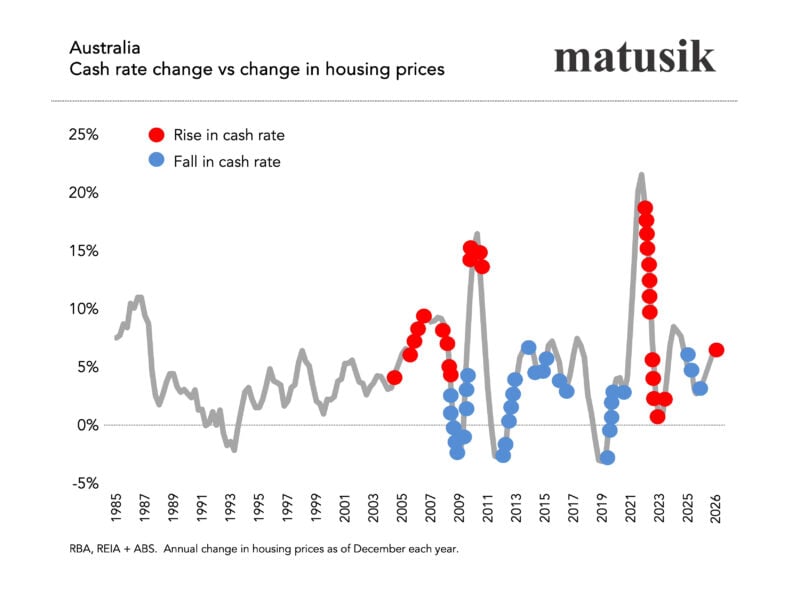
One of the more persistent questions I get asked at recent speaking gigs during the Q+A that follows by babble, is “When the RBA lifted rates 13 times across 2022 and 2023, why didn’t housing crash?.”
The chart suggests it should have has more impact.
Historically, rising cash rates slow dwelling prices. Sometimes sharply. Yet post-Covid, after an initial wobble, housing values pushed higher again.
The answer isn’t a mystery. It’s money.
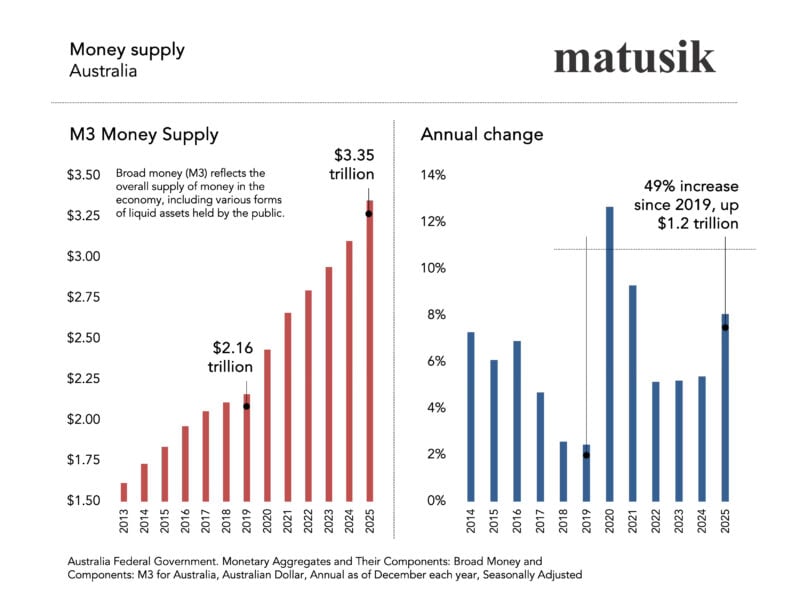
Between 2020 and 2022, Australia experienced the largest monetary expansion in its modern history.
Quantitative easing, large-scale government bond purchases, fiscal transfers, business grants, wage subsidies and state stimulus combined to deliver close to $1.2 trillion in policy support across the economy.
Over the same period, Australia’s broad money supply (M3) rose from around $2.16 trillion in 2019 to approximately $3.35 trillion today - an increase of roughly $1.2 trillion, or about 55%.
That is an extraordinary lift in liquidity in a very short period of time.
For context, Australia’s annual GDP is approximately $2.64 trillion, currently growing at around 2.1% per annum.
Put more simply: Australia’s money supply is now more than half again as large as it was pre-Covid, and more than one-third of all Australian dollars in existence today were created in the past five years.
Stop and read that last sentence again.
And you cannot pour that much liquidity into our housing system and expect no distortion.
Yes, the initial Covid response was justified. Pandemic panic demanded circuit breakers.
But emergency settings didn’t simply unwind, they morphed, and big time.
Government spending rose structurally. Every social problem now has an automatic funding solution, even if really just needs some tough love. Every constituency has become a budget line item.
Of course we aren’t alone.
Throughout advanced economies, fiscal settings remain elevated compared to the pre-pandemic norm.
Public balance sheets are larger, structural deficits wider and political appetite for restraint very limited, more like non-existent, if you ask me.
Interest rate increases have tightened the margin, but they haven’t fully offset the magnitude of the earlier and continuing liquidity surge.
- Also read:Melbourne housing market update | September 2026

- Also read:Australian housing market update | September 2026

- Also read:Latest Property Price Forecasts. Australian Property Market Outlook 2026-2027: Navigating a Market Correction

- Also read:Brisbane Property Market Forecast [2026 & Beyond] – What The Olympics Decade Means for Investors.

- Also read:Melbourne property market forecast for 2026 & 2027 | Separating the fundamentals from the sentiment

And housing sits downstream of this.
The excess liquidity did three things.
First, it permanently lifted household balance sheets. Savings buffers surged. Deposits ballooned. Even as rates rose, many borrowers had cushions.
Second, it embedded higher nominal incomes. Wage growth accelerated way above productivity gains. Asset inflation boosted perceived wealth.
Third, policy actively supported housing demand. Since 2020, just over 265,000* Australians have entered home ownership via federal deposit guarantee schemes. That has demand brought forward. It narrowed the deposit hurdle and pulled buyers into the market earlier than would otherwise occur. This activity distorts the housing cycle.
Layer that atop record migration and weak new housing supply (especially in 2023 and 2024), and you get resilience not collapse.
But here’s the uncomfortable bit.
This recent growth rhythm is unlikely to repeat.
Inflation is proving sticky. And for mine will remain so in a more fractured global order - regional trade blocs, supply chain duplication, defence spending and now spreading overseas conflicts - adds to structural costs.
Deglobalisation is inflationary. Energy transition costs are inflationary. Ageing demographics are inflationary when you don’t have the right policy settings.
That likely means interest rates stay higher for longer than history taught us to expect.
Meanwhile, debt levels across households, developers and governments are materially higher. When leverage rises, margin for error falls.
Recent housing price growth appears less like the start of a new cycle and more like the lagged effect of unprecedented stimulus still working its way through the economy.
Monetary expansions rarely lift productivity; they primarily inflate asset values and bring forward demand.
The risk
The risk for housing investors - and especially new housing developers - is assuming the anomaly is the baseline.
Higher construction costs. Thinner feasibility. Tighter credit assessment. Greater sales risk.
We are not returning to the ultra-cheap money era any time soon. And without that tailwind, housing returns revert toward income growth, not liquidity growth.
That’s a very different equation than where things have been at over the past five or so years.
The post-Covid housing upswing wasn’t magic. Pump enough money into an economy and asset prices will respond.
The question now isn’t why prices didn’t fall. It’s what happens when the sugar hit finally wears off.