

Australia loves a big housing target.
A million homes here, 1.2 million there - bold numbers splashed across press releases and podium backdrops.
But the latest BuildSkills Housing Workforce Capacity Study makes one thing painfully clear:
We don’t have the people to build the homes we keep promising.
And nowhere is that shortage sharper than in regional Australia.
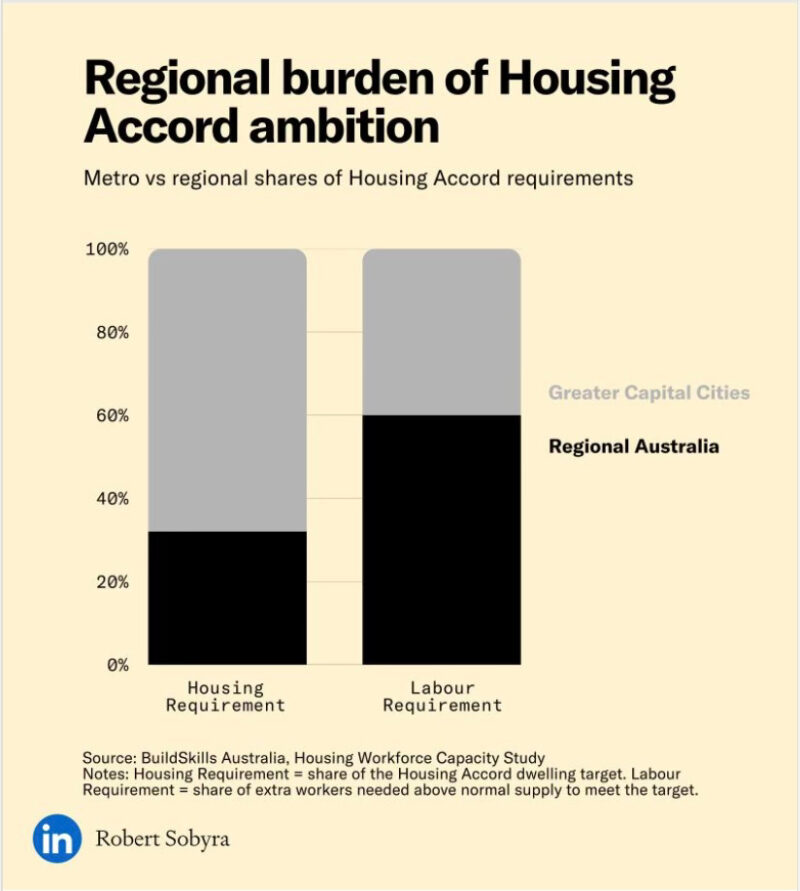
The chart - and thanks Robert for your great work - tells the story.
While the regions are expected to deliver roughly a third of the homes under the Housing Accord, they’re somehow expected to supply over half of the additional workers needed to build them.
That’s a big ask for places that have been steadily losing their 25- to 40-year-olds — the age group that swings hammers, runs sites, mentors apprentices and keeps the whole machine rolling.
We’re asking the wrong people, in the wrong places, to deliver the right amount of housing.
The state of play: running on fumes
Australia’s housing shortage didn’t begin with migration; it began with shrinking households.
COVID pushed people apart - kids moved out, share houses split, couples uncoupled. Household sizes dropped, vacancies collapsed and homelessness rose.
Now affordability is so stretched, and migration so strong, household sizes are growing again - but vacancies haven’t budged. We’re still chronically short of roofs.
On the supply side, things are worse. Construction costs jumped 30% during the pandemic and stayed there. Margins remain thin. Builders keep falling over. And even when projects stack up on paper, they often can’t find the workers.
Construction unemployment remains well below the national average. Job vacancies are still historically elevated.
The industry doesn’t have enough labour for current output, let alone a 40% expansion.
The accord: big target, small workforce
To meet the Housing Accord, completions need to lift from around 43,000 per quarter to 60,000 — and stay there for five years straight. That requires 139,300 additional workers by 2029.
BuildSkills is blunt: even if every policy lever works at full strength, Australia still falls short.
That shortfall is nowhere more acute than outside the capitals.
The regional burden: twice the pain, half the workforce
Regional Australia faces structural disadvantages:
- smaller, ageing labour pools
- weak apprenticeship pipelines
- limited TAFE and training access
- competition from mining and agriculture
- high building costs and long travel distances
- severe rental shortages that make relocation difficult
And sitting above all of that is the demographic ache: the regions keep losing their younger workers.
The very group the housing industry depends on is thinning out year by year.
This isn’t a capacity gap. It’s a capacity canyon!
- Also read:Latest Property Price Forecasts. Australian Property Market Outlook 2026-2027: Navigating a Market Correction

- Also read:Brisbane Property Market Forecast [2026 & Beyond] – What The Olympics Decade Means for Investors.
- Also read:Melbourne property market forecast for 2026 & 2027 | Separating the fundamentals from the sentiment
- Also read:Sydney property market forecast for 2026 and 2027 | Why the short-term softness is a long-term opportunity

- Also read:Home Prices Down Again Over September – But Not as Much | Latest Property Market Stats

Why the regions can’t deliver what the Accord expects
- Residential construction already has no slack. Only 20% of construction workers are in residential work; the rest are tied up in commercial, industrial and infrastructure — skills that don’t transfer easily.
- Costs never came back down. The pandemic raised the construction cost base, and it’s stayed elevated. That kills feasibility and delays pipelines.
- Productivity is stuck in the 1980s. Low tech adoption, slow approvals, fragmented supply chains, minimal standardisation.
- Demand for construction workers is rising everywhere. Net-zero infrastructure, defence spending, mining investment, transport upgrades — housing is competing with all of it. Oh and the bloody Olympics too and probably another fcuking expensive white-elephant, the MacPoint Stadium in Hobart.
How to fix it? A National workforce reset
The BuildSkills report is clear: Australia needs a workforce reboot built around five major levers.
The first is apprenticeships.
We need to rebuild the entire pipeline — payroll tax relief for employers, better wage support via Group Training Organisations, a digitised apprenticeship system to remove paperwork bottlenecks, and a higher tax-free threshold to make apprenticeships financially viable.
Mature-age workers need accelerated pathways; school students need exposure to real construction careers; and major contractors must help drive pre-apprenticeship programs. If we don’t double apprentice throughput, the Accord goes nowhere.
Second, women must enter the trades in far greater numbers.
Adopting the Culture Standard on government projects is a start.
Add structured mid-career transition pathways and paid placement programs, and the industry can finally access the single biggest untapped labour pool in the country.
Third, immigration must be smarter.
We need streamlined skilled migration, labour mobility pathways so small builders can access migrant workers, bridging programs so overseas tradies can become job-ready quickly, and targeted global recruitment campaigns.
Migration can carry more load — but only if the system stops tripping over itself.
Fourth, productivity must improve.
Mandatory continuing professional development, modern procurement, planning concessions for innovative construction methods, and shared technology precincts can unlock real efficiency gains.
You can’t solve a labour shortage with more labour alone.
Finally, the training system needs reform.
The VET sector must be capable of producing job-ready tradies at scale. That means reworking construction pathways, reducing literacy and numeracy hurdles, streamlining accreditation, and expanding trainer capacity.
None of these levers work alone.
Pull all of them together, and you finally get a workforce capable of meeting the nation’s housing ambitions.
The bottom line
Australia doesn’t just have a housing shortage, it has a construction workforce shortage. And that shortage is structurally worse outside the capitals.
Assuming we have the will, we can fix planning; release more land and more importantly free up under-utilised urban land and we redirect funding away from vanity projects to housing infrastructure.
But you can’t build homes without builders.
And building 1.2 million new homes over the next five years is just fantasy land. Moreover, the builders we have right now aren’t even where we need them.
Matusik Missive by independent property analyst, Michael Matusik. Each week Michael shares his thoughts on the Australian housing market. Visit www.matusik.substack.com to find out more.