

Key takeaways
In January, cheaper houses were outperforming more expensive houses by 1.3 percentage points over three months
By September, this had reversed, with expensive houses ahead by 0.18 points and expensive units by 0.32 points
Expensive homes aren't booming, but cheaper homes are now falling faster
The Budget's changes to negative gearing and CGT hit the investor-heavy end of the market hardest
Owner-occupier demand is proving the more reliable support for values
Investment-grade properties in established, owner-occupier suburbs are holding up best
At the start of this year the cheapest homes in our capital cities were the stars of the property market, outpacing their more expensive neighbours almost everywhere you looked.
Then the May Budget landed, and within a few months that advantage had disappeared.
A new analysis by Ray White chief economist Nerida Conisbee shows just how quickly the tide turned, and I think it offers important lessons for anyone serious about building a long-term property portfolio.
It also confirms something we’ve been saying at Metropole for decades about where the real long-term value sits in our housing markets.
What the numbers show
Nerida's analysis compares the performance of properties at the 25th percentile of prices with those at the 75th percentile, which is a neat way of comparing the cheaper end of each market with the more expensive end.
In January, cheaper houses were outperforming more expensive houses by an average of 1.3 percentage points over three months, and the advantage for cheaper units was similarly strong.
By September this had completely reversed.
More expensive houses were outperforming by 0.18 percentage points, while higher-priced units were ahead by 0.32 percentage points.
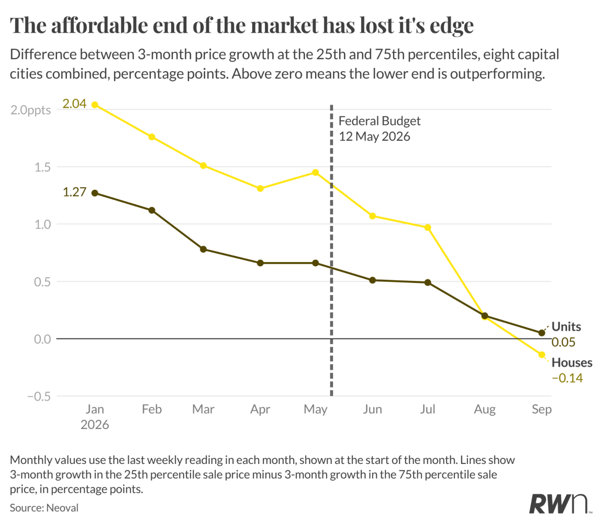
Source: Nerida Conisbee, Ray White
Those margins might look small on paper, but the speed of the turnaround is what caught my eye, because a swing of around one and a half percentage points in relative performance within eight months is a meaningful change in direction.
Why cheaper homes were running hot
To understand the reversal, it helps to remember why the affordable end was outperforming in the first place.
The expanded 5% deposit scheme, which became far more generous from October 2025 when income caps were removed and price caps were lifted, pushed a wave of first home buyers into the lower price brackets.
At the same time, investors were active in exactly the same segments, buying apartments, townhouses and cheaper houses.
So you had two groups of buyers chasing a limited pool of entry-level stock, and prices responded the way you'd expect.
Meanwhile, the more expensive end of the market had already started softening as interest rates began rising again, because premium buyers carry bigger loans and their borrowing capacity is more sensitive to rate moves.
What changed after Budget night
The Budget substantially reduced the tax advantages of buying established investment properties after 12 May, with the changes to negative gearing and the capital gains tax discount aimed squarely at investors.
That removed one of the two legs holding up the cheaper end of the market.
Earlier this year Ms Conisbee summed up the problem neatly when she pointed out that the government had helped push first home buyers into the cheaper end of the market, and through the Budget it would push investors out of that same segment.
That's pretty much what has played out.
Ray White's lending analysis found that for every additional investor loan written for a new home, there were roughly 16 fewer loans for established properties, so the investor money hasn't been redirected so much as withdrawn.
Interestingly, Nerida's auction data hasn't shown investors dumping property either, and as she put it, "There is no evidence of a post-Budget investor sell-off."
The pressure on cheaper homes comes from fewer investors buying, not more investors selling.
A relative shift rather than a boom
Just to be clear…this doesn't mean expensive homes are suddenly booming.
Across the combined capitals, dwelling values fell 4.3% over the September quarter, so most segments of the market have been going backwards.
What has changed is that cheaper properties are now falling faster, while higher-priced homes are holding their value better.
Higher interest rates have added to the slowdown, but Ray White’s view is that the Budget changes explain why the relative performance of the two ends of the market has shifted so sharply.
Ms Conisbee also expects cheaper properties to keep underperforming for some time, even once the broader market recovers.





Why this doesn't surprise me
I've always believed the most reliable long-term capital growth comes from properties that owner-occupiers want to buy, because their decisions are driven by lifestyle, family and emotion rather than tax settings or rental yields.
When a market is propped up by government incentives and tax-driven investor demand, it's vulnerable the moment those supports are withdrawn.
That is exactly what we're seeing now in many of the cheaper apartment blocks and investor-dominated outer suburbs.
On the other hand, the established family homes and quality townhouses in Melbourne's and Sydney's inner and middle-ring suburbs are bought mainly by owner-occupiers who have never relied on negative gearing to make the numbers work.
Ray White's open home data supports this, with buyer engagement in Sydney already above pre-Budget levels and Melbourne back to where it was before Budget night.
Nerida described Melbourne as looking like it was moving from stabilisation towards an upswing, which fits with what our team at Metropole is seeing on the ground in the better suburbs.
The trap of chasing cheap
Over the last couple of years I've watched plenty of investors chase the cheapest properties they could find, often guided by "data-driven" hotspot lists or the promise of a strong rental yield.
The appeal is easy to understand when borrowing capacity is tight, but cheap properties are usually cheap for a reason, and their values tend to be propped up by investors and first home buyers rather than by a deep pool of affluent owner-occupiers.
Now that the investor pool has shrunk, and with the cheaper segment likely to lag even after the market recovers, some of these buyers may find themselves holding assets that take a long time to generate meaningful growth.
That's a costly lesson in the difference between a cheap property and a good investment.
The other side of the ledger
To be balanced, the premium end still carries its own risks.
Nerida Conisbee has warned that the recovery at the top end remains fragile, because borrowing capacity at higher price points is very sensitive to interest rates, and a worse rate outlook could slow the momentum.
There's also a twist for renters and the wider market, since fewer investors in established housing means less rental supply.
Rents across the combined capitals were still 5.5% higher than a year earlier, and lower house prices don’t necessarily mean housing conditions are easing.
Over time, rising rents will lift rental yields on established properties, which should eventually bring some investors back, but that will take a while to play out.
What I'd be doing now
If you already own investment property, now is a good time to review each asset and ask who the next buyer is likely to be.
If the answer is mainly another investor or a first home buyer relying on a government scheme, that property is more exposed to policy changes than one that will appeal to owner-occupiers with strong incomes.
I'd also think very carefully before selling a property bought before Budget night, because those holdings retain their existing tax treatment. That grandfathered status has real value you can't recreate by buying again.
If you're planning your next purchase, I'd be wary of being steered towards new off-the-plan apartments or house-and-land packages simply because the tax rules now favour them.
New stock tends to carry a developer's margin, often lacks the scarcity that drives long-term growth, and a tax benefit won't make up for a property that underperforms for a decade.
For those with borrowing capacity and buffers to act, I see this period of weaker sentiment as an opportunity to secure investment-grade properties in established owner-occupier suburbs while many buyers remain on the sidelines.
You won't pick the exact bottom, and you don't need to, because time in the market does the heavy lifting when you own the right asset.
The bottom line
This analysis is a timely reminder that government policy can shift parts of the market very quickly, while the fundamentals that drive long-term growth remain largely unchanged.
Properties that rely on incentives and tax settings for their appeal will keep being knocked around each time the rules change.
The properties that owner-occupiers aspire to own, in locations with strong economic drivers and limited new supply, are much more likely to continue outperforming over the decades ahead.
If you'd like a second opinion on how your portfolio is positioned after the Budget changes, the team at Metropole can help you build a strategic property plan that's designed for the long term. Why not click here now and have a chat with one of our wealth strategists to discuss your options?