

Key takeaways
Migration remains a key driver of Australia's growth. Population growth is still heavily supported by migration, helping address labour shortages and offset the challenges of an ageing population.
Housing affordability is primarily a supply issue. Restricting migration won't solve the housing crisis while planning delays, zoning restrictions and slow construction continue to limit new housing supply.
Australia's housing shortage will take years to fix. Even with more homes being built, the nation remains well behind its housing targets, meaning the supply-demand imbalance is likely to persist.
Population growth continues to support property values. Ongoing migration and limited housing supply provide a strong long-term foundation for well-located, investment-grade property in major cities.
Migration policy should focus on long-term planning, not politics. Australia needs a balanced approach that aligns migration with housing, infrastructure and economic priorities to support future prosperity.
Few topics generate more heat and less light in Australian public life than migration, and even though so much has been written about it, I felt I must give you my views.
Over the past few years, migration has become a flashpoint for every frustration Australians feel about housing costs, infrastructure strain, and cost of living pressure.
And while some of those frustrations are completely legitimate, the conversation has become so politically charged that we're in danger of making bad long-term decisions based on short-term emotion.
I've watched property markets through five decades of cycles, and one thing I know for certain is that demographic trends matter more than almost anything else to long-term asset values.
So when migration policy shifts, investors should be paying close attention.
The numbers are genuinely large
Between 2000 and 2023, Australia's population grew by 40 per cent - the highest growth rate of all developed nations, with more than 30 per cent of the 2023 population born overseas.
Net overseas migration hit a post-pandemic peak of over 500,000 before pulling back somewhat, with the population now at 27.7 million and net overseas migration of around 311,000 people driving 1.6 per cent annual growth.
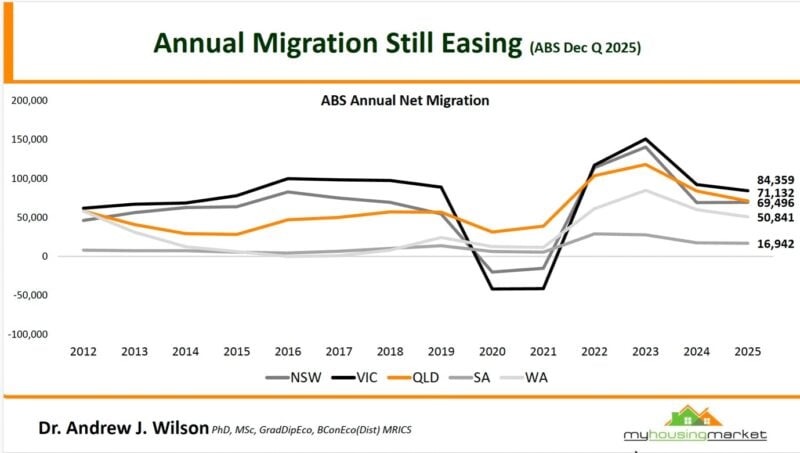
Those are significant figures, so it's understandable that they have fuelled a public debate about what level of migration Australia can actually absorb comfortably.
In the twelve months to February 2026, net permanent and long-term arrivals were close to half a million, at 478,910 - the third consecutive year-to-February in which net arrivals exceeded 400,000.
Meanwhile the government's official forecast for the full financial year was 260,000, which tells you something about how hard migration flows are to manage once they're in motion.
What migration is actually for
Here's the thing that gets lost in the political noise: migration has always served multiple purposes at once, and those purposes sometimes pull in different directions.
The Australian labour market continues to experience shortages in essential sectors from healthcare and engineering to hospitality and technology, and skilled permanent migrants contribute not only to the workforce but also to tax revenues and broader economic productivity.
At the same time, migration is also about family reunification, humanitarian obligations, and maintaining the multicultural society that most Australians genuinely value.
Migration has had a dominant role in Australia's development, and the contribution from natural increase - births minus deaths - has declined in an almost linear manner over the past 160 years, falling from around 2 percentage points to less than 0.5 percentage points now.
Put simply, without migration, Australia's population would be ageing far faster, with fewer working-age people supporting an ever-growing retired population.
Global competition for talent is fierce, and the composition of migration matters enormously to its economic impact - skilled migrants and international students can have a significant effect on innovation and productivity in the domestic economy.
The housing tension is real, but misunderstood
This is where I want to push back a little on the dominant narrative, because I think the framing of "too many migrants, not enough houses" misdiagnoses the actual problem.
Housing shortages persist when demand rises faster than supply due to regulatory constraints - strict zoning, slow approvals, and infrastructure bottlenecks limit new housing construction in high-demand areas, and restricting immigration reduces economic growth without fixing those underlying supply constraints.
In other words, Australia's housing shortage is fundamentally a supply problem, and it existed before the post-pandemic migration surge and will persist if we simply cut migration targets without addressing the planning and construction constraints that prevent new homes from being built quickly.
- Also read:Latest Property Price Forecasts. Australian Property Market Outlook 2026-2027: Navigating a Market Correction

- Also read:Brisbane Property Market Forecast [2026 & Beyond] – What The Olympics Decade Means for Investors.
- Also read:Melbourne property market forecast for 2026 & 2027 | Separating the fundamentals from the sentiment
- Also read:Sydney property market forecast for 2026 and 2027 | Why the short-term softness is a long-term opportunity
- Also read:Adelaide housing market update | September 2026

The National Housing Supply and Affordability Council's 2025 report projects that housing completions will fall short of the national target - roughly 938,000 new homes over five years versus the 1.2 million target.
That gap exists independently of what happens to migration numbers.
New dwelling commencements increased by 11.6 per cent year-on-year to 48,778 in the September quarter of 2025, suggesting the housing pipeline is strengthening - but from a very low base, and given the typical lag between commencement and completion, this improvement won't translate into meaningful additional supply until late 2026 at the earliest.
What this means for property investors
I've always believed that population growth is one of the most reliable long-term drivers of property values, and migration is the single biggest lever on Australia's population trajectory.
That's why I watch these policy debates very carefully.
Sydney and Melbourne receive the most overseas migrants, but Perth, Brisbane and Adelaide are seeing strong interstate migration as people seek affordability. This matters to investors thinking about where to position their portfolios over the next decade.
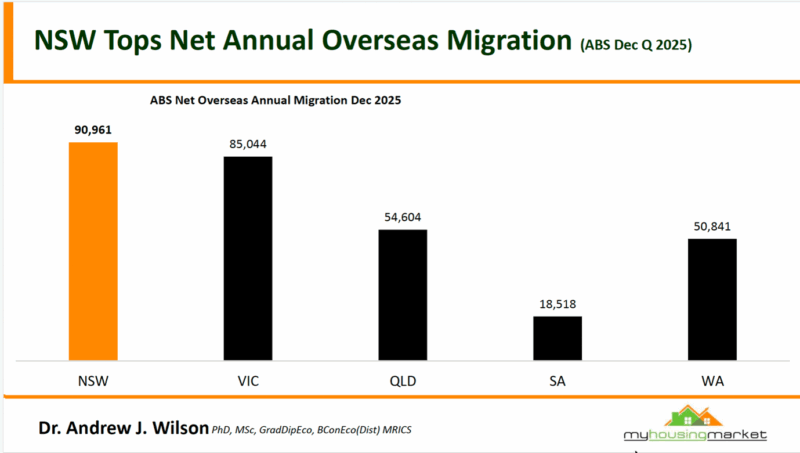
Even with migration moderating from its post-pandemic peak, Australia is still adding people at a rate that sustains structural housing demand. The undersupply of well-located, quality housing in our major cities isn't going away, and that continues to underpin values for well-chosen investment properties.
If the government is able to get net migration down to Treasury's forecast of 225,000 for 2026-27 and housing completions meet targets, we would eventually see a period from around 2027 where housing completions substantially exceed population growth - but we are still a long way from that outcome.
And of course, that doesn't account for the 200-300,000 housing shortfall we already have.
That means the supply-demand imbalance supporting property values in desirable locations is likely to persist for many years yet.
A more honest conversation
The migration debate deserves better than the political shouting match it has often become.
The appropriate level of migration is ultimately a subjective decision for a country, but an informed debate starts with good information, and migration policies work best when they are consistent, well-articulated, and clear about their objectives.
A larger population, managed well with appropriate infrastructure investment, can result in improved living standards rather than declining ones - but targeted migration policies need to align with infrastructure and housing supply to support economic growth without straining services.
Australia is a country built by migration. Every wave of new arrivals has, over time, enriched the economy, the culture, and the social fabric.
The challenge right now is making sure our planning systems, our infrastructure investment, and our housing supply can actually keep pace with the population growth that migration generates.
That's a policy and planning challenge - and it's solvable. The alternative, a shrinking and rapidly ageing population with too few workers supporting too many retirees, carries its own serious risks that rarely get the same media attention.
For property investors, the message is straightforward: strong underlying population growth, persistent housing undersupply, and a long pipeline before new supply catches up all point in the same direction.
Well-located, investment-grade properties in our major cities remain among the most structurally sound assets an Australian can hold over the long term.
At Metropole, we help our clients cut through the noise of these big-picture debates to make strategic decisions grounded in long-term fundamentals. If you'd like to discuss what this means for your portfolio, I'd encourage you to book a Wealth Discovery Session with one of our wealth strategists at Metropole. Just click here.